


China uses influencers to spread disinformation in Taiwan through social media such as TikTok and YouTube, aimed at creating suspicion and sabotaging Taiwan-US relations, but it is difficult for the government to assign an agency to regulate online activities, a government official said yesterday.
In an effort to prevent the Chinese Communist Party (CCP) from using TikTok to spread disinformation and threaten national security, the Cabinet late last year called for cross-ministerial meetings, but such meetings have not yet been held due to the Cabinet reshuffle this year, the government official said on condition of anonymity.
The Cabinet led by former premier Su Tseng-chang (蘇貞昌) banned the use of short video platform Douyin, the Chinese version of TikTok, on government devices, but there has been no further discussion about other methods to combat threats since the Cabinet reshuffle in January, the official said.
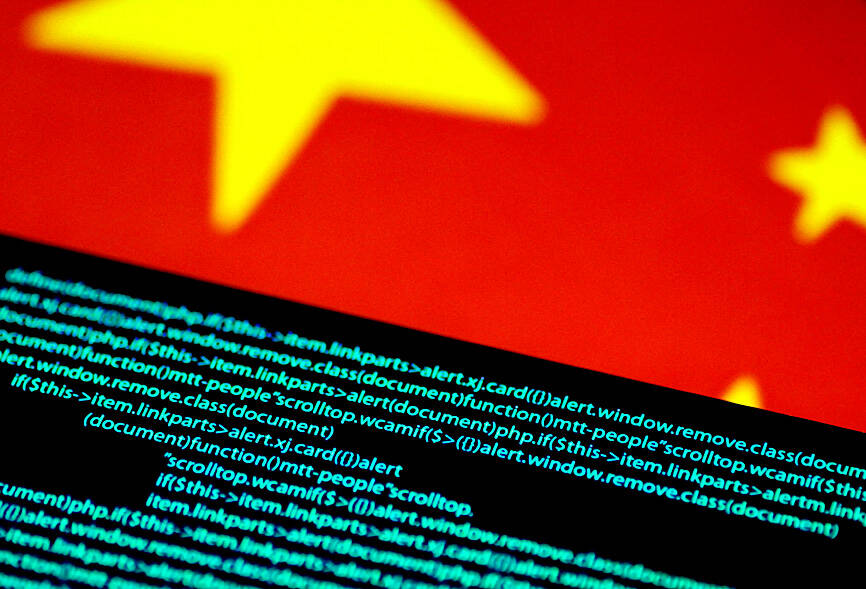
Photo: Reuters
The issue involves free speech censorship and content management, so the government must be very careful, the official said, adding that the EU also began banning TikTok on government devices.
India has banned TikTok entirely, but short videos posted on TikTok can still be shared to other streaming platforms, and if the government wants to ban specific content, it must carefully consider whether it would be effective, the official said.
Taiwan is still evaluating the issue, while referencing the methods adopted by other countries, they said.
There is a government authority supervising radio and television broadcast content, but with the draft “digital intermediary service act” suspended, there is no government authority monitoring online activities, the official added.
Asked if the Ministry of Digital Affairs could become the authority to manage the issue, the official said the Information and Communication Security Management Act (資通安全管理法) and the Personal Data Protection Act (個人資料保護法) cover the operations of several ministries, so it is difficult for only one agency to regulate online activity.
China uses “united front” tactics, cognitive warfare and infiltration campaigns to divide Taiwanese society, and tries to sabotage the relationship between Taiwan and like-minded countries, the Mainland Affairs Council said.
To prevent external forces from infiltrating Taiwan, the government would continue to collect opinions about whether to amend the Anti-Infiltration Act (反滲透法) to require social media influencers to make the source of their funding public, the council said, adding that such action could help maintain national security and social stability.
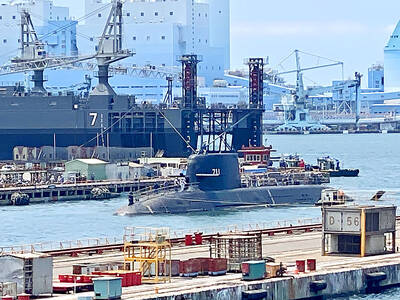
AGING: While Japan has 22 submarines, Taiwan only operates four, two of which were commissioned by the US in 1945 and 1946, and transferred to Taiwan in 1973 Taiwan would need at least 12 submarines to reach modern fleet capabilities, CSBC Corp, Taiwan chairman Chen Cheng-hung (陳政宏) said in an interview broadcast on Friday, citing a US assessment. CSBC is testing the nation’s first indigenous defense submarine, the Hai Kun (海鯤, Narwhal), which is scheduled to be delivered to the navy next month or in July. The Hai Kun has completed torpedo-firing tests and is scheduled to undergo overnight sea trials, Chen said on an SET TV military affairs program. Taiwan would require at least 12 submarines to establish a modern submarine force after assessing the nation’s operational environment and defense
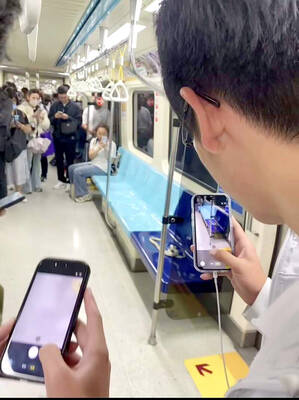
A white king snake that frightened passengers and caused a stir on a Taipei MRT train on Friday evening has been claimed by its owner, who would be fined, Taipei Rapid Transit Corp (TRTC) said yesterday. A person on Threads posted that he thought he was lucky to find an empty row of seats on Friday after boarding a train on the Bannan (Blue) Line, only to spot a white snake with black stripes after sitting down. Startled, he jumped up, he wrote, describing the encounter as “terrifying.” “Taipei’s rat control plan: Release snakes on the metro,” one person wrote in reply, referring
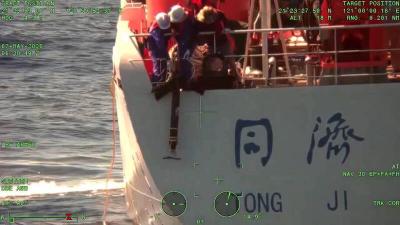
The coast guard today said that it had disrupted "illegal" operations by a Chinese research ship in waters close to the nation and driven it away, part of what Taipei sees a provocative pattern of China's stepped up maritime activities. The coast guard said that it on Thursday last week detected the Chinese ship Tongji (同濟號), which was commissioned only last year, 29 nautical miles (54km) southeast of the southern tip of Taiwan, although just outside restricted waters. The ship was observed lowering ropes into the water, suspected to be the deployment of scientific instruments for "illegal" survey operations, and the coast
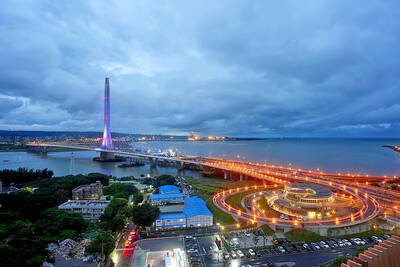
An inauguration ceremony was held yesterday for the Danjiang Bridge, the world’s longest single-mast asymmetric cable-stayed bridge, ahead of its official opening to traffic on Tuesday, marking a major milestone after nearly three decades of planning and construction. At the ceremony in New Taipei City attended by President William Lai (賴清德), Premier Cho Jung-tai (卓榮泰), Minister of Transportation and Communications Chen Shih-kai (陳世凱) and New Taipei City Mayor Hou Yu-ih (侯友宜), the bridge was hailed as both an engineering landmark and a long-awaited regional transport link connecting Tamsui (淡水) and Bali (八里)


 RSS
RSS