


Researchers have developed a smartphone app that they say can help detect mild cognitive impairment (MCI), a condition that often leads to dementia.
The number of people who develop Alzheimer’s disease or other forms of dementia each year is rising as Taiwan’s population ages, but early detection can enable doctors to manage the condition’s symptoms, Yuan Ze University researchers Chao Yao-keng (趙燿庚) and Lee Chien-cheng (李建誠) said last week.
The researchers and their team developed a smartphone app that they say can help people quickly and easily detect MCI, which has been expensive and time-consuming to detect.

Photo courtesy of Yuan Ze University via CNA
“Half of people with MCI develop dementia within five years, and the condition progresses 10 to 15 percent each year after that,” Chao said. “It’s not reversible, and it costs families a lot of time and resources to treat someone with dementia, so early detection is very important.”
The team worked with psychiatrists from Far Eastern Memorial Hospital in New Taipei City and was supported by US technology firm Qualcomm through the Qualcomm Innovate in Taiwan Challenge program in the development of the app.
The team analyzed video data from 48 patients and developed a testing model based on data amplification and artificial intelligence deep learning technologies, Chao said.
He said that 1,516 video clips, including 867 clips of people with MCI, were used during the development phase, he said.
The clips ranged in length from 5 minutes to 30 minutes, he added.
“Machine learning can be used to track eye movements and facial expressions,” he said, adding that the technology can “notice signs of dementia, such as gazing and certain lip movements.”
“We’ve achieved an accuracy of more than 80 percent with the program,” he added.
The team is planning to expand their research and develop an automatic detection solution for MCI, he said.
“If the software passes review, it would make it possible for those with dementia to seek medical treatment as soon as possible to prevent the deterioration of the condition,” he said.

The military has spotted two Chinese warships operating in waters near Penghu County in the Taiwan Strait and sent its own naval and air forces to monitor the vessels, the Ministry of National Defense (MND) said. Beijing sends warships and warplanes into the waters and skies around Taiwan on an almost daily basis, drawing condemnation from Taipei. While the ministry offers daily updates on the locations of Chinese military aircraft, it only rarely gives details of where Chinese warships are operating, generally only when it detects aircraft carriers, as happened last week. A Chinese destroyer and a frigate entered waters to the southwest

A magnitude 6.1 earthquake struck off the coast of Yilan County at 8:39pm tonight, the Central Weather Administration (CWA) said, with no immediate reports of damage or injuries. The epicenter was 38.7km east-northeast of Yilan County Hall at a focal depth of 98.3km, the CWA’s Seismological Center said. The quake’s maximum intensity, which gauges the actual physical effect of a seismic event, was a level 4 on Taiwan’s 7-tier intensity scale, the center said. That intensity level was recorded in Yilan County’s Nanao Township (南澳), Hsinchu County’s Guansi Township (關西), Nantou County’s Hehuanshan (合歡山) and Hualien County’s Yanliao (鹽寮). An intensity of 3 was

Japanese Prime Minister Sanae Takaichi’s comment last year on Tokyo’s potential reaction to a Taiwan-China conflict has forced Beijing to rewrite its invasion plans, a retired Japanese general said. Takaichi told the Diet on Nov. 7 last year that a Chinese naval blockade or military attack on Taiwan could constitute a “survival-threatening situation” for Japan, potentially allowing Tokyo to exercise its right to collective self-defense. Former Japan Ground Self-Defense Force general Kiyofumi Ogawa said in a recent speech that the remark has been interpreted as meaning Japan could intervene in the early stages of a Taiwan Strait conflict, undermining China’s previous assumptions
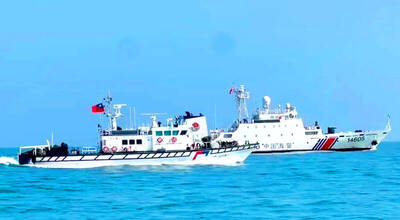
Instead of focusing solely on the threat of a full-scale military invasion, the US and its allies must prepare for a potential Chinese “quarantine” of Taiwan enforced through customs inspections, Stanford University Hoover fellow Eyck Freymann said in a Foreign Affairs article published on Wednesday. China could use various “gray zone” tactics in “reconfiguring the regional and ultimately the global economic order without a war,” said Freymann, who is also a nonresident research fellow at the US Naval War College. China might seize control of Taiwan’s links to the outside world by requiring all flights and ships entering or leaving Taiwan


 RSS
RSS