


The Cabinet yesterday approved a plan to disburse NT$380 billion (US$12.5 billion) in tax surplus to boost the economy, including a cash subsidy of NT$6,000 to Taiwanese and eligible foreign residents.
The proposal is to be sent to the legislature for approval.
The plan would allow the government to use last year’s tax surplus from 2023 to 2025 to provide economic incentives.

Photo: Tien Yu-hua, Taipei Times
This includes the allocation of NT$141.7 billion — more than one-third of the total — for disbursement to all Taiwanese and eligible foreign residents, who would each receive NT$6,000 in cash, the Directorate-General of Budget, Accounting and Statistics (DGBAS) said.
The proposal would also allocate NT$30 billion to the labor insurance fund, NT$20 billion to the National Health Insurance Administration and NT$50 billion to state-run Taiwan Power Co (Taipower), which have incurred operational losses, senior DGBAS official Hsu Yung-yi (許永議) told a news conference in Taipei.
The Ministry of Economic Affairs would receive NT$31.7 billion to help fund its subsidies to small and medium-sized enterprises, and the manufacturing sector, Hsu said.
The plan would allocate NT$10.3 billion to the Ministry of Health and Welfare to fund financial assistance programs for low-income and lower-middle-income households, people with disabilities and other disadvantaged groups, Hsu said.
The Ministry of Transportation and Communications would receive NT$27.4 billion to subsidize public transportation fares and to provide incentives for foreign tourists to visit Taiwan, he added.
Except for NT$1.3 billion that would be held in reserve, the remaining tax surplus revenues would go to the education, culture and interior ministries for subsidies and programs, Hsu said.
National Development Council Minister Kung Ming-hsin (龔明鑫) said that pending legislative approval, the budget would provide timely resources amid “serious challenges” to Taiwan’s economy due to projected headwinds in the global economy.
In light of such factors, the government has lowered its GDP growth forecast for this year by 0.63 percentage points to 2.12 percent, Kung said, citing DGBAS figures released on Wednesday.
He said that the aim of the cash subsidies and other incentives is to boost domestic spending and contribute at least 0.45 percentage points to this year’s domestic economic growth.
Meanwhile, Vice Premier Cheng Wen-tsan (鄭文燦) said he hopes that lawmakers across party lines would approve the plans without delay so that the funds could be disbursed soon.
Regarding the NT$6,000 cash subsidy, Cheng said the government would create several channels for Taiwanese, including diplomats posted overseas, foreign permanent residents and foreign residents with Taiwanese spouses to receive the payments.
The government is working on an online system that would allow direct transfers to people’s bank accounts, he said, adding that the system would be tested next month and then opened for applications.
Cheng said the NT$50 billion allocated to Taipower would help cover some of its losses, adding that the government’s budget for this year has also allocated NT$150 billion to cover losses at the utility.
As of the end of last year, Taipower’s accumulated losses were NT$267.5 billion, the company said, adding that it was due to rising international energy costs and the government’s reluctance to increase electricity prices.
Taipower has estimated that it would lose another NT$278.5 billion this year.
Cheng said that the government’s cap on electricity and fuel prices would remain part of its efforts to stabilize the cost of living in the country.
Similarly, the government is committed to allocating resources to the labor insurance fund to keep it “financially sustainable,” he said.
In addition to the proposed NT$30 billion in tax surplus funds, the labor insurance fund would also receive NT$45 billion from the government’s budget for this year, he said.
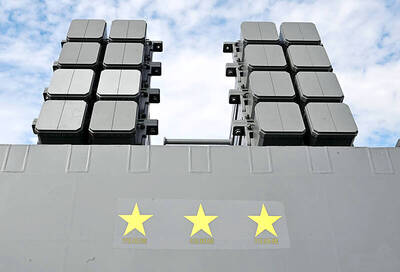
UPGRADE: The Kang Ding-class frigate is replacing its Chaparall missiles with Tien Chien II and Hua Yang VLS, which would provide it with long-range, 360° air defense Taiwan plans to produce 1,200 to 1,376 Hai Chien II missiles (海劍二, Sea Sword II) — also known as TC-2N — to serve as the standard air defense system of the navy’s surface combatant fleet, a source said yesterday. Last week, the Hai Chien II, the naval version of the Tien Kung II missile (天劍二, Sky Sword II), completed a live-fire test in waters off the National Chungshan Institute of Science and Technology’s Jiupeng facility (九鵬) in Pingtung County’s Manjhou Township (滿州). The MIM72 Chaparral and other dated air defense missiles that currently arm Taiwanese ships have inadequate range to combat Chinese

REASONS FOR TRAVEL: An assistant professor said that proposed amendments to penalize drivers if they used drugs overseas would not deter people from traveling People who operate a motor vehicle under the influence of marijuana would have their driver’s license revoked, even if they used the substance while overseas, the Ministry of Transportation and Communications said yesterday, citing proposed amendments to the Road Traffic Management and Penalty Act (道路交通管理處罰條例). The amendments would also authorize the government to revoke the licenses of people determined to have used Category 1 or Category 2 narcotics, even if they were not operating a vehicle while under the influence of drugs, as well as ban them from taking the license test for three years, the ministry said. People aged 18 or

HEAVY WEATHER: Typhoon Jangmi is due to crash straight into the Ryukyus as airlines look to shift flights to larger aircraft or cancel flights to Okinawa entirely Taiwan’s international air carriers announced flight adjustments over the weekend as Typhoon Jangmi is forecast to hit the Ryukyu Islands today and tomorrow. The Central Weather Administration (CWA) upgraded Jangmi from a tropical storm to a typhoon at 8am yesterday, with the eye located 580km south of Naha city. It was moving north at 19kph. Today, China Airlines’ CI-120, CI-121, CI-122 and CI-123 flights between Taoyuan and Naha, Okinawa, have been canceled as well as CI-132 and CI-133 between Kaohsiung and Naha. EVA Air’s BR-112, BR-113, BR-186 and BR-185 flights between Taoyuan and Naha are also canceled. Low-cost carrier Tigerair Taiwan canceled IT-230,
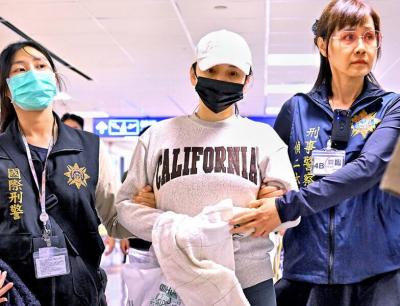
Johanne Liou (劉喬安), a Taiwanese woman who shot to unwanted fame during the Sunflower movement protests in 2014, returned to Taiwan last night after being deported from the US. She is to stand trial in Taiwan for charges involving embezzlement, fraud and drug crimes. The Criminal Investigation Bureau (CIB) said it took her into custody at Taiwan Taoyuan International Airport and would first question her before transferring her to the New Taipei District Prosecutors’ Office. She was arrested upon disembarking a flight from San Francisco that landed shortly before 7pm. Liou absconded to the US in 2019 after jumping bail


 RSS
RSS