


China could have deliberately severed the two undersea cables linking Lienchiang County as part of a targeted campaign or “dry run” to cut the entire nation off from the Internet, a security analyst said.
“It is not uncommon for undersea cables to be damaged — but losing two in a row is either really unfortunate or quite possibly not a coincidence,” American Enterprise Institute senior research fellow Elizabeth Braw wrote in Foreign Affairs on Tuesday.
Internet access in Lienchiang County is provided through two marine telecom cables, Taima No. 2 and Taima No. 3.
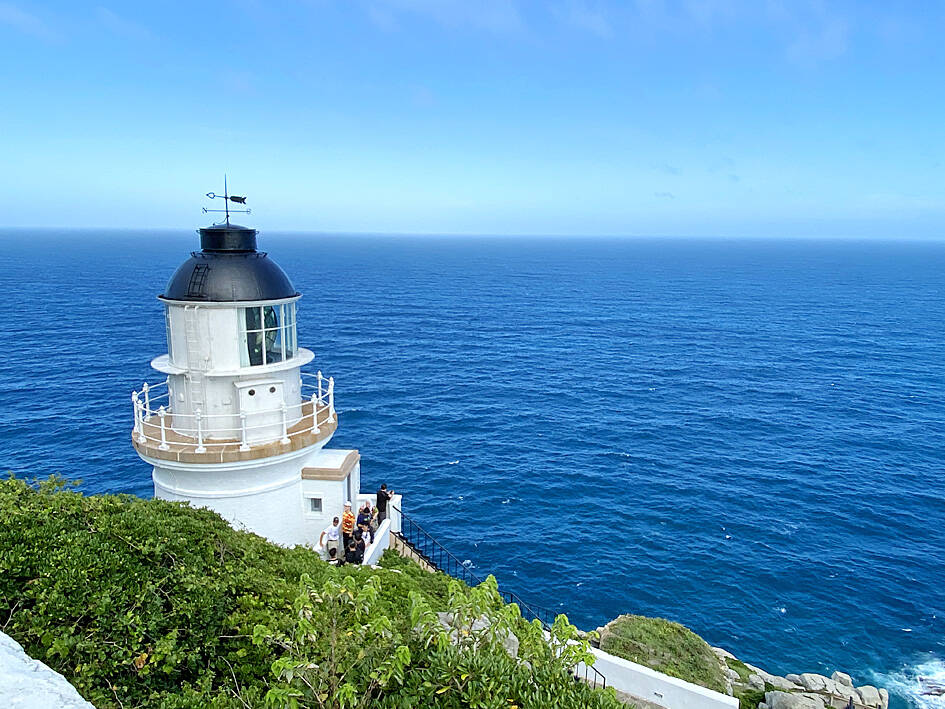
Photo: Yu Chao-fu, Taipei Times
A Chinese fishing boat severed the No. 2 cable, while the No. 3 cable was cut by an unknown freighter — incidents occurring separately on Feb. 2 and Feb. 8 respectively, the National Communications Commission said on Thursday last week.
Although Taiwanese officials said that at least one of the incidents was a mishap, Chinese vessels have been regularly causing damage to undersea cables, Braw said.
“It is especially striking because it is no mystery where the world’s 380 undersea cables are located,” she said. “On the contrary, there are maps detailing their location to ensure that fishing vessels do not accidentally harm them while dragging their nets.”
The damage to the links has severely curbed telecom services in Lienchiang County, disrupted Internet access, and slowed text messaging and picture-sending to a crawl, with repairs not expected to be completed before the end of April, she said.
How the country responds to the issues are likely being observed by Beijing, which deems the nation’s tenuous link to its outlying islands a military weakness that can be exploited, she said.
Citing the International Cable Protection Committee, Braw said that there are about 100 to 200 cases of damage to undersea cables every year, only 50 to 100 of which involve fishing boats.
“The incidents involving damage to the cables connecting the Matsu Islands are, in other words, disproportionately frequent,” she said, adding that accidentally damaging just one cable would have required “an unbelievable amount of bad luck.”
Reports of damage to cables off Lienchiang County primarily revolved around Chinese excavators illegally dredging sand in Taiwanese waters, which is a form of “classic gray-zone aggression” that inflicts harm on Taiwan’s maritime cables and environment, Braw said.
“Cable sabotage could become our era’s blockade, and unlike past generations’ blockades, it can be conducted on the sly,” she said.

The brilliant blue waters, thick foliage and bucolic atmosphere on this seemingly idyllic archipelago deep in the Pacific Ocean belie the key role it now plays in a titanic geopolitical struggle. Palau is again on the front line as China, and the US and its allies prepare their forces in an intensifying contest for control over the Asia-Pacific region. The democratic nation of just 17,000 people hosts US-controlled airstrips and soon-to-be-completed radar installations that the US military describes as “critical” to monitoring vast swathes of water and airspace. It is also a key piece of the second island chain, a string of
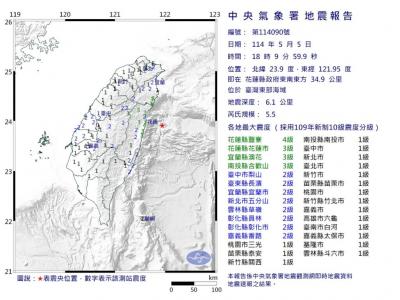
A magnitude 5.9 earthquake that struck about 33km off the coast of Hualien City was the "main shock" in a series of quakes in the area, with aftershocks expected over the next three days, the Central Weather Administration (CWA) said yesterday. Prior to the magnitude 5.9 quake shaking most of Taiwan at 6:53pm yesterday, six other earthquakes stronger than a magnitude of 4, starting with a magnitude 5.5 quake at 6:09pm, occurred in the area. CWA Seismological Center Director Wu Chien-fu (吳健富) confirmed that the quakes were all part of the same series and that the magnitude 5.5 temblor was

Taiwan will now have four additional national holidays after the Legislative Yuan passed an amendment today, which also made Labor Day a national holiday for all sectors. The Chinese Nationalist Party (KMT) and Taiwan People’s Party (TPP) used their majority in the Legislative Yuan to pass the amendment to the Act on Implementing Memorial Days and State Holidays (紀念日及節日實施辦法), which the parties jointly proposed, in its third and final reading today. The legislature passed the bill to amend the act, which is currently enforced administratively, raising it to the legal level. The new legislation recognizes Confucius’ birthday on Sept. 28, the

The Central Weather Administration has issued a heat alert for southeastern Taiwan, warning of temperatures as high as 36°C today, while alerting some coastal areas of strong winds later in the day. Kaohsiung’s Neimen District (內門) and Pingtung County’s Neipu Township (內埔) are under an orange heat alert, which warns of temperatures as high as 36°C for three consecutive days, the CWA said, citing southwest winds. The heat would also extend to Tainan’s Nansi (楠西) and Yujing (玉井) districts, as well as Pingtung’s Gaoshu (高樹), Yanpu (鹽埔) and Majia (瑪家) townships, it said, forecasting highs of up to 36°C in those areas


 RSS
RSS