


Some people, especially adolescents, could experience “appearance anxiety” when the mask mandate is lifted today, as they can no longer hide their face behind a mask, a psychiatrist said.
Appearance anxiety is often observed among adolescents, as this age group tend to be more concerned about their appearance, Taiwan Adventist Hospital psychiatrist Hsu Cheng-dien (許正典) said.
During the COVID-19 pandemic, people were able to hide their face behind a mask, but they could become anxious as masking is no longer required, Hsu said.
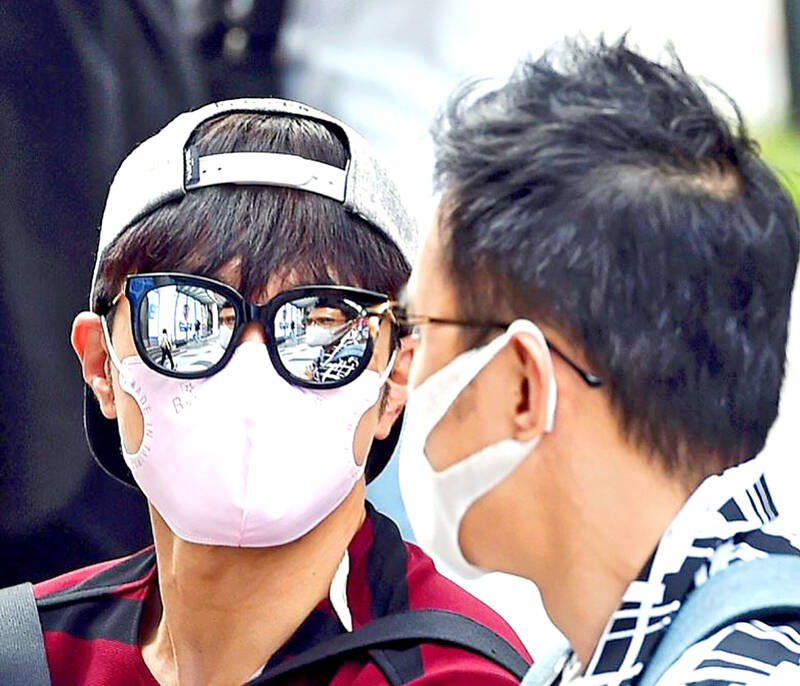
Photo: Taipei Times file photo
Many young people seek treatment at dermatology clinics for acne and other skin problems, but some are so concerned about their skin that it affects their learning, so they are referred to psychiatrists, he said, adding that these cases include boys and girls.
This is more common among Asians than teenagers elsewhere, as they are subjected to stricter beauty standards, Hsu said, adding that it can be reflected through a lack of self-confidence, self-suppression and overemphasis on appearance.
He suggested that parents encourage their children to value their achievements and hobbies, rather than focusing on their appearance.
A student who declined to be named said teenagers care a lot about their appearance, and taking off their mask would feel like “opening up a surprise goodie bag.”
Some students who have “appearance anxiety” think they “don’t look good without a mask,” St Dominic High School student association vice president Lo Ze-lun (羅則倫) said.
A student surnamed Huang (黃) at the Affiliated Senior High School of National Taiwan Normal University said he was traumatized after someone said he “looks different” without a mask on.
Yuan Ze University student association president Liu Yao-wei (劉曜維) said some people “feel naked” when taking off their masks; while Chung Yu-han (鍾玉涵), a senior student at Tzu Chi University’s Department of Family Studies and Child Development, said she thinks she looks better wearing a mask.
A survey showed that about 78 percent of students would continue wearing a mask, Taiwan Youth Association for Democracy director Chang Yu-meng (張育萌) said.
Some academics have said appearance anxiety stems from a sense of insecurity, and that anxiety comes from lack of self-confidence.
“Unmasking” anxiety could have five aspects: health concerns, group infections, insecurity, habitual behavior and an altered sense of security, said Wang Lih-rong (王麗容), a professor in National Taiwan University’s Department of Social Work.
Appearance anxiety is caused by insecurity, she said, adding that some people feel they do not look good, so the lack of self-confidence and the habit of masking makes them feel anxious when they are not wearing a mask, thus it could be difficult for them to adjust.
Explaining the idea of an altered sense of security, Wang said some good-looking people could find that wearing a mask prevents some troubling social interactions, such as being hit on, so they feel safer wearing a mask.
Masking used to be associated with illness or crime, National Pingtung University College of Education dean Chien Cheng-hsi (簡成熙) said, adding that after the SARS outbreak in 2003, many people in Asia learned that wearing a mask not only protects oneself, but also protects others.
As masking is seen as a positive social norm in Taiwan, he said he expects about 30 percent to 50 percent of people to continue wearing a mask.
People who experience appearance anxiety when unmasked might have an unstable sense of self and be more sensitive to the opinions of others, Light Heart Counseling Institute counseling psychologist Lin Shang-neng (林上能) said, adding that wearing a mask allows them to avoid their appearance being evaluated.
He said people should enrich themselves internally, find hobbies, recognize their own strengths and interact with family and friends — which would shift their concern about their appearance.
People can also explore different types of clothing and hairstyles on themselves, he added.
Many school principals said school faculties would pay attention and give guidance to students to avoid bullying.
As COVID-19 regulations have mostly been lifted, teachers would remind students to have respect for each other, and not to exclude or bully classmates who choose to continue wearing a mask, Secondary and Elementary Principals’ Association president Chang Hsin-wu (張信務) said.
The mask mandate on campus would be lifted in phases, as individuals require different adjustment times, and teachers would coach students to recognize and accept themselves, Taipei Xishan Experimental Elementary School principal Shi Chun-ming (施春明) said.
The pandemic has made many people dependent on a mask, but wearing a mask is a habit that was developed, and it takes time to change habits, National Chi Nan University president Wuu Dong-sing (武東星) said.
He encouraged young people to “bravely remove their mask and enjoy the pleasure of breathing freely,” gradually take off their mask when with friends and sometimes wear a mask in crowded places to slowly get used to an unmasked life.
Due to the climate and air quality, many people in Asia were already used to wearing a mask before the pandemic, so the mask-wearing culture would likely continue, National Tsing Hua University president John Kao (高為元) said.
Masks are also fashion items and worn for public health reasons, not just to hide your face, he said.
Additional reporting by Yang Mien-chieh and Chang Wei-chen

FUKUOKA SITUATION: Japanese media reported that the pathogen is expected to be identified by the summer, while the CDC downplayed the idea that it was hMPV A “mysterious cold-like illness” reported in Japan’s Fukuoka Prefecture does not seem to be a new disease, but Japanese authorities have been asked about the situation, the Centers for Disease Control (CDC) said yesterday. The Fukuoka Prefectural Medical Association on Wednesday told a news conference that a “mystery cold” that has become a hot topic on social media is “highly likely to be caused by some kind of viral infection,” Japan’s KBC News reported. “Many people are experiencing symptoms starting with a sore throat, followed by a runny nose, phlegm and a severe cough,” KBC News reported, citing association officials. Health authorities are

Nvidia Corp CEO Jensen Huang (黃仁勳) arrived in Taiwan yesterday ahead of upcoming AI and technology events, saying he plans to meet with clients and Taiwan Semiconductor Manufacturing Co Chairman C.C. Wei (魏哲家) during his visit. After landing at Taipei Songshan Airport, Huang posed for photos with fans and handed out Yakult drinks to reporters and supporters waiting at the scene, saying he has “a lot to do” during the trip. Asked about reports that Nvidia’s planned headquarters site in Taipei’s Beitou Shilin Technology Park could break ground on May 27, Huang said that if the company holds an event, he would

Carrefour Taiwan is to begin using a new name from the start of July, but it cannot divulge the name until then, the chairman of the supermarket chain's parent company said today. President Chain Store Co chairman Lo Chih-hsien (羅智先) was asked by reporters after a shareholders' meeting to confirm whether the company has settled on a new name for the supermarket brand. In March, the government-registered name of two Carrefour Taiwan branches was quietly changed to "Le Chia Kang" (樂家康) in Chinese, raising speculation that has been selected as the name. Lo said that because of local regulations and contractual obligations, the

The Philippines would likely be involved in any conflict over Taiwan due to its proximity to the democracy claimed by China, President Ferdinand Marcos Jr said, reiterating a stance that risks angering Beijing. “In the Philippines, we do not have a choice because Taiwan is so close to the Philippines and we have almost 200,000 Filipino nationals living and working in Taiwan,” Marcos said in an interview with Japanese media in Manila on Monday. The Philippine leader’s comments come ahead of a state visit to Japan next week, where he is to meet with Japanese Prime Minister Sanae Takaichi to discuss security


 RSS
RSS