


Taipei prosecutors yesterday indicted eight executives of funeral services provider Chan Yun Enterprise Co (展雲事業公司), including company chairman Chung Ke-hsin (鍾克信), on charges of fraud that is alleged to have deceived investors of NT$18.2 billion (US$601.9 million).
The other seven charged with contravening the Banking Act (銀行法) were chief financial officer Chu Kan-chung (朱淦忠), former chief financial officer Chen Jen-chieh (陳仁杰), board member Chin Kai-wen (金開文), sales manager Yu Hsing-hua (于興華), business manager Lo Shih-chi (羅仕吉), and assistant managers Lee Pei-hsuan (李珮瑄) and Yu Li-chuan (游麗娟).
Prosecutors said an international alert for Chung’s arrest was issued after he left Taiwan following questioning in 2020 over a corruption probe.
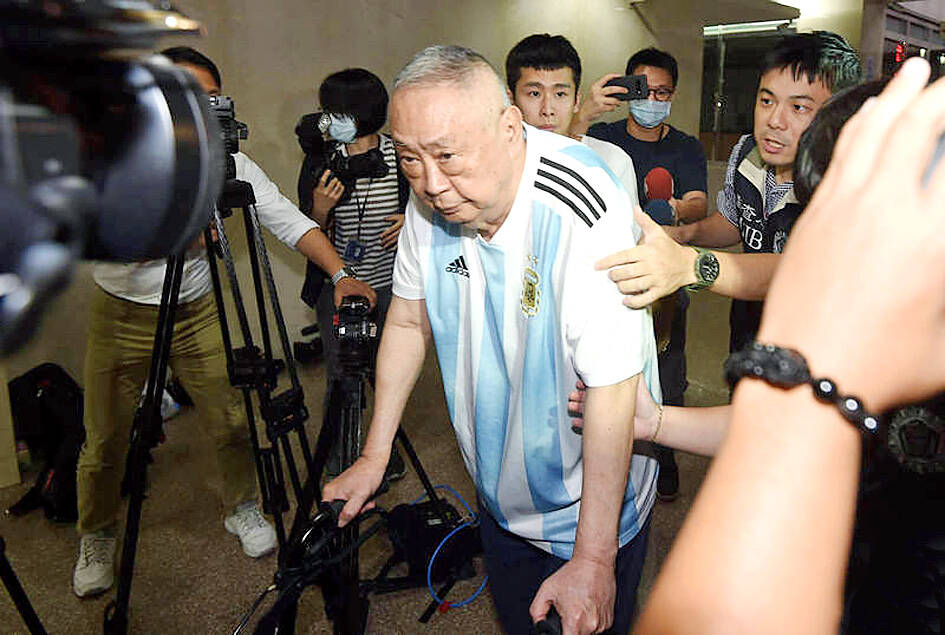
Photo: Chien Li-chung, Taipei Times
Authorities tried to serve him with a summons in 2021 regarding the current investigation, and discovered that he had left Taiwan and had not scheduled a return, prosecutors said.
The filing said that Chan Yun from 2012 to 2021 offered up to 10.8 percent yearly return on investments in company-operated burial plots, columbaria and cemeteries in New Taipei City’s Jinsan District (金山), with portions within Yangmingshan National Park (陽明山國家公園).
Records and transaction documents were seized, showing that 9,832 investors bought into the company’s investments.
Prosecutors alleged that Chung and his executives operated a Ponzi scheme, taking money from new investors to pay the promised rewards to earlier investors.
Among the schemes was the Penglai Cemetary Park project in Jinshan, promising a 30 percent return on resale of burial plots after four years, with an initial investment of NT$118,000, prosecutors said, adding that NT$10 billion in debt was left after the scheme collapsed.
Despite hearing of some investors having trouble collecting gains from the company, many people continued to invest, given the firm’s perceived political connections, the filing said.
Some investors were quoted in the filing as saying they trusted Chung’s claims of political influence and had faith in his business acumen, given his family’s background.
Chung’s father, Chung Shih-yi (鍾時益), served as a high-ranking official under Chiang Kai-shek (蔣介石) before the Chinese Civil War, and graduated from an armed forces institute in China. He was responsible for finances and budgeting for Chinese Nationalist Party (KMT) troops during the exodus to Taiwan. In Taiwan, he served as head of the KMT central financial committee, in charge of party-run enterprises and investments, and then as minister for budgets and accounting, and director of National Audit Office until his retirement in 1989.
Chung Ke-hsin remains at large and has been charged in absentia.

The military has spotted two Chinese warships operating in waters near Penghu County in the Taiwan Strait and sent its own naval and air forces to monitor the vessels, the Ministry of National Defense (MND) said. Beijing sends warships and warplanes into the waters and skies around Taiwan on an almost daily basis, drawing condemnation from Taipei. While the ministry offers daily updates on the locations of Chinese military aircraft, it only rarely gives details of where Chinese warships are operating, generally only when it detects aircraft carriers, as happened last week. A Chinese destroyer and a frigate entered waters to the southwest
The eastern extension of the Taipei MRT Red Line could begin operations as early as late June, the Taipei Department of Rapid Transit Systems said yesterday. Taipei Rapid Transit Corp said it is considering offering one month of free rides on the new section to mark its opening. Construction progress on the 1.4km extension, which is to run from the current terminal Xiangshan Station to a new eastern terminal, Guangci/Fengtian Temple Station, was 90.6 percent complete by the end of last month, the department said in a report to the Taipei City Council's Transportation Committee. While construction began in October 2016 with an
NON-RED SUPPLY: Boosting the nation’s drone industry is becoming increasingly urgent as China’s UAV dominance could become an issue in a crisis, an analyst said Taiwan’s drone exports to Europe grew 41.7-fold from 2024 to last year, with demand from Ukraine’s fight against Russian aggression the most likely driver of growth, a study showed. The Institute for Democracy, Society and Emerging Technology (DSET) in a statement on Wednesday said it found that many of Taiwan’s uncrewed aerial vehicle (UAV) sales were from Poland and the Czech Republic. These countries likely transferred the drones to Ukraine to aid it in its fight against the Russian invasion that started in 2022, it said. Despite the gains, Taiwan is not the dominant drone exporter to these markets, ranking second and fourth

Japanese Prime Minister Sanae Takaichi’s comment last year on Tokyo’s potential reaction to a Taiwan-China conflict has forced Beijing to rewrite its invasion plans, a retired Japanese general said. Takaichi told the Diet on Nov. 7 last year that a Chinese naval blockade or military attack on Taiwan could constitute a “survival-threatening situation” for Japan, potentially allowing Tokyo to exercise its right to collective self-defense. Former Japan Ground Self-Defense Force general Kiyofumi Ogawa said in a recent speech that the remark has been interpreted as meaning Japan could intervene in the early stages of a Taiwan Strait conflict, undermining China’s previous assumptions


 RSS
RSS