

The number of COVID-19 cases reported last week dropped 24.7 percent from the previous week, the Central Epidemic Command Center (CECC) said yesterday, as it reported 16,902 new local cases, 297 imported cases and 57 deaths from the disease.
Yesterday’s number of new local cases was 25.2 percent lower than on Sunday last week, it said.
Most cases were reported in the six special municipalities, led by 3,179 in New Taipei City, the center said.

Photo: Liao Chen-huei, Taipei Times
The other five special municipalities reported between 1,513 and 1,996 cases, while 16 cities and counties reported fewer than 1,000 cases each, it said.
Of the 57 people who died, 54 had underlying health conditions and 39 had not received a booster dose of a COVID-19 vaccine, the center said.
The youngest person who died was a man in his 20s who did not have any chronic illness and had received two doses of a vaccine, the center said, adding that he was a long-term smoker.
The man had a headache for several days, but only took pain relievers before he lost consciousness on Feb. 2 and was taken to a hospital, the center said, adding that he was found to have had a brain aneurysm causing bleeding and tested positive for COVID-19.
He died on Tuesday, it said.
Centers for Disease Control Deputy Director-General Chuang Jen-hsiang (莊人祥), who is the CECC’s spokesman, said 138,344 new local cases were reported between Monday and Saturday, 24.7 percent fewer than the previous week.
The center expects weekly cases to decrease further this week, Chuang said.
The largest number of imported cases came from Japan, he said.
As the new school semester is to begin this week, students might be at risk of exposure to the virus due to more interpersonal contact, and therefore the mask mandate is to remain in schools until next month, Chuang said.
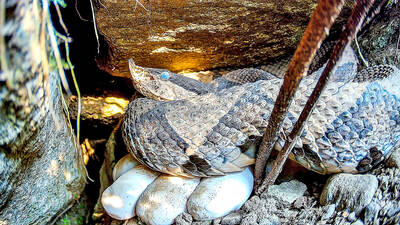
NATURE TAKES ITS COURSE: The agency’s head said he felt a sense of loss watching red-banded snakes eat the babies, as they had decided on non-intervention The Forestry and Nature Conservation Agency yesterday released a documentary on a hundred-pace viper that had incubated 16 eggs, all of which hatched, but only a baby viper escaped after they were attacked by red-banded snakes. The agency’s Taichung branch last year launched the viper reproduction monitoring project soon after forest rangers Lin Chun-yu (林俊佑) and Chou Chia-cheng (周家成) spotted a pregnant hundred-pace viper in a grass-covered burrow near a parking lot in Tbulan Village (松鶴部落). The Atayal village, in Taichung’s Heping District (和平), is headed by Ecyang Yapu, who was positive about the project and assisted in access control and power

The Coast Guard Administration (CGA) yesterday said that it had deployed vessels to “monitor” Chinese ships operating in waters off the east coast. The CGA said it dispatched vessels in response to a China Coast Guard announcement that it had carried out another “routine law-enforcement patrol” in waters off the east coast. “The CGA firmly rejects China’s cognitive warfare campaign of ‘law enforcement in name, jurisdictional expansion in practice,’” it said on X. As of 11am yesterday, two China Coast Guard ships were “loitering and drifting” about 105 nautical miles (195km) and 74 nautical miles east of Green Island (綠島) respectively, it said. It

A sharp rise in compensation to be paid by air force officers who leave before completing their required service could indicate an increase in pilots leaving the military early, an analyst said on Friday, warning that the trend could worsen a shortage of experienced personnel. Chieh Chung (揭仲), a researcher at the Association for Strategic Foresight, issued the warning even though the number of volunteer military personnel is expected to increase next year. The planned headcount for volunteer military personnel, covering officers, noncommissioned officers (NCO) and enlisted soldiers, is 158,223 for next year, up 4,258 from 153,965 this year, Chieh said. The increase

A Straits Exchange Foundation official today warned that yielding to political pressure in exchange for access to China’s entertainment industry rarely ends well, amid rumors that China is seeking to lure Taiwanese K-pop star Chou Tzu-yu (周子瑜). Chou, more commonly known as Tzuyu, is the only Taiwanese member of the girl group Twice. Her contract with JYP Entertainment is set to expire at the end of this year, and there have been widespread reports that she would not renew it. She is reportedly planning to pursue solo activities under her parents’ agency, Yu Hai Entertainment (瑜海娛樂), although China has also reportedly offered


 RSS
RSS