


Human rights campaigners yesterday called on the Chinese government to uphold the rights of lawyer Xu Zhihong (許志永), journalist Sophia Huang (黃雪琴) and other Chinese activists who are being held in prison.
Taiwanese democracy advocate Lee Ming-che (李明哲) told a news conference in Taipei that he hoped the Chinese Communist Party (CCP) would “abide by the laws of the People’s Republic of China and not arbitrarily deprive political prisoners of family visitation rights and the right to hire lawyers on the grounds of national security.”
Lee was held in China for five years under similar conditions, after he entered Shenzhen via Hong Kong in March 2017. He was accused of “subverting state power.”
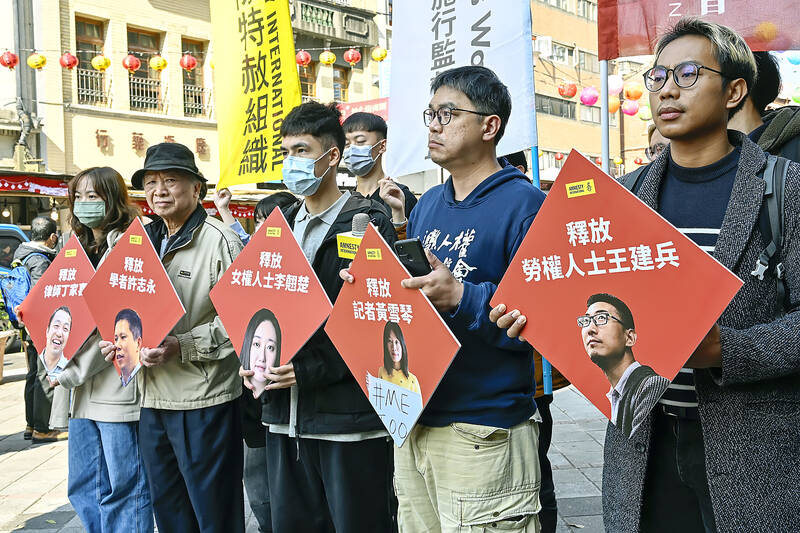
Photo: Chen Chih-chu, Taipei Times
The news conference was organized by Amnesty International Taiwan, Taiwan Association for Human Rights, Taiwan Support China Human Rights Lawyers Network and the Judicial Reform Foundation, among others. The groups called on the CCP to allow rights activists in custody to hire lawyers, and to return home to visit their families during the Lunar New Year.
Lee said the charges of sedition brought against Xu, Huang, Chinese labor and women’s rights campaigner Li Qiaochu (李翹楚), civil rights activist Ding Jiaxi (丁家喜) and labor rights advocate Wang Jianbing (王建兵) were unfounded, as none of them had ever publicly advocated overthrowing the CCP, or expressed opposition to socialism.
Providing an example of how the CCP arbitrarily accuses rights campaigners of sedition, Lee recounted a meeting with a dissident at the time he was being held in China.
The man, named Chengyuan (程淵), was charged with sedition after he complained about China’s family planning fine, and proposed decoupling family planning from the household registration system.
“The CCP is afraid of the independent civil society that these people represent,” Lee said.
“It hopes that Chinese people can be like atoms that revolve around it, depending on it for food, clothing, housing, transportation, education and entertainment — for survival,” he said.
Lee compared the situation faced by Chinese activists to that experienced by Taiwanese during the White Terror era.
Their families often face harassment and loss of employment, and their children face discrimination in school, he said.
“The CCP even goes as far as to publicly declare these activists to be bad people who undermine social stability. It attempts to rally the public against them, to deter future activism,” he said.
Citing an example of inhumane conditions that political prisoners are subjected to while in detention, Amnesty International Taiwan secretary-general Chiu Ee-ling (邱伊翎) said that Xu, who is serving a four-year prison term, has been tortured while in prison.
Li, who is Xu’s wife, wrote on Twitter in 2020 that Xu was being tied to a metal chair for 10 hours each day.
Hong Kong Outlanders secretary-general Sky, who goes by one name, said he has had to live in exile in Taiwan since the introduction of Hong Kong’s National Security Law, and he is unable to return to home to spend the Lunar New Year with his family for fear of arrest.
Taiwan Tibetan Welfare Association chairman Tashi Tsering said 160,000 Tibetans have been living in exile since the CCP invaded Tibet 70 years ago, and “6 million Tibetans continue to live in suffering in Tibet” under CCP rule.

Fast food chain McDonald's is to raise prices by up to NT$5 on some products at its restaurants across Taiwan, starting on Wednesday next week, the company announced today. The prices of all extra value meals and sharing boxes are to increase by NT$5, while breakfast combos and creamy corn soup would go up by NT$3, the company said in a statement. The price of the main items of those meals, if ordered individually, would remain the same. Meanwhile, the price of a medium-sized lemon iced tea and hot cappuccino would rise by NT$3, extra dipping sauces for chicken nuggets would go up
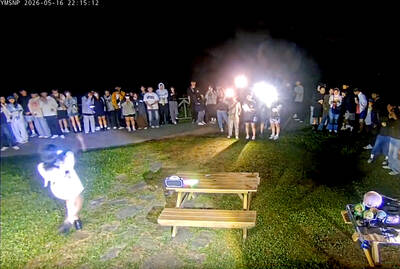
Yangmingshan National Park’s Qingtiangang (擎天崗) nature area has gone viral after a park livestream camera observed a couple in the throes of intimate congress, which was broadcast live on YouTube, drawing large late-night crowds and sparking a backlash over noise, bright lights and disruption to wildlife habitat. The area’s livestream footage appeared to show a couple engaging in sexual activity on a picnic table in the park on Friday last week, with the uncensored footage streamed publicly online. The footage quickly spread across social media, prompting a tide of visitors to travel to the site to “check in” and recreate the

Minister of Digital Affairs Lin Yi-ching (林宜敬) yesterday cited regulatory issues and national security concerns as an expert said that Taiwan is among the few Asian regions without Starlink. Lin made the remarks on Facebook after funP Innovation Group chief executive officer Nathan Chiu (邱繼弘) on Friday said Taiwan and four other countries in Asia — China, North Korea, Afghanistan and Syria — have no access to Starlink. Starlink has become available in 166 countries worldwide, including Ukraine, Malaysia, the Philippines and Vietnam, in the six years since it became commercial, he said. While China and North Korea block Starlink, Syria is not

GROUNDED: A KMT lawmaker proposed eliminating drone development programs and freezing funding for counterdrone systems, despite China’s adoption of the technology China has deployed attack drones at air bases near the Taiwan Strait in a strategy aimed at overwhelming Taiwan’s air defense systems through saturation attacks, the Mainland Affairs Council (MAC) said. The council’s latest quarterly report on China said that satellite imagery and open-source intelligence indicate that the Chinese People’s Liberation Army (PLA) had converted retired J-6 fighter jets into J-6W drones, which the PLA has stationed at six air bases near Taiwan, five in China’s Fujian Province and one in Guangdong Province. The report cited J. Michael Dahm, a senior fellow at the US-based Mitchell Institute, as saying that China has


 RSS
RSS