


The written component of driver’s license tests now include more questions on what to do at uncontrolled intersections, after new testing guidelines took effect on Tuesday, the Directorate-General of Highways said.
Test takers need to answer three or four compulsory questions about uncontrolled intersections, the agency said.
The written component of the test comprises 50 randomly chosen questions.
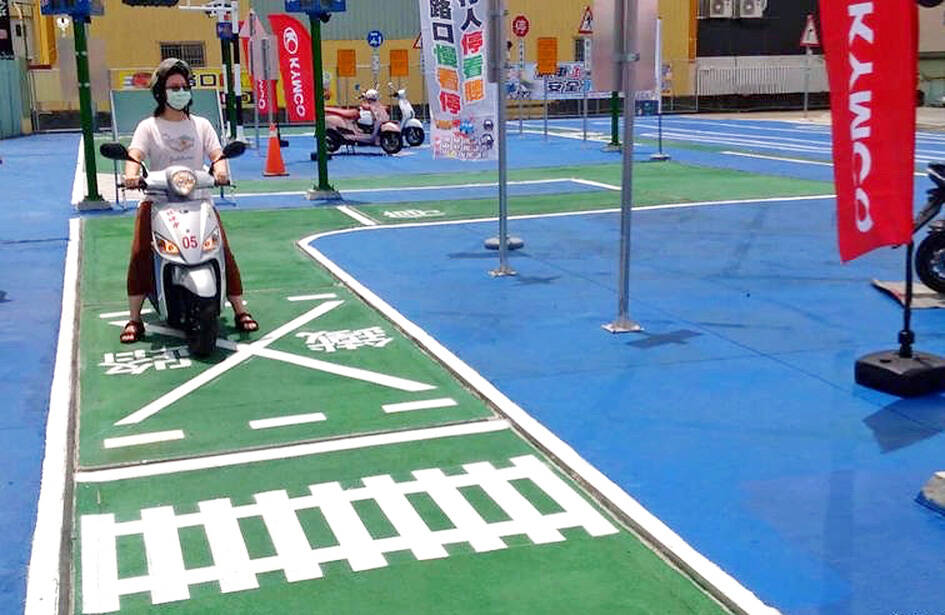
Photo: Huang Liang-chieh, Taipei Times
Also, starting in April, a mandatory road component is to be added to motorcycle driving courses at 14 course operators nationwide, it said.
The agency on Saturday met with representatives from operators, driving training institutes and other concerned parties to discuss the road test.
“Plans call for a three-hour road component, which will cover eight to 10 training items, including changing lanes, roadside parking, avoiding blind spots of larger vehicles and stopping at uncontrolled intersections,” Motor Vehicle Section Deputy Director Wei Wu-sheng (魏武盛) said.
“It will include two hours of riding experience and one hour of pre-riding instruction, along with a post-riding review and corrective measures,” Wei said.
Other training items that might be covered in the road portion include two-stage left turns and riding at a safe distance from other vehicles, he said, adding that some items might be conducted in simulated scenarios at the program operators’ facilities.
Trainees are to be accompanied by an instructor throughout the road test, while scooters used for training are to be equipped with cameras, and riders must wear Bluetooth headsets at all times to communicate with instructors, he said.
Taiwan has 72 state-owned motorcycle driving courses, 14 of which are to implement the road component.
Three of the participating operators are in New Taipei City, two are in Kaohsiung, and one each in Taipei, Tainan, Taoyuan and Taichung, and one each in Hsinchu, Changhua, Pingtung, Taitung and Chiayi counties.
“We are working out course fees for programs that include road components, but to make it easier for people, we are offering NT$1,200 subsidies to students throughout 2023,” Wei said.
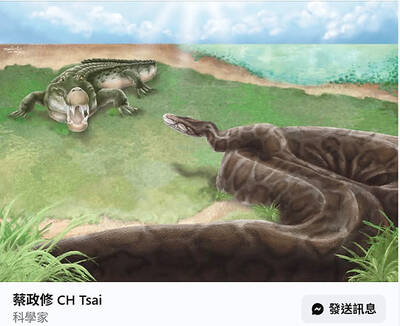
Taiwanese paleontologists have discovered fossil evidence that pythons up to 4m long inhabited Taiwan during the Pleistocene epoch, reporting their findings in the international scientific journal Historical Biology. National Taiwan University (NTU) Institute of Ecology and Evolutionary Biology associate professor Tsai Cheng-hsiu (蔡政修) led the team that discovered the largest snake fossil ever found in Taiwan. The single trunk vertebra was discovered in Tainan at the Chiting Formation, dated to between 400,000 and 800,000 years ago in the Middle Pleistocene, the paper said. The area also produced Taiwan’s first avian fossil, as well as crocodile, mammoth, saber-toothed cat and rhinoceros fossils, it said. Discoveries

Taiwanese paleontologists have discovered fossil evidence that pythons up to 4m long inhabited Taiwan during the Pleistocene epoch, reporting their findings in the international scientific journal Historical Biology. National Taiwan University (NTU) Institute of Ecology and Evolutionary Biology associate professor Tsai Cheng-hsiu (蔡政修) led the team that discovered the largest snake fossil ever found in Taiwan. A single trunk vertebra was discovered in Tainan at the Chiting Formation, dated to between 800,000 to 400,000 years ago in the Middle Pleistocene, the paper said. The area also produced Taiwan’s first avian fossil, as well as crocodile, mammoth, sabre-toothed cat and rhinoceros fossils, it said. Discoveries
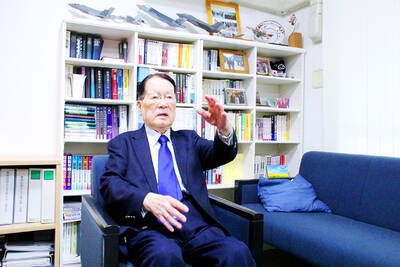
Whether Japan would help defend Taiwan in case of a cross-strait conflict would depend on the US and the extent to which Japan would be allowed to act under the US-Japan Security Treaty, former Japanese minister of defense Satoshi Morimoto said. As China has not given up on the idea of invading Taiwan by force, to what extent Japan could support US military action would hinge on Washington’s intention and its negotiation with Tokyo, Morimoto said in an interview with the Liberty Times (sister paper of the Taipei Times) yesterday. There has to be sufficient mutual recognition of how Japan could provide
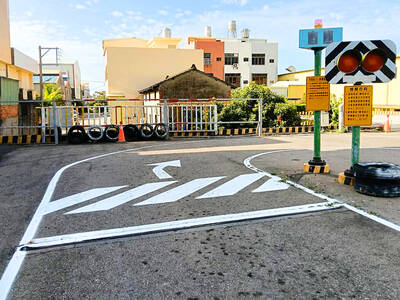
UPDATED TEST: The new rules aim to assess drivers’ awareness of risky behaviors and how they respond under certain circumstances, the Highway Bureau said Driver’s license applicants who fail to yield to pedestrians at intersections or to check blind spots, or omit pointing-and-calling procedures would fail the driving test, the Highway Bureau said yesterday. The change is set to be implemented at the end of the month, and is part of the bureau’s reform of the driving portion of the test, which has been criticized for failing to assess whether drivers can operate vehicles safely. Sedan drivers would be tested regarding yielding to pedestrians and turning their heads to check blind spots, while drivers of large vehicles would be tested on their familiarity with pointing-and-calling


 RSS
RSS