


Cultural institutions in conjunction with the National Performing Arts Center are hosting a series of jazz and classical concerts across Taiwan from today until Monday.
In Taipei, violinists Lin Cho-liang (林昭亮) and Hu Nai-yuan (胡乃元) are to perform at the National Concert Hall with the National Symphony Orchestra (NSO) tonight and tomorrow evening.
The CF Koo Foundation has been trying to arrange the orchestral concert for the past two years to accommodate Lin’s and Hu’s schedules, CEO Vivien Koo (辜懷群) said, describing the concerts as a “rare” event.
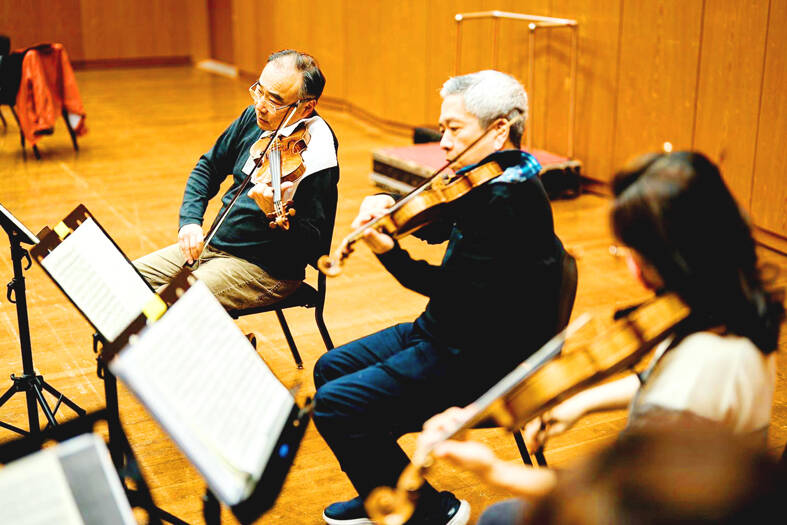
Photo courtesy of the National Symphony Orchestra via CNA
A previous attempt to bring the two together last year had to be canceled due to the COVID-19 pandemic, she said.
The two violinists last performed together in Houston, Texas, several years ago, she said.
Tonight, Lin, Hu and pianist Wang Pei-yao (王佩瑤) are scheduled to play a selection of violin duets by Miklos Rozsa, Dmitri Shostakovich and Moritz Moszkowski.
In the second half of the show, the NSO is to play Taiwanese composer Chang Shiuan’s (張玹) Nian Tu — which had its first performance by the orchestra in Tokyo in January 2020 — and Felix Mendelssohn’s String Octet in E-flat major, Op 20, the NSO said.
On New Year’s Eve, Lin and Hu are scheduled perform three concertos during the first half of an NSO concert led by conductor Wu Yao-yu (吳曜宇), with the orchestra also playing polkas composed by members of the Strauss family.
Meanwhile, the National Taichung Theater is set to present two nights of jazz concerts titled “Let’s Party Back-To-Back” tonight and tomorrow evening.
Planned and led by trumpeter Stacey Wei (魏廣?), a group of musicians including drummer Rich Huang (黃瑞豐) are to be joined by singers including Shih Ying-ying (史茵茵) and Ctwo (林玟圻) to perform classics such as Swing Time, Anything Goes and Pal Joey during the first of the two concerts, the theater said.
New Year’s Eve is to feature a funk and soul night featuring singer YELLOW (黃宣), with backing from Wei and his group.
On New Year’s Day, a performance by the National Taiwan Symphony Orchestra (NTSO) conducted by Shui Lan (水藍) and featuring violinist Tseng Yu-chien (曾宇謙) has been scheduled.
The third of three concerts organized by the Taichung-based NTSO for the festive season is to feature Tseng playing Antonin Dvorak’s Violin Concerto in A minor, Op 53. The first concert was held in Taipei on Christmas Eve.
The NTSO’s festive concerts are to open with Hector Berlioz’s Overture to Benvenuto Cellini, Op 23, followed by a guest performance by Tseng and an orchestral performance of George Gershwin’s An American in Paris and Porgy and Bess: A Symphonic Picture for Orchestra, the latter being an arrangement of Gershwin pieces by Russel Bennett.
On New Year’s Eve, the NTSO and Tseng are to perform at the National Kaohsiung Center for the Arts, known locally as Weiwuying, the orchestra said.
On New Year’s Day, a live broadcast of the Vienna Philharmonic Orchestra’s New Year’s Concert can be viewed at 6pm on Jan. 1, it said.
On Monday, a public holiday in Taiwan, Weiwuying is to present “Afro-Cuban Con Soul: The Sound of Motown and Irakere,” performed by double bassist Vincent Hsu (徐崇育) and the Jazz Supreme Orchestra.
Pianist Javier Masso and Cuban drummer Raul Pineda are to join Hsu and the jazz group to perform Stevie Wonder’s Fingertips, among other songs.

Considering that most countries issue more than five denominations of banknotes, the central bank has decided to redesign all five denominations, the bank said as it prepares for the first major overhaul of the banknotes in more than 24 years. Central bank Governor Yang Chin-lung (楊金龍) is expected to report to the Legislative Yuan today on the bank’s operations and the redesign’s progress. The bank in a report sent to the legislature ahead of today’s meeting said it had commissioned a survey on the public’s preferences. Survey results showed that NT$100 and NT$1,000 banknotes are the most commonly used, while NT$200 and NT$2,000

The Centers for Disease Control (CDC) yesterday reported the first case of a new COVID-19 subvariant — BA.3.2 — in a 10-year-old Singaporean girl who had a fever upon arrival in Taiwan and tested positive for the disease. The girl left Taiwan on March 20 and the case did not have a direct impact on the local community, it said. The WHO added the BA.3.2 strain to its list of Variants Under Monitoring in December last year, but this was the first imported case of the COVID-19 variant in Taiwan, CDC Deputy Director-General Lin Ming-cheng (林明誠) said. The girl arrived in Taiwan on

South Korea is planning to revise its controversial electronic arrival card, a step Taiwanese officials said prompted them to hold off on planned retaliatory measures, a South Korean media report said yesterday. A Yonhap News Agency report said that the South Korean Ministry of Foreign Affairs is planning to remove the “previous departure place” and “next destination” fields from its e-arrival card system. The plan, reached after interagency consultations, is under review and aims to simplify entry procedures and align the electronic form with the paper version, a South Korean ministry official said. The fields — which appeared only on the electronic form

The Ministry of Foreign Affairs (MOFA) is suspending retaliation measures against South Korea that were set to take effect tomorrow, after Seoul said it is updating its e-arrival system, MOFA said today. The measures were to be a new round of retaliation after Taiwan on March 1 changed South Korea's designation on government-issued alien resident certificates held by South Korean nationals to "South Korea” from the "Republic of Korea," the country’s official name. The move came after months of protests to Seoul over its listing of Taiwan as "China (Taiwan)" in dropdown menus on its new online immigration entry system. MOFA last week


 RSS
RSS