


A YouTuber and his assistant have been ordered to pay NT$1 million (US$32,548) to each of two women whose likenesses they used in deepfake pornography videos, one of whom was Kaohsiung City Councilor Huang Jie (黃捷).
Chu Yu-chen (朱玉宸), who goes by Xiaoyu (小玉) on YouTube, was arrested in October last year on suspicion of creating and selling deepfake pornography videos of dozens of politicians and influencers, accumulating more than NT$13 million in illicit profits.
In July, the New Taipei City District Court sentenced Chu to five years and six months in prison and his assistant, Chuang Hsin-jui (莊炘睿), to three years and eight months for contravening the Personal Data Protection Act (個人資料保護法).

Photo provided by Huang Jie’s office
Prosecutors have appealed the ruling on the grounds that the sentences are too light.
The verdicts in two of 21 civil lawsuits also filed in July by Chu and Chuang’s victims were made public on Monday. The complainants were Huang and an unidentified female flight attendant.
In its ruling, the New Taipei District Court said that in today’s Internet-based society, it is nearly impossible to expunge content that has been shared online.

Photo: CNA
As a result, Chu and Chuang’s victims would continue to be haunted by the misuse of their likenesses for decades, along with harm to their reputations, it said.
Perpetrators of “digital sexual violence” such as Chu and Chuang can often only be prosecuted for contravening the Personal Data Protection Act, the court said.
Due to a lack of legal tools with regard to holding the owners of platforms and sites that disseminate such content accountable, the threat of a civil lawsuit is often the only legal deterrent that potential victims have at their disposal, the court said in its verdict.
Huang thanked the court for serving justice and bringing “some measure of comfort” to the two.
“However, the more pressing issue is still the passage of a digital sexual violence law” in Taiwan, with provisions on preventing and punishing such crimes, and a mechanism for removing the offending content from the Internet, she said.

SECURITY: Starlink owner Elon Musk has taken pro-Beijing positions, and allowing pro-China companies to control Taiwan’s critical infrastructure is risky, a legislator said Starlink was reluctant to offer services in Taiwan because of the nation’s extremely high penetration rates in 4G and 5G services, the Ministry of Digital Affairs said yesterday. The ministry made the comments at a meeting of the legislature’s Transportation Committee, which reviewed amendments to Article 36 of the Telecommunications Management Act (電信管理法). Article 36 bans foreigners from holding more than 49 percent of shares in public telecommunications networks, while shares foreigners directly and indirectly hold are also capped at 60 percent of the total, unless specified otherwise by law. The amendments, sponsored by Chinese Nationalist Party (KMT) Legislator Ko

The eastern extension of the Taipei MRT Red Line could begin operations as early as late June, the Taipei Department of Rapid Transit Systems said yesterday. Taipei Rapid Transit Corp said it is considering offering one month of free rides on the new section to mark its opening. Construction progress on the 1.4km extension, which is to run from the current terminal Xiangshan Station to a new eastern terminal, Guangci/Fengtian Temple Station, was 90.6 percent complete by the end of last month, the department said in a report to the Taipei City Council's Transportation Committee. While construction began in October 2016 with an
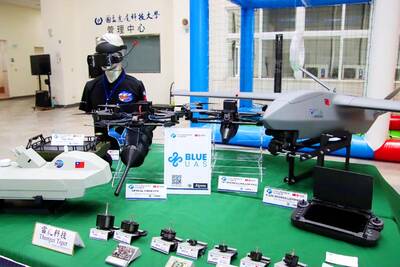
NON-RED SUPPLY: Boosting the nation’s drone industry is becoming increasingly urgent as China’s UAV dominance could become an issue in a crisis, an analyst said Taiwan’s drone exports to Europe grew 41.7-fold from 2024 to last year, with demand from Ukraine’s fight against Russian aggression the most likely driver of growth, a study showed. The Institute for Democracy, Society and Emerging Technology (DSET) in a statement on Wednesday said it found that many of Taiwan’s uncrewed aerial vehicle (UAV) sales were from Poland and the Czech Republic. These countries likely transferred the drones to Ukraine to aid it in its fight against the Russian invasion that started in 2022, it said. Despite the gains, Taiwan is not the dominant drone exporter to these markets, ranking second and fourth
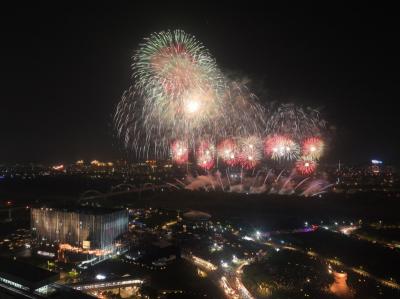
The New Taipei City Art Museum this weekend plans to celebrate its first anniversary with a two-day extravaganza featuring live concerts and a large-scale synchronized fireworks and drone display, the New Taipei City Cultural Affairs Department said. The two-day celebrations are to take place in the museum’s outdoor park, with markets and live performances by singers including Ann Bai (白安), Bii (畢書盡) and the Cosmos People (宇宙人), the department said. The highlight on both evenings would be the "Echoes of Light" show, an aerial spectacle combining fireworks and drone performances designed around the concept of "dual stages in the sky," it


 RSS
RSS