


The Democratic Progressive Party (DPP) caucus yesterday said it would amend the Civil Servants Election and Recall Act (公職人員選舉罷免法) to disallow people with criminal convictions involving organized crime, money laundering, firearms or drugs from running in national or local elections.
The caucus made the proposal at a news conference in response to public calls for enhanced national security.
DPP Legislator Lo Chih-cheng (羅致政), director of the caucus, said that politicians should be held to the highest standards, and that the law is the minimum regulation of ethics in politics.
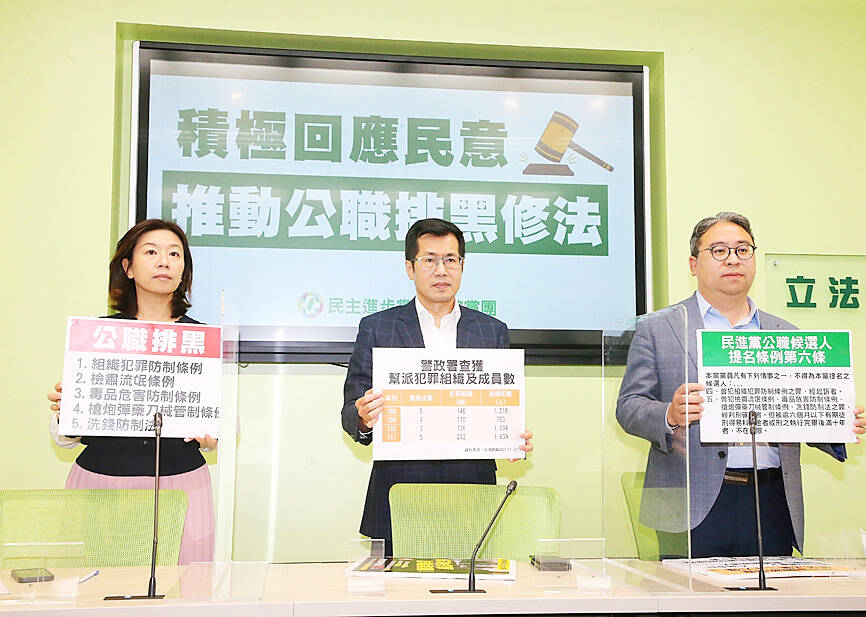
Photo: CNA
The National Police Agency conducted five sets of crackdowns on gangs this year and investigated a record number suspects, with unprecedented amounts of money involved, Lo said.
The caucus discussed what kind of amendments to introduce, and asked the agency to step up the crackdowns, he said.
DPP caucus deputy director Huang Shih-chieh (黃世杰) said that mayors, county commissioners and local representatives are trusted to use great power and large resources in an ethical manner.
As such, regulations on their eligibility should follow the example of Article 26 of the Presidential and Vice Presidential Election and Recall Act (總統副總統選舉罷免法), which says that a person cannot run for the top two offices if they have been convicted of any crime described in the Organized Crime Prevention Act (組織犯罪防制條例), Huang said.
Eligibility for election should be further restricted to disallow candidates for any office who have been convicted under the Organized Crime Prevention Act, the Narcotics Hazard Prevention Act (毒品危害防制條例), the Act Controlling Guns, Knives and Ammunition (槍砲彈藥刀械管制條例) or the Money Laundering Control Act (洗錢防制法), he said.
The restrictions should apply to legislators, borough wardens, mayors of townships and township-level cities, and city and county councilors, Lo said.
The DPP already disallows people prosecuted for organized crime from running for any civil servant position, he added.
DPP caucus deputy secretary-general Lin Ching-yi (林靜儀) said that the disreputable backgrounds of many politicians and political organizations have discouraged many ethical people from participating in national or local elections.
The backgrounds of civil servants should be considered more carefully, given the power they hold and their duty to serve the public, she added.
The caucus is drafting an amendment to the Civil Servants Election and Recall Act in the hope of clearing corruption out of Taiwanese politics, and a draft is to be made after party deliberation, Lin said.

FUKUOKA SITUATION: Japanese media reported that the pathogen is expected to be identified by the summer, while the CDC downplayed the idea that it was hMPV A “mysterious cold-like illness” reported in Japan’s Fukuoka Prefecture does not seem to be a new disease, but Japanese authorities have been asked about the situation, the Centers for Disease Control (CDC) said yesterday. The Fukuoka Prefectural Medical Association on Wednesday told a news conference that a “mystery cold” that has become a hot topic on social media is “highly likely to be caused by some kind of viral infection,” Japan’s KBC News reported. “Many people are experiencing symptoms starting with a sore throat, followed by a runny nose, phlegm and a severe cough,” KBC News reported, citing association officials. Health authorities are

Nvidia Corp CEO Jensen Huang (黃仁勳) arrived in Taiwan yesterday ahead of upcoming AI and technology events, saying he plans to meet with clients and Taiwan Semiconductor Manufacturing Co Chairman C.C. Wei (魏哲家) during his visit. After landing at Taipei Songshan Airport, Huang posed for photos with fans and handed out Yakult drinks to reporters and supporters waiting at the scene, saying he has “a lot to do” during the trip. Asked about reports that Nvidia’s planned headquarters site in Taipei’s Beitou Shilin Technology Park could break ground on May 27, Huang said that if the company holds an event, he would

Carrefour Taiwan is to begin using a new name from the start of July, but it cannot divulge the name until then, the chairman of the supermarket chain's parent company said today. President Chain Store Co chairman Lo Chih-hsien (羅智先) was asked by reporters after a shareholders' meeting to confirm whether the company has settled on a new name for the supermarket brand. In March, the government-registered name of two Carrefour Taiwan branches was quietly changed to "Le Chia Kang" (樂家康) in Chinese, raising speculation that has been selected as the name. Lo said that because of local regulations and contractual obligations, the
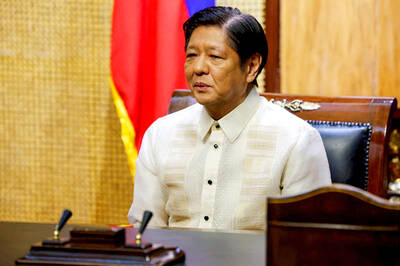
The Philippines would likely be involved in any conflict over Taiwan due to its proximity to the democracy claimed by China, President Ferdinand Marcos Jr said, reiterating a stance that risks angering Beijing. “In the Philippines, we do not have a choice because Taiwan is so close to the Philippines and we have almost 200,000 Filipino nationals living and working in Taiwan,” Marcos said in an interview with Japanese media in Manila on Monday. The Philippine leader’s comments come ahead of a state visit to Japan next week, where he is to meet with Japanese Prime Minister Sanae Takaichi to discuss security


 RSS
RSS