


Democratic Progressive Party (DPP) Legislator Tsai Shih-ying (蔡適應) yesterday said he had his doctoral degree revoked by National Taipei University for plagiarism in his dissertation.
Tsai, who ran in the Keelung mayoral election on Saturday last week, but lost against Hsieh Kuo-liang (謝國樑) of the Chinese Nationalist Party (KMT), said he had been informed by the university that its Graduate Institute of Urban Planning revoked the degree after a recommendation by the school’s academic ethics committee.
However, he had not received a formal notice from the committee, he wrote on Facebook.

Photo: CNA
Tsai passed his dissertation defense in October 2019 and received his doctorate in 2020, after he was re-elected as a legislator by his constituency in Keelung in January that year.
However, several Keelung and Taipei city councilor candidates from the New Power Party in September accused Tsai of plagiarizing his dissertation and filed a report with the university, which then announced a review of his dissertation.
Tsai said he respected the university’s decision and apologized for his negligence in not listing all of the necessary citations in his dissertation, as well as for the trouble caused to his teachers and the school.
Tsai said he had spent almost 10 years to complete the dissertation, including conducting field studies.
Despite the missing citations, his dissertation was original, he said, adding that only 2 percent of its content was similar to other works.
During the review, he appeared before the committee in person and offered to add the missing citations, he said.
Tsai said he is planning to file an appeal to protect his own interests and prove that his dissertation is original.
When he served as a Keelung City councilor, he pursued a doctoral degree in urban planning because he had seen the city’s stagnation, hoping that the studies would enable him to help improve its development, Tsai said.
He said he had applied what he had learned from the program to public service, and expressed gratitude to the university and his professors for the education he had received.
Tsai said that as a lawmaker, he would never forget the trust that his constituents put in him and would continue to devote himself to developing the city.
The announcement of the revocation of Tsai’s doctorate came a day after the revocation of Taoyuan Mayor Cheng Wen-tsan’s (鄭文燦) master’s degree from National Taiwan University (NTU), also over plagiarism in his thesis.
Cheng’s and Tsai’s cases are among a spate of plagiarism accusations in the run-up to the nine-in-one elections, with the most high-profile case being against former DPP Hsinchu mayor Lin Chih-chien (林智堅), who at the time was the party’s candidate to replace Cheng as Taoyuan mayor.
Lin’s two master’s degrees from NTU and Chung Hua University were revoked by the two schools in August, prompting him to drop out of the mayoral race.

Actor Darren Wang (王大陸) was sentenced to six months in prison, commutable to a fine, by the New Taipei District Court today for contravening the Personal Data Protection Act (個人資料保護法) in a case linked to an alleged draft-dodging scheme. Wang allegedly paid NT$3.6 million (US$114,380) to an illegal group to help him evade mandatory military service through falsified medical documents, prosecutors said. He transferred the funds to Chen Chih-ming (陳志明), the alleged mastermind of a draft-evasion ring, although he lost contact with him as he was already in detention on fraud charges, they said. Chen is accused of helping a

SECURITY: Starlink owner Elon Musk has taken pro-Beijing positions, and allowing pro-China companies to control Taiwan’s critical infrastructure is risky, a legislator said Starlink was reluctant to offer services in Taiwan because of the nation’s extremely high penetration rates in 4G and 5G services, the Ministry of Digital Affairs said yesterday. The ministry made the comments at a meeting of the legislature’s Transportation Committee, which reviewed amendments to Article 36 of the Telecommunications Management Act (電信管理法). Article 36 bans foreigners from holding more than 49 percent of shares in public telecommunications networks, while shares foreigners directly and indirectly hold are also capped at 60 percent of the total, unless specified otherwise by law. The amendments, sponsored by Chinese Nationalist Party (KMT) Legislator Ko
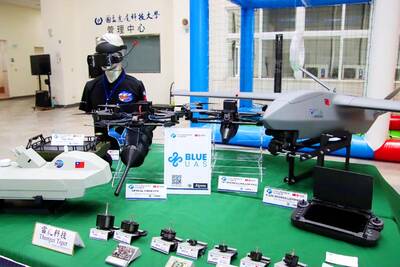
NON-RED SUPPLY: Boosting the nation’s drone industry is becoming increasingly urgent as China’s UAV dominance could become an issue in a crisis, an analyst said Taiwan’s drone exports to Europe grew 41.7-fold from 2024 to last year, with demand from Ukraine’s fight against Russian aggression the most likely driver of growth, a study showed. The Institute for Democracy, Society and Emerging Technology (DSET) in a statement on Wednesday said it found that many of Taiwan’s uncrewed aerial vehicle (UAV) sales were from Poland and the Czech Republic. These countries likely transferred the drones to Ukraine to aid it in its fight against the Russian invasion that started in 2022, it said. Despite the gains, Taiwan is not the dominant drone exporter to these markets, ranking second and fourth

The eastern extension of the Taipei MRT Red Line could begin operations as early as late June, the Taipei Department of Rapid Transit Systems said yesterday. Taipei Rapid Transit Corp said it is considering offering one month of free rides on the new section to mark its opening. Construction progress on the 1.4km extension, which is to run from the current terminal Xiangshan Station to a new eastern terminal, Guangci/Fengtian Temple Station, was 90.6 percent complete by the end of last month, the department said in a report to the Taipei City Council's Transportation Committee. While construction began in October 2016 with an


 RSS
RSS