


A team from National Tsing Hua University (NTHU) outperformed nine groups to finish first at the Student Cluster Competition in Dallas, Texas, this month.
Led by NTHU computer science professor Jerry Chou (周志遠), the team included Mau Chan-yu (牟展佑), Ting Hsu-tzu (丁緒慈), Kuo Pin-yi (郭品毅), Chang Fu-chiang (張富強), Huang En-min (黃恩敏) and Wu Pang-ning (吳邦寧), who stood out among six teams from the US, and three from Germany, Singapore and Switzerland, NTHU and the National Applied Research Laboratories (NARLabs) said in a statement last week.
From Nov. 14 to Nov. 16 at Bailey Hutchinson Convention Center, students competed for 56 hours. The teams had eight hours to create a high-performance computing (HPC) solution using no more than 3,000 watts, and then had 48 hours to use the system to solve four application questions.
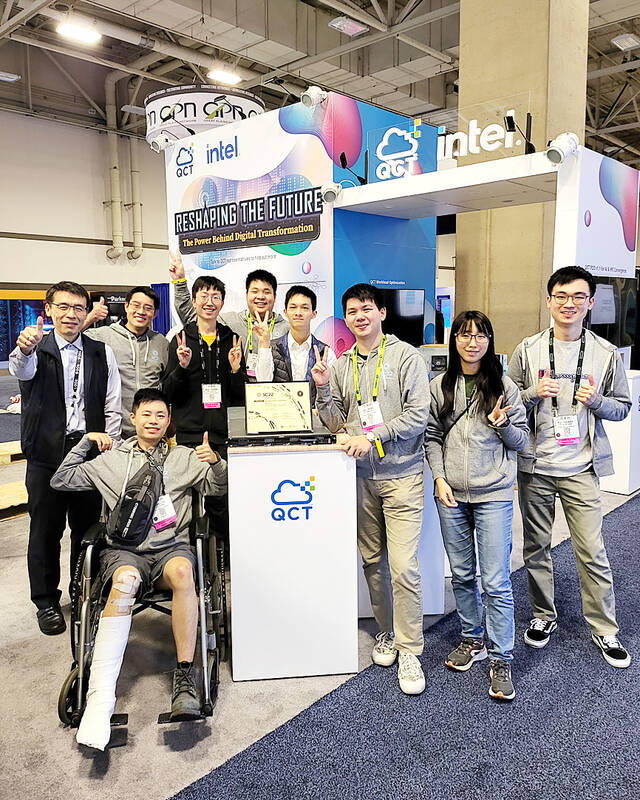
Photo courtesy of National Tsing Hua University
After NTHU team leader Mau was injured in a traffic accident that almost forced him out of the competition, some of the team’s computer equipment was damaged on the way to the convention center, forcing them to rearrange their cluster and adjust their strategy, Chou said.
However, the drastic changes did not stop the team from shining, he said.
Chou said he was grateful to NARLabs for its support, student coach Kerwin Tsai (蔡闊光) from the department of computer science’s graduate program for training the team and Quanta Cloud Technology Inc for its sponsorship.
The annual competition was first held in 2007 to “provide an immersive high-performance computing experience to undergraduate and high-school students,” its Web site says.
“With sponsorship from hardware and software vendor partners, student teams design and build small clusters, learn scientific applications, apply optimization techniques for their chosen architectures and compete in a nonstop, 48-hour challenge at the SC [Super Computing] conference to complete real-world scientific workloads, showing off their HPC knowledge for conference attendees and judges,” it added.
In addition to winning this year’s competition, the Web site shows that NTHU teams won in Seattle, Washington, in 2010 and New Orleans, Louisiana, in 2011.
Chang Chau-lyan (張朝亮), director-general of NARLabs’ National Center for High-performance Computing, called the students’ success the fruition of Taiwan’s long-term academic investment in HPC.
NARLabs said it would continue to provide students with training and support to familiarize them with clusters, to boost Taiwan’s HPC talent.

REASONS FOR TRAVEL: An assistant professor said that proposed amendments to penalize drivers if they used drugs overseas would not deter people from traveling People who operate a motor vehicle under the influence of marijuana would have their driver’s license revoked, even if they used the substance while overseas, the Ministry of Transportation and Communications said yesterday, citing proposed amendments to the Road Traffic Management and Penalty Act (道路交通管理處罰條例). The amendments would also authorize the government to revoke the licenses of people determined to have used Category 1 or Category 2 narcotics, even if they were not operating a vehicle while under the influence of drugs, as well as ban them from taking the license test for three years, the ministry said. People aged 18 or

GLOBALGIVING: ‘ Caving to external pressure is not acceptable for an organization that has cultivated justice reform and human rights for 30 years,’ one NGO said A slew of non-government organizations (NGOs) have withdrawn from the GlobalGiving fundraising platform after it announced it would use “Chinese Taipei” instead of “Taiwan” from next month. The Taiwan Good Rice Association wrote on Facebook on Friday that it was informed on April 28 via a teleconference call of the change, which was made because the platform wanted to operate in China. Taiwan Good Rice is to terminate all cooperative relationships with GlobalGiving in response to the platform’s “unilateral and non-negotiable” decision to remove references to Taiwan, the NGO said. “Taiwan is in the official name of Taiwan Good Rice Association and the

HEAVY WEATHER: Typhoon Jangmi is due to crash straight into the Ryukyus as airlines look to shift flights to larger aircraft or cancel flights to Okinawa entirely Taiwan’s international air carriers announced flight adjustments over the weekend as Typhoon Jangmi is forecast to hit the Ryukyu Islands today and tomorrow. The Central Weather Administration (CWA) upgraded Jangmi from a tropical storm to a typhoon at 8am yesterday, with the eye located 580km south of Naha city. It was moving north at 19kph. Today, China Airlines’ CI-120, CI-121, CI-122 and CI-123 flights between Taoyuan and Naha, Okinawa, have been canceled as well as CI-132 and CI-133 between Kaohsiung and Naha. EVA Air’s BR-112, BR-113, BR-186 and BR-185 flights between Taoyuan and Naha are also canceled. Low-cost carrier Tigerair Taiwan canceled IT-230,

UPGRADE: The Kang Ding-class frigate is replacing its Chaparall missiles with Tien Chien II and Hua Yang VLS, which would provide it with long-range, 360° air defense Taiwan plans to produce 1,200 to 1,376 Hai Chien II missiles (海劍二, Sea Sword II) — also known as TC-2N — to serve as the standard air defense system of the navy’s surface combatant fleet, a source said yesterday. Last week, the Hai Chien II, the naval version of the Tien Kung II missile (天劍二, Sky Sword II), completed a live-fire test in waters off the National Chungshan Institute of Science and Technology’s Jiupeng facility (九鵬) in Pingtung County’s Manjhou Township (滿州). The MIM72 Chaparral and other dated air defense missiles that currently arm Taiwanese ships have inadequate range to combat Chinese


 RSS
RSS