


Legislator Ann Kao (高虹安) was listed as a suspect yesterday after former legislative assistants of the Hsinchu mayoral candidate for the Taiwan People’s Party (TPP) accused her of making illegal payroll deductions and personal gains from public funds.
Lee Chung-ting (李忠庭), who is reportedly Kao’s boyfriend, was also listed as a suspect by the Taipei District Prosecutors’ Office, which said it opened the case after completing a preliminary assessment.
Several whistleblowers, reportedly former legislative assistants at Kao’s office, presented material to investigators showing that she registered Lee as an office assistant, despite his position with the Yonglin Foundation which paid an annual salary of NT$6 million (US$192,567), prosecutors said.
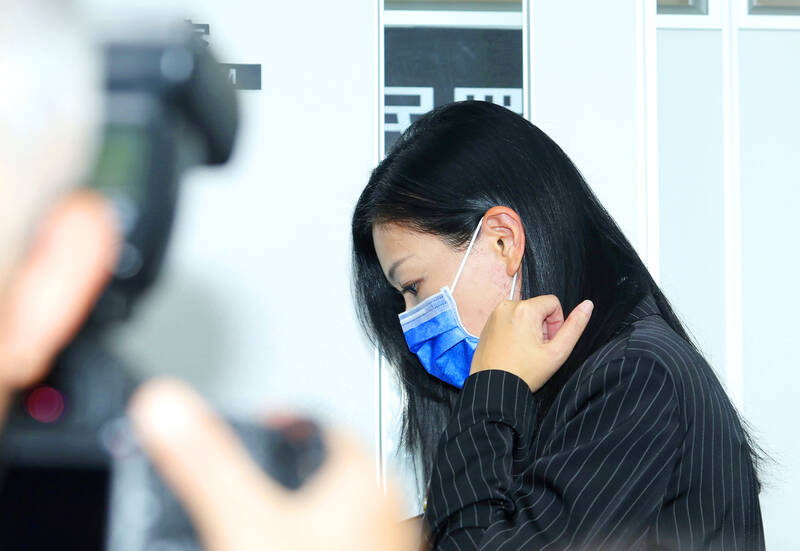
Photo: CNA
The Ministry of Justice’s Investigation Bureau passed the material and testimony on to prosecutors, the office said.
Kao and Lee are likely to face charges related to document forgery regarding alleged employee payroll deductions contravening the Labor Standards Act (勞動基準法), bureau officials said.
More serious charges might arise from the wage fraud allegations linked to Lee’s role in the legislative office, the bureau officials said, adding that Kao might have contravened Article 5 of the Anti-Corruption Act (貪污治罪條例).
The article stipulates a minimum seven-year term, and/or a fine not exceeding NT$60 million for “withdrawing or withholding public funds without authorization with an intent to profit, or unlawfully collecting taxes or floating government bonds.”
Legislative Yuan rules state that legislators are entitled to NT$500,000 per month to pay regular wages and overtime for up to eight office assistants, who generally earn NT$35,000 to NT$45,000 per month.
Kao’s campaign spokeswoman Hsu Chien-ching (徐千晴) said that “being listed as a suspect is normal procedure when a case is launched by prosecutors.”
“It does not mean they have been found guilty,” Hsu said. “Kao has already provided a lot of evidence to prove the office assistants were working and she submitted the documents to the authorities on her own initiative.”
Kao would respect the work of the prosecutors and would cooperate with the investigation, Hsu added.
“People should not make assumptions and mislead the public on this case to influence the election,” she said.
Material provided by whistleblowers alleged that the assistants had some of their wages illegally deducted, with the cash put into a coffer and spent by Kao on personal items, prosecutors said, adding that other material indicated that employees pay was deducted when they took sick leave.
There are allegations that Kao included in accounting documents people who did not work in her office, reported paying wages higher than what were actually provided and made false statements about overtime hours to obtain the maximum amount allowed each month from the Legislative Yuan, prosecutors said.
Kao has been linked to several controversies since she announced her candidacy.
She has been accused of plagiarism in her doctoral thesis and of collecting a corporate salary while on staff at a government-affiliated institute.

The Ministry of Finance this afternoon announced the winning numbers for the March-April uniform invoice lottery. The winning number for the NT$10 million (US$318,060) special prize is 19531471, and the winning number for the NT$2 million grand prize is 85941329. Three numbers were drawn for the NT$200,000 first prize: 07225810, 20231230 and 83518781. Those with receipts matching the last seven digits of any of the first-prize numbers will win the NT$40,000 second prize, while those matching the last six digits will win the NT$10,000 third prize. Those whose receipts match the last five digits of the first-prize numbers can claim the NT$4,000 fourth prize,

SIX SUBSIDIES: The monthly allowance for older farmers is to increase to NT$10,000, and NT$5,000 is to be given to homemakers under the national pension system, Lai said The government is to implement major welfare policies for disadvantaged groups, including raising the monthly allowance for older farmers to NT$10,000 and providing homemakers with NT$5,000 per month, President William Lai (賴清德) said yesterday. Lai made the remarks during a visit to Wangling Temple in Chiayi County, saying that the planned increases were being introduced amid economic growth and an increase in tax revenue. Touting a policy, in which the government plans to provide a monthly allowance of NT$5,000 for every child under the age of 18 in a bid to address Taiwan’s low birthrate, Lai said that if received for the
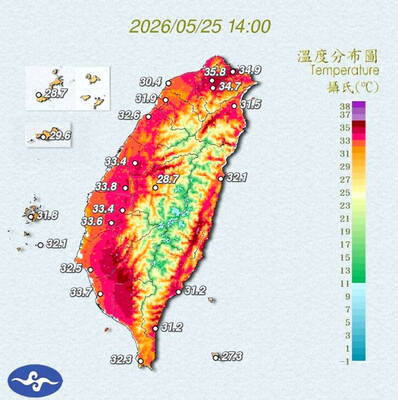
STAY COOL: The HPA recommended that people stay hydrated, use air-conditioning or fans while indoors, wear loose-fitting clothes and walk in the shade while outdoors Employers must implement measures such as installing cooling equipment, and providing drinking water and rest breaks for outdoor workers starting from Monday next week, the Taipei Department of Labor said on Sunday. Employers who fail to comply could face fines of NT$30,000 to NT$300,000 under the Occupational Safety and Health Act (職業安全衛生法), the department said. Businesses in Taipei employing fewer than 100 workers, as well as registered self-employed workers with labor insurance coverage, could receive on-site assessments and guidance from occupational safety consultants to help them apply for central government subsidies to implement or improve heat-protection measures, it said. Under the Ministry of

NATIONAL SECURITY: Authorities are working to confirm the identities of the military personnel involved and investigating possible illegal conduct and regulatory violations Authorities are probing possible national security implications after Kinmen police and immigration officers on Sunday found a Chinese woman allegedly posing as a tourist while engaging in prostitution involving more than 10 military personnel. The woman, surnamed Chen (陳), has since been deported, authorities said, adding that investigators are still working to confirm the identities of those implicated, as the records only listed code names and aliases. The case stemmed from a report received by the Kinmen District Prosecutors’ Office on Friday last week from the Jinhu Precinct of the Kinmen County Police Bureau. On Sunday, police, along with the National Immigration


 RSS
RSS