


Tainan residents yesterday gathered in front of the Presidential Office Building in Taipei to protest solar energy projects in Tainan’s Cigu District (七股), which they say endanger fish farms, agricultural land and natural habitats.
There should be a binding limit on new projects, they said.
The photovoltaic facilities in Cigu are some of the largest power plants of their type in Taiwan. The government is planning to add more capacity to achieve its net zero emissions goal by 2050.
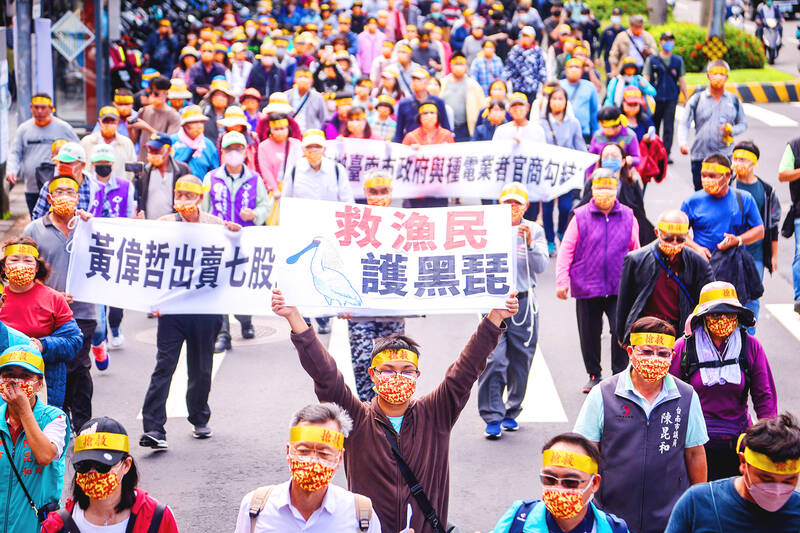
Photo: CNA
About 200 protesters participated in the event organized by the Alliance to Save the Lands of Cigu, with some holding up banners that read: “Impose construction limits to stop photovolaitic overdevelopment in Cigu,” among other demands.
The demonstrators marched to the Executive Yuan and dumped clam shells near the building before attending a public hearing at the Legislative Yuan.
Cigu Borough Wardens Association vice president Huan Hsien-li (黃仙立) said that Cigu residents support the government’s energy policy and solar power, but believe photovoltaic installations should not be set up on land used for agriculture.
The government has allowed contractors to develop solar projects in Cigu without enough oversight, resulting in 11.48km2, or about 10 percent of the district’s area, being occupied by solar farms, he said.
Contractors are allegedly planning to develop about the same area for new projects, which would result in about one-sixth of land nationwide used for solar farms being in Cigu, he said.
Yang Hui-chin (楊惠欽), an environmental advocate based in Cigu, said solar farms have been set up on land formerly used for clam aquaculture, adding that the solar sector endangers the wintering grounds of the black-faced spoonbill.
Cigu-based pisciculturist Chiu Chuan-yi (邱創禕), a recipient of the Council of Agriculture’s commendation of excellence for young farmers, said the solar projects cut fish farmers off from feed sources for their fish.
Landowners have their properties rezoned without warning the farmers, leading to the rent for farmland in the district increasing 10-fold, he said, adding that the developments diminish the job prospects for young people.
Independent Tainan City Councilor Chen Kun-he (陳昆和) accused Tainan Mayor Huang Wei-che (黃偉哲) of colluding with private interests for personal gain and urged law enforcement to investigate the projects.
Executive Yuan spokesman Lo Ping-cheng (羅秉成) said Premier Su Tseng-chang (蘇貞昌) has ordered a task force to be convened to deal with farmers’ complaints.
There is a mechanism for community feedback and officials are working with residents to resolve the problems, Deputy Minister of Economic Affairs Tseng Wen-sheng (曾文生) said.
The protesters’ demand for a binding limit on new projects is not feasible, he said, but urged Cigu residents to voice their concerns through the existing mechanisms to help make adjustments to new projects.

SECURITY: Starlink owner Elon Musk has taken pro-Beijing positions, and allowing pro-China companies to control Taiwan’s critical infrastructure is risky, a legislator said Starlink was reluctant to offer services in Taiwan because of the nation’s extremely high penetration rates in 4G and 5G services, the Ministry of Digital Affairs said yesterday. The ministry made the comments at a meeting of the legislature’s Transportation Committee, which reviewed amendments to Article 36 of the Telecommunications Management Act (電信管理法). Article 36 bans foreigners from holding more than 49 percent of shares in public telecommunications networks, while shares foreigners directly and indirectly hold are also capped at 60 percent of the total, unless specified otherwise by law. The amendments, sponsored by Chinese Nationalist Party (KMT) Legislator Ko

The military has spotted two Chinese warships operating in waters near Penghu County in the Taiwan Strait and sent its own naval and air forces to monitor the vessels, the Ministry of National Defense (MND) said. Beijing sends warships and warplanes into the waters and skies around Taiwan on an almost daily basis, drawing condemnation from Taipei. While the ministry offers daily updates on the locations of Chinese military aircraft, it only rarely gives details of where Chinese warships are operating, generally only when it detects aircraft carriers, as happened last week. A Chinese destroyer and a frigate entered waters to the southwest
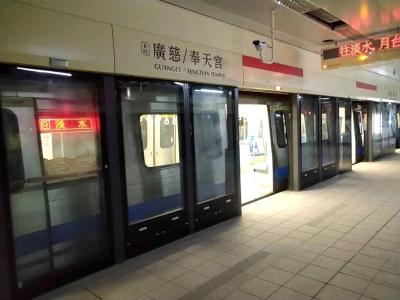
The eastern extension of the Taipei MRT Red Line could begin operations as early as late June, the Taipei Department of Rapid Transit Systems said yesterday. Taipei Rapid Transit Corp said it is considering offering one month of free rides on the new section to mark its opening. Construction progress on the 1.4km extension, which is to run from the current terminal Xiangshan Station to a new eastern terminal, Guangci/Fengtian Temple Station, was 90.6 percent complete by the end of last month, the department said in a report to the Taipei City Council's Transportation Committee. While construction began in October 2016 with an
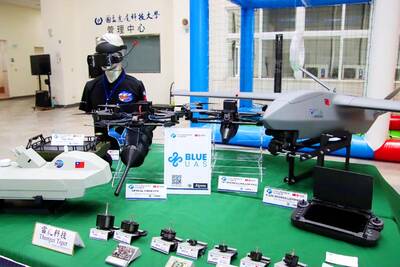
NON-RED SUPPLY: Boosting the nation’s drone industry is becoming increasingly urgent as China’s UAV dominance could become an issue in a crisis, an analyst said Taiwan’s drone exports to Europe grew 41.7-fold from 2024 to last year, with demand from Ukraine’s fight against Russian aggression the most likely driver of growth, a study showed. The Institute for Democracy, Society and Emerging Technology (DSET) in a statement on Wednesday said it found that many of Taiwan’s uncrewed aerial vehicle (UAV) sales were from Poland and the Czech Republic. These countries likely transferred the drones to Ukraine to aid it in its fight against the Russian invasion that started in 2022, it said. Despite the gains, Taiwan is not the dominant drone exporter to these markets, ranking second and fourth


 RSS
RSS