


China’s military exercises around Taiwan earlier this year showed that intelligence and public affairs mechanisms need to be revised, a defense think tank said.
The Center for Peace and Security at the Taipei School of Economics and Political Science Foundation on Thursday last week published a report in Chinese and English analyzing the Chinese People’s Liberation Army (PLA) exercises around Taiwan following US House of Representatives Speaker Nancy Pelosi’s visit in early August.
The report compared the PLA’s exercises to the third Taiwan Strait crisis 26 years ago, finding them similar in their unprecedented provocation, but significantly worse in terms of scale, execution and pressure on Taiwanese forces.
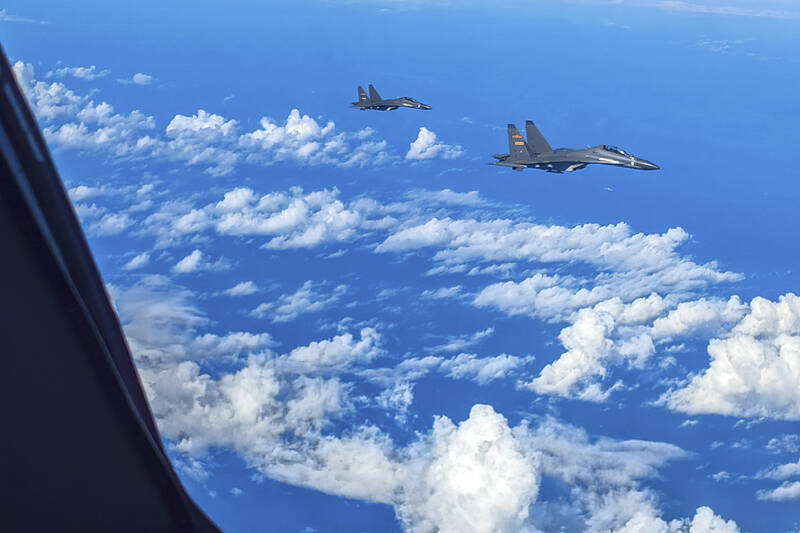
Photo: Xinhua news agency via AP
Since the exercises, PLA craft crossing the median line of the Taiwan Strait has “become routine,” erasing the informal dividing line that previously had generally been respected, it said.
A PLA Eastern Command spokesperson when announcing the end of the exercises vowed that routine combat patrols would continue, indicating that Beijing’s “gray zone activities would be even more exacerbated from now on,” it added.
As opposed to the third Taiwan Strait crisis, the government “suffered unprecedented criticism” for its insufficient intelligence, the center said.
During the 1995-1996 event, then-president Lee Teng-hui (李登輝) announced 18 courses of action in response to the PLA’s activity, while the US intervened directly, it said.
However, in August, the only government announcements were made through the Ministry of National Defense’s Web site and a news conference held afterward, leaving most people to seek out information on social media or news outlets, it said.
“Most people were not able to distinguish real information from disinformation due to the bombardment of information from the cyberworld,” exacerbating disinformation and undermining government credibility, it said.
In addition to military operations, cognitive warfare and cyberattacks have become common practice, the report said.
The report concludes with seven recommendations for the government and military to prepare for future uncertainties.
In dealing with the August exercise, “Taiwan was at best unable to meet its intelligence needs. At worst, it was a failure as far as the function of intelligence estimate is concerned,” it said.
The government should create an entirely new intelligence exchange mechanism with the US, which should include the exchange of personnel, as well as intelligence, the report said.
The military must also revise its operational plans to incorporate asymmetric, innovative tactics, it said.
Third, the armed forces must prepare for a “long resources attrition type of campaign,” as any future conflict would likely be drawn out, it added.
Fourth, the military should revise its rules of engagement in detail to give commanders the ability to respond should a routine patrol become a sudden attack, the report said.
As for public affairs, communication should be approached with a more open mindset and respect for the public’s information needs in a crisis, it said.
“Taiwan’s government and military need to become more sophisticated in striking a balance between operational security and keeping the public informed to hedge against or even pre-empt the enemy’s cognitive attacks,” it added.
Strengthening cybersecurity is also critical as an area in which Taiwan could “relatively easily gain superiority,” even if physical assets are lacking, it said.
Superiority in cyberspace would not only “control the narrative and bolster morale, but also could contribute to military success in combat,” it said, recommending that the government take advantage of the nation’s robust information industry and cultivate more talent in the field.
Last, it suggested managing expectations about US involvement. Instead, the government should base all deterrence efforts on Taiwan’s own capabilities and will to fight, it said.
The center was founded on Sept. 1 to provide research on Taiwan defense issues for policymaking and reference, with former chief of general staff Admiral Lee Hsi-min (李喜明) as chief executive officer.

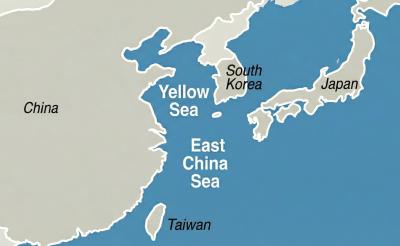
China has reserved offshore airspace in the Yellow Sea and East China Sea from March 27 to May 6, issuing alerts usually used to warn of military exercises, although no such exercises have been announced, the Wall Street Journal (WSJ) reported yesterday. Reserving such a large area for 40 days without explanation is an “unusual step,” as military exercises normally only last a few days, the paper said. These alerts, known as Notice to Air Missions (Notams), “are intended to inform pilots and aviation authorities of temporary airspace hazards or restrictions,” the article said. The airspace reserved in the alert is
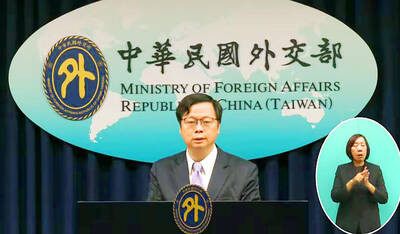
NAMING SPAT: The foreign ministry called on Denmark to propose an acceptable solution to the erroneous nationality used for Taiwanese on residence permits Taiwan has revoked some privileges for Danish diplomatic staff over a Danish permit that lists “Taiwan” as “China,” Eric Huang (黃鈞耀), head of the Ministry of Foreign Affairs’ Department of European Affairs, told a news conference in Taipei yesterday. Reporters asked Huang whether the Danish government had responded to the ministry’s request that it correct the nationality on Danish residence permits of Taiwanese, which has been listed as “China” since 2024. Taiwan’s representative office in Denmark continues to communicate with the Danish government, and the ministry has revoked some privileges previously granted to Danish representatives in Taiwan and would continue to review

More than 6,000 Taiwanese students have participated in exchange programs in China over the past two years, despite the Mainland Affairs Council’s (MAC) “orange light” travel advisory, government records showed. The MAC’s publicly available registry showed that Taiwanese college and university students who went on exchange programs across the Strait numbered 3,592 and 2,966 people respectively. The National Immigration Agency data revealed that 2,296 and 2,551 Chinese students visited Taiwan for study in the same two years. A review of the Web sites of publicly-run universities and colleges showed that Taiwanese higher education institutions continued to recruit students for Chinese educational programs without
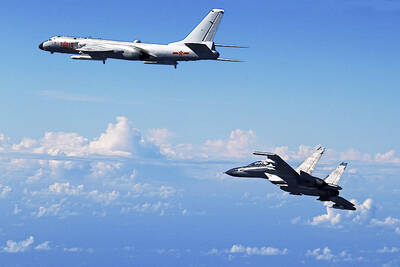
China has reserved offshore airspace over the Yellow Sea and East China Sea from March 27 to May 6, issuing alerts that are usually used to warn of military exercises, although no such exercises have been announced, the Wall Street Journal (WSJ) reported on Sunday. Reserving such a large area for 40 days without explanation is an “unusual step,” as military exercises normally only last a few days, the paper said. The alerts, known as notice to air missions (NOTAMs), “are intended to inform pilots and aviation authorities of temporary airspace hazards or restrictions,” the article said. The airspace reserved in the alert


 RSS
RSS