


Astronomy enthusiasts on Tuesday next week are to have a rare view of a full lunar eclipse and a lunar occultation of Uranus, the Central Weather Bureau said yesterday.
People who miss the astronomical events this year would have to wait until Sept. 8, 2025, to see another full lunar eclipse, and April 12, 2038, for the next visible lunar occultation of Uranus, the bureau said.
The process of the total lunar eclipse is to begin at 4:01pm with a penumbral eclipse, when the Earth’s outer shadow starts moving over the moon, it said.
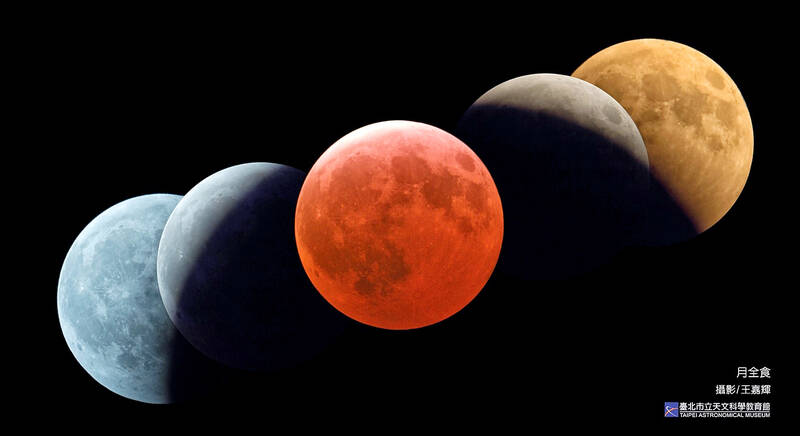
Photo courtesy of the Taipei Astronomical Museum
The penumbral eclipse is to be followed by a partial eclipse at 5:09pm, a total eclipse at 6:16pm and a maximum eclipse at 6:59pm, it said.
The total eclipse is to end at 7:42pm, followed by the end of the partial eclipse at 8:49pm and the end of the penumbral eclipse at 9:58pm, the bureau said.
When the penumbral eclipse ends, the Earth’s shadow completely moves away from the moon.
As the moon would not be visible in Taiwan until between 5:02pm and 5:17pm, stargazers would only start seeing the different phases of the total lunar eclipse during or after the partial eclipse, it added.
During the nearly six-hour event, the moon would appear in an uncommon copper-red hue for about 86 minutes, the bureau said.
The dim color is caused by sunlight being refracted from the Earth’s atmosphere, it said.
The lunar occultation of Uranus is to occur between 7:03pm and 7:05pm, it said, adding that the planet is to reappear between 7:46pm and 7:56pm.
When the moon passes in front of Uranus, the planet will be in the umbra area of the Earth’s shadow, the bureau said.
“As such, the beginning and the end of the occultation will all occur on the edge of the moon’s umbra area,” it added.
A total of 228 lunar eclipses are to occur worldwide between 2001 and 2100: 86 full lunar eclipses, 57 partial lunar eclipses and 85 penumbral lunar eclipses, it said.
In Taiwan, 63 total lunar eclipses, 38 partial lunar eclipses and 60 penumbral lunar eclipses can be observed, it said.
In addition to a full lunar eclipse, people in Taiwan can watch a penumbral lunar eclipse and a partial lunar eclipse next year, it said.
Although lunar occultation of planets occurs every year, the phenomenon is only visible in certain regions, the bureau said, adding that some are not observable because they occur during the day.
The last time a lunar occultation of Uranus was visible at night in Taiwan was on Nov. 15, 1999, it said.
“This time, a total lunar eclipse and a lunar occultation of Uranus are to happen on the same night, which is quite rare,” it said.
Bureau data showed that a partial lunar eclipse and a lunar occultation of Uranus occurred on the same night on Oct. 8, 1930, although the process of occultation occurred at the Earth’s penumbral area, not the umbra area.
The bureau recommends using an astronomical telescope to better observe the phenomena.
People can also watch a livestream of the total lunar eclipse from 5pm at the bureau’s Web site at www.cwb.gov.tw, it said.

Considering that most countries issue more than five denominations of banknotes, the central bank has decided to redesign all five denominations, the bank said as it prepares for the first major overhaul of the banknotes in more than 24 years. Central bank Governor Yang Chin-lung (楊金龍) is expected to report to the Legislative Yuan today on the bank’s operations and the redesign’s progress. The bank in a report sent to the legislature ahead of today’s meeting said it had commissioned a survey on the public’s preferences. Survey results showed that NT$100 and NT$1,000 banknotes are the most commonly used, while NT$200 and NT$2,000

The Centers for Disease Control (CDC) yesterday reported the first case of a new COVID-19 subvariant — BA.3.2 — in a 10-year-old Singaporean girl who had a fever upon arrival in Taiwan and tested positive for the disease. The girl left Taiwan on March 20 and the case did not have a direct impact on the local community, it said. The WHO added the BA.3.2 strain to its list of Variants Under Monitoring in December last year, but this was the first imported case of the COVID-19 variant in Taiwan, CDC Deputy Director-General Lin Ming-cheng (林明誠) said. The girl arrived in Taiwan on

South Korea is planning to revise its controversial electronic arrival card, a step Taiwanese officials said prompted them to hold off on planned retaliatory measures, a South Korean media report said yesterday. A Yonhap News Agency report said that the South Korean Ministry of Foreign Affairs is planning to remove the “previous departure place” and “next destination” fields from its e-arrival card system. The plan, reached after interagency consultations, is under review and aims to simplify entry procedures and align the electronic form with the paper version, a South Korean ministry official said. The fields — which appeared only on the electronic form

The Ministry of Foreign Affairs (MOFA) is suspending retaliation measures against South Korea that were set to take effect tomorrow, after Seoul said it is updating its e-arrival system, MOFA said today. The measures were to be a new round of retaliation after Taiwan on March 1 changed South Korea's designation on government-issued alien resident certificates held by South Korean nationals to "South Korea” from the "Republic of Korea," the country’s official name. The move came after months of protests to Seoul over its listing of Taiwan as "China (Taiwan)" in dropdown menus on its new online immigration entry system. MOFA last week


 RSS
RSS