


The government plans to arrange a meeting between international digital platforms and local news media outlets within a month to discuss the reasonable distribution of revenue for news content published on digital platforms, Minister of Digital Affairs Audrey Tang (唐鳳) said yesterday.
“Broadcast news media and print news media have different ways of calculating revenue generated through online news content. The Ministry of Culture is investigating the amount of revenue that has been lost to digital platforms among broadcast news outlets, while the National Communications Commission [NCC] is investigating revenue loss in print journalism,” Tang told the legislature’s Transportation Committee.
“When we meet, we will focus on how much digital platforms should pay to compensate for the revenue losses. Formulas used to calculate revenue losses should use various parameters to ensure that everyone can agree to them,” she said, adding that the government would also look into similar practices in other countries.

Photo: Liu Hsin-de, Taipei Times
Local news media and large online platform operators are willing to talk about the fair distribution of revenue for online news content, Tang said, adding that no cross-border digital platform would dispute that news concerns the public interest and should have value.
Democratic Progressive Party Legislator Tsai Yi-yu (蔡易餘) asked Tang whether the government would introduce bills to ensure that news media companies get paid for content published online.
Tang said the government is considering three possible options.
The first is to draft a mandatory bargaining code between news media and digital platforms; the second is to draft a bill to protect the neighboring rights of news media outlets; and the third is to establish a special fund, Tang said.
Negotiations between news media and digital platforms, and drafting a bill should proceed simultaneously, she added.
The committee also passed a motion requiring the Ministry of Digital Affairs and relevant agencies to list within one month all possible pricing schemes for online news content by consulting similar systems in other countries, which would facilitate negotiations between news media and digital platforms.
Meanwhile, DPP Legislator Lin Chun-hsien (林俊憲) said the government should also focus on building Taiwan’s digital resilience in software, aside from that of key infrastructure.
Millions of South Koreans were affected last weekend when a fire broke out at a data center used by KakaoTalk, which controls about 97 percent the messaging app market in the country, Lin said.
Its services cover banking, ride-hailing, maps and games, he said.
In Taiwan, the Line messaging app has a market share of nearly 95 percent and offers services similar to those offered by KakaoTalk, Lin said.
However, unlike the South Korean company, Line’s data servers are not in Taiwan, he said.
Dominant software operators such as Line should be asked to establish data centers in Taiwan, Lin said.
The government should emulate Japan in exercising long-arm jurisdiction over how Line uses personal data collected from its users in Taiwan, as authorized by the Personal Data Protection Act (個人資料保護法), he added.

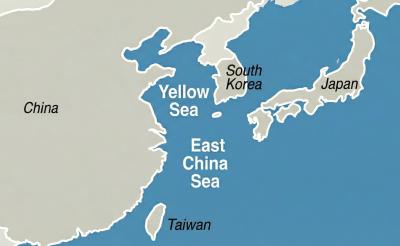
China has reserved offshore airspace in the Yellow Sea and East China Sea from March 27 to May 6, issuing alerts usually used to warn of military exercises, although no such exercises have been announced, the Wall Street Journal (WSJ) reported yesterday. Reserving such a large area for 40 days without explanation is an “unusual step,” as military exercises normally only last a few days, the paper said. These alerts, known as Notice to Air Missions (Notams), “are intended to inform pilots and aviation authorities of temporary airspace hazards or restrictions,” the article said. The airspace reserved in the alert is

NAMING SPAT: The foreign ministry called on Denmark to propose an acceptable solution to the erroneous nationality used for Taiwanese on residence permits Taiwan has revoked some privileges for Danish diplomatic staff over a Danish permit that lists “Taiwan” as “China,” Eric Huang (黃鈞耀), head of the Ministry of Foreign Affairs’ Department of European Affairs, told a news conference in Taipei yesterday. Reporters asked Huang whether the Danish government had responded to the ministry’s request that it correct the nationality on Danish residence permits of Taiwanese, which has been listed as “China” since 2024. Taiwan’s representative office in Denmark continues to communicate with the Danish government, and the ministry has revoked some privileges previously granted to Danish representatives in Taiwan and would continue to review

More than 6,000 Taiwanese students have participated in exchange programs in China over the past two years, despite the Mainland Affairs Council’s (MAC) “orange light” travel advisory, government records showed. The MAC’s publicly available registry showed that Taiwanese college and university students who went on exchange programs across the Strait numbered 3,592 and 2,966 people respectively. The National Immigration Agency data revealed that 2,296 and 2,551 Chinese students visited Taiwan for study in the same two years. A review of the Web sites of publicly-run universities and colleges showed that Taiwanese higher education institutions continued to recruit students for Chinese educational programs without

China has reserved offshore airspace over the Yellow Sea and East China Sea from March 27 to May 6, issuing alerts that are usually used to warn of military exercises, although no such exercises have been announced, the Wall Street Journal (WSJ) reported on Sunday. Reserving such a large area for 40 days without explanation is an “unusual step,” as military exercises normally only last a few days, the paper said. The alerts, known as notice to air missions (NOTAMs), “are intended to inform pilots and aviation authorities of temporary airspace hazards or restrictions,” the article said. The airspace reserved in the alert


 RSS
RSS