


Support for lowering the voting age to 18 is at 45.8 percent, 4.2 percentage points short of the 50 percent threshold needed to ratify the constitutional amendment, a survey released yesterday by a voting rights group showed.
A referendum on a proposed constitutional amendment aimed at lowering the voting age from 20 to 18 is to be held alongside the local elections on Nov. 26. It is the first referendum on amending the Constitution.
The poll showed the referendum could fail by a margin of 810,000 votes, Forward Alliance founder Enoch Wu (吳怡農) told a news conference in Taipei.
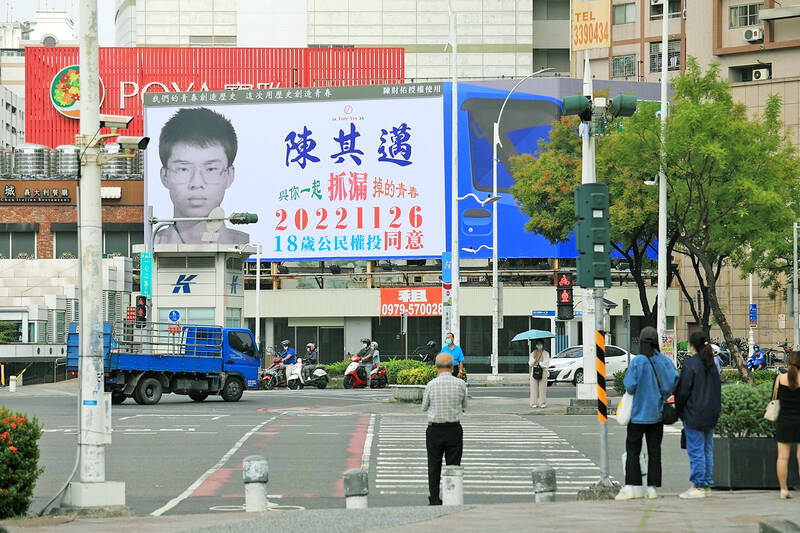
Photo: Wang Jung-hsiang, Taipei Times
Swing voters would be key in ratifying the proposed constitutional amendment, as 16 percent of that demographic remains undecided on the issue and more than 50 percent of them said they did not know the referendum would be on the ballot, he said.
Voting rights supporters should redouble their efforts to raise awareness and support for the amendment in the month that remains before the elections, he said.
People, groups and political parties that support lowering the voting age should prepare strategies to push through the referendum, he said, adding that now is the time for parties to show genuine commitment to the amendment.
The survey showed that popular support for the proposition has surged by 1 million voters from a previous poll in August, which showed only 39.5 percent of respondents approved of the initiative, Taiwan Youth Association for Democracy president Alvin Chang (張育萌) said.
“This is a heartening development, and it means we are a small step away from reaching the threshold,” he said, adding that pro-amendment candidates would move the needle if current trends hold.
The referendum should be as prominently featured in election campaigns as the names of candidates running for office, he said in a call for allies to communicate with voters about the issue at a grassroots level.
The voting age should be the same as the age of majority and eligibility for military conscription, said Lin Yu-sheng (林于聖), deputy secretary-general of the Taiwan Alliance for Advancement of Youth Rights and Welfare.
Cross-analysis of the data showed that the more informed a respondent was about the referendum, the more likely they were to express support for it, which means that increasing awareness is the way forward, he said.
Focus Survey Research conducted the survey from Oct. 13 to Oct. 16 in telephone interviews of people aged 20 or older. It collected 1,492 valid samples at a confidence level of 95 percent, with a margin of error of 2.54 percentage points.

Considering that most countries issue more than five denominations of banknotes, the central bank has decided to redesign all five denominations, the bank said as it prepares for the first major overhaul of the banknotes in more than 24 years. Central bank Governor Yang Chin-lung (楊金龍) is expected to report to the Legislative Yuan today on the bank’s operations and the redesign’s progress. The bank in a report sent to the legislature ahead of today’s meeting said it had commissioned a survey on the public’s preferences. Survey results showed that NT$100 and NT$1,000 banknotes are the most commonly used, while NT$200 and NT$2,000

The Centers for Disease Control (CDC) yesterday reported the first case of a new COVID-19 subvariant — BA.3.2 — in a 10-year-old Singaporean girl who had a fever upon arrival in Taiwan and tested positive for the disease. The girl left Taiwan on March 20 and the case did not have a direct impact on the local community, it said. The WHO added the BA.3.2 strain to its list of Variants Under Monitoring in December last year, but this was the first imported case of the COVID-19 variant in Taiwan, CDC Deputy Director-General Lin Ming-cheng (林明誠) said. The girl arrived in Taiwan on

South Korea is planning to revise its controversial electronic arrival card, a step Taiwanese officials said prompted them to hold off on planned retaliatory measures, a South Korean media report said yesterday. A Yonhap News Agency report said that the South Korean Ministry of Foreign Affairs is planning to remove the “previous departure place” and “next destination” fields from its e-arrival card system. The plan, reached after interagency consultations, is under review and aims to simplify entry procedures and align the electronic form with the paper version, a South Korean ministry official said. The fields — which appeared only on the electronic form

The Ministry of Foreign Affairs (MOFA) is suspending retaliation measures against South Korea that were set to take effect tomorrow, after Seoul said it is updating its e-arrival system, MOFA said today. The measures were to be a new round of retaliation after Taiwan on March 1 changed South Korea's designation on government-issued alien resident certificates held by South Korean nationals to "South Korea” from the "Republic of Korea," the country’s official name. The move came after months of protests to Seoul over its listing of Taiwan as "China (Taiwan)" in dropdown menus on its new online immigration entry system. MOFA last week


 RSS
RSS