


Taipei police said they had begun an investigation into a gang-related shooting after a hostage situation on Wednesday night that left the alleged shooter dead and four people injured.
Police had identified the suspect in the shooting in Taipei’s Wanhua District (萬華) as Chiu Kuo-lung (邱國隆), an alleged member of the Wan Guo gang, Wanhua Precinct Police Chief Hsieh Tsung-hung (謝宗宏) told a news conference.
Chiu, 54, took his own life at the end of a shooting spree, Hsieh said.
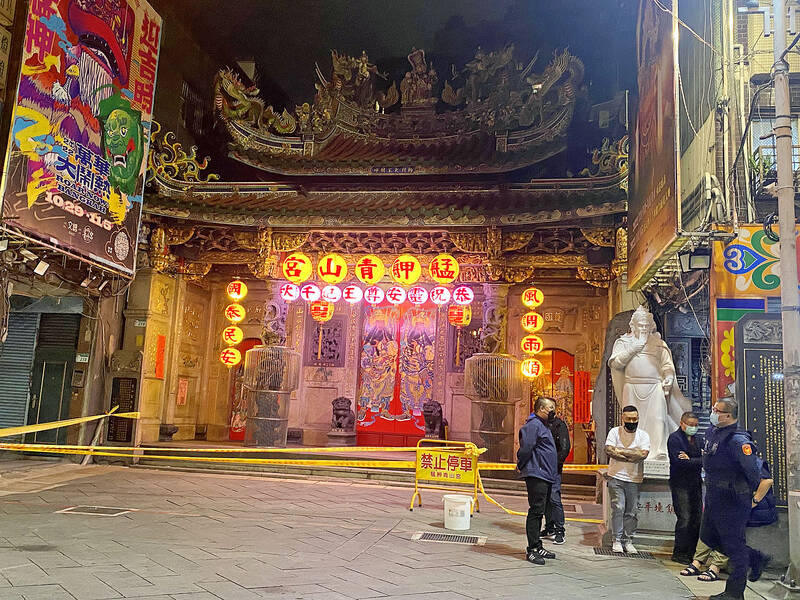
Photo: CNA
Police said the incident began at 7:26pm, when Chiu arrived at a residence on Hankou Street for a meeting with alleged Wan Guo leader Hung Ching-cheng (洪清正) and another gang member.
After an unspecified “disagreement,” Chiu shot the two others, hitting one nine times — once in the back, once in the right arm and seven times in the legs — and the second man in the back and all four limbs, police said.
Chiu then fled to the nearby Bangka Qingshan Temple on Guiyang Street, where he sought to speak with the temple’s vice chairperson, surnamed Hsu (許), Hsieh said.
However, Hsu refused to help him, and Chiu allegedly shot him three times and then took four people hostage — Hsu’s wife, son and daughter, and an unidentified friend of the family — at a storefront across from the temple, police said.
After arriving at the scene at 7:50pm, police engaged in a standoff with Chiu, during which one officer, attending to the injured temple official, was shot in the thigh, police said.
At 8:50pm, Chiu gradually began releasing the hostages, they said.
Hsu’s daughter — who was released first and exited the storefront holding a white flag — told police that Chiu was planning to kill himself, police said.
After releasing all four hostages, Chiu walked out of the building and shot himself in the head, police said.
He was rushed to a hospital and pronounced dead at 10:09pm, they added.
Late on Wednesday, Hsieh said initial evidence suggested the incident stemmed from a dispute between gangs.
Hsieh said police would begin interrogating witnesses to determine Chiu’s motives and find out how he had obtained a gun.
Hours after the hostage situation, Chinese-language media reported that Chiu’s Facebook account at 7pm posted a photograph of him with his son and daughter.
The post said that Chiu’s “time is up,” and that his children should take care of themselves and their mother.
“Daddy will always love both of you. Grow up to be good people, not like your dad,” the post said.
At about 8pm, the account responded to comments under the post and explained Chiu’s motives for the shootings.
One of the comments said that more than a year ago, Chiu pulled a gun on an unspecified individual who had been bullying a friend of his.
Since the incident in Taipei’s Ximending (西門町) area, the person had been harassing Chiu in a constant “game of cat and mouse,” the comment said.
“I’ve failed my kids, failed society. I have no choice,” the comment added. “When it’s time to go, it’s time to go.”
Police said they believed Chiu’s post referred to a confrontation last year between him and a member of the He Gou Tou gang, who was not one of those injured in Wednesday’s shootings.
Meanwhile, the shooting of Hung and the temple official appeared to stem from an incident earlier this year in which Chiu allegedly got into a fistfight, and he later blamed the two men, who had tried to mediate the fight, for not siding with him, police said.
As of yesterday morning, all four people injured in the incident were in stable condition and receiving treatment at hospitals in Taipei.
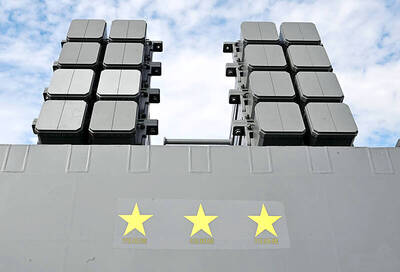
UPGRADE: The Kang Ding-class frigate is replacing its Chaparall missiles with Tien Chien II and Hua Yang VLS, which would provide it with long-range, 360° air defense Taiwan plans to produce 1,200 to 1,376 Hai Chien II missiles (海劍二, Sea Sword II) — also known as TC-2N — to serve as the standard air defense system of the navy’s surface combatant fleet, a source said yesterday. Last week, the Hai Chien II, the naval version of the Tien Kung II missile (天劍二, Sky Sword II), completed a live-fire test in waters off the National Chungshan Institute of Science and Technology’s Jiupeng facility (九鵬) in Pingtung County’s Manjhou Township (滿州). The MIM72 Chaparral and other dated air defense missiles that currently arm Taiwanese ships have inadequate range to combat Chinese

REASONS FOR TRAVEL: An assistant professor said that proposed amendments to penalize drivers if they used drugs overseas would not deter people from traveling People who operate a motor vehicle under the influence of marijuana would have their driver’s license revoked, even if they used the substance while overseas, the Ministry of Transportation and Communications said yesterday, citing proposed amendments to the Road Traffic Management and Penalty Act (道路交通管理處罰條例). The amendments would also authorize the government to revoke the licenses of people determined to have used Category 1 or Category 2 narcotics, even if they were not operating a vehicle while under the influence of drugs, as well as ban them from taking the license test for three years, the ministry said. People aged 18 or

HEAVY WEATHER: Typhoon Jangmi is due to crash straight into the Ryukyus as airlines look to shift flights to larger aircraft or cancel flights to Okinawa entirely Taiwan’s international air carriers announced flight adjustments over the weekend as Typhoon Jangmi is forecast to hit the Ryukyu Islands today and tomorrow. The Central Weather Administration (CWA) upgraded Jangmi from a tropical storm to a typhoon at 8am yesterday, with the eye located 580km south of Naha city. It was moving north at 19kph. Today, China Airlines’ CI-120, CI-121, CI-122 and CI-123 flights between Taoyuan and Naha, Okinawa, have been canceled as well as CI-132 and CI-133 between Kaohsiung and Naha. EVA Air’s BR-112, BR-113, BR-186 and BR-185 flights between Taoyuan and Naha are also canceled. Low-cost carrier Tigerair Taiwan canceled IT-230,
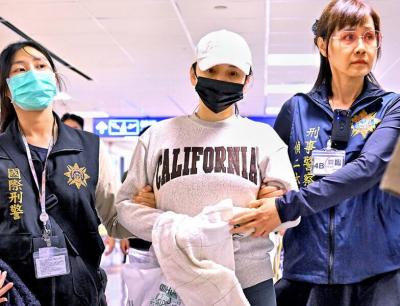
Johanne Liou (劉喬安), a Taiwanese woman who shot to unwanted fame during the Sunflower movement protests in 2014, returned to Taiwan last night after being deported from the US. She is to stand trial in Taiwan for charges involving embezzlement, fraud and drug crimes. The Criminal Investigation Bureau (CIB) said it took her into custody at Taiwan Taoyuan International Airport and would first question her before transferring her to the New Taipei District Prosecutors’ Office. She was arrested upon disembarking a flight from San Francisco that landed shortly before 7pm. Liou absconded to the US in 2019 after jumping bail


 RSS
RSS