


The nation’s first COVID-19 cases infected with the Omicron XBB and BQ.1.1 subvariants of SARS-CoV-2 have been identified among inbound travelers, the Central Epidemic Command Center (CECC) said yesterday.
It also said the daily caseload fell 10.2 percent from a week earlier.
Genome sequencing was conducted on 41 virus samples collected from local cases last week, and the results showed that 98 percent were infected with the Omicron BA.5 subvariant and 2 percent with BA.2, said Centers for Disease Control (CDC) Deputy Director-General Philip Lo (羅一鈞), deputy head of the CECC’s medical response division.

Photo courtesy of the Central Epidemic Command Center
As the BA.5 strain now accounts for the absolute majority of local cases, the CECC would pay extra attention to the spread of emerging variants in other countries, as well as their detection among imported cases, he said.
The center also conducted genome sequencing on samples collected from 59 imported cases last week, Lo said.
Of those, 76 percent were infected with BA.5, 10 percent with BA.2.75, 7 percent with BA.2, 5 percent with BA.4.6 and 2 percent with BF.7, he said.
Lo said BF.7 is an emerging subvariant that has been causing more infections in China, Europe and the US.
It has a high transmission rate and better immune escape than other subvariants, he said.
Of the four BF.7 cases detected among inbound travelers, two were from the US, one was from France and another was from the Netherlands, he added.
Late last month, two travelers from Germany and the Netherlands were identified to have the BQ.1.1 subvariant, while a traveler from Hong Kong was identified to have the XBB subvariant, Lo said.
BF.7 and BQ.1.1 are subvariants of BA.5, he said, adding that the BQ.1.1 cases are mostly reported in Europe and the US, while the XBB subvariant is mostly reported in Southeast Asia, including Singapore, where it accounts for more than half of the local cases.
Three characteristics observed in the emerging subvariants are higher transmissibility, increased immune escape and mutations to resist monoclonal antibody therapy, he said.
“It is still difficult to predict which emerging subvariant would replace BA.5 to become the next predominant strain,” he said.
The best way to prevent infection is to stay up to date with COVID-19 vaccines, especially as the bivalent vaccine booster is adapted for Omicron and would provide some protection against the new Omicron subvariants, Lo said.
The new subvariants have not yet been found to cause more severe illness or deaths, but people should still take preventive measures, especially if they are planning to travel abroad, he said.
CDC Director-General Chou Jih-haw (周志浩), head of the CECC’s disease surveillance division, said 28,806 new local infections, 41 imported cases and 53 deaths were confirmed yesterday.
The local caseload fell 10.2 percent from Monday last week, which is a good sign, but people should stay vigilant, as the local COVID-19 situation remains on a plateau, Chou said.
Meanwhile, Deputy Minister of Health and Welfare Victor Wang (王必勝), who heads the CECC, denied a rumor that each dose of the locally made Medigen COVID-19 vaccine cost about NT$1,000.
Commenting on speculation that an overdue fine was not imposed on Medigen for delivering vaccines more than 30 days behind schedule, Wang said the company had been fined according to its contract with the government when the doses were checked and received on March 24.
When Medigen obtained emergency use authorization for its COVID-19 vaccine last year, the Food and Drug Administration required it to submit a report on effectiveness of the vaccine based on overseas and domestic trials within a year, Wang said.
The agency has received the report, but asked for additional data, he said, adding that it would conduct a review after receiving the information.
As for the National Audit Office listing five flaws in the procurement process of COVID-19 vaccines in its report to the Legislative Yuan, including not complying with the Government Procurement Act (政府採購法), Wang said the vaccines were purchased under an emergency rule according to a special act.

FUKUOKA SITUATION: Japanese media reported that the pathogen is expected to be identified by the summer, while the CDC downplayed the idea that it was hMPV A “mysterious cold-like illness” reported in Japan’s Fukuoka Prefecture does not seem to be a new disease, but Japanese authorities have been asked about the situation, the Centers for Disease Control (CDC) said yesterday. The Fukuoka Prefectural Medical Association on Wednesday told a news conference that a “mystery cold” that has become a hot topic on social media is “highly likely to be caused by some kind of viral infection,” Japan’s KBC News reported. “Many people are experiencing symptoms starting with a sore throat, followed by a runny nose, phlegm and a severe cough,” KBC News reported, citing association officials. Health authorities are

Nvidia Corp CEO Jensen Huang (黃仁勳) arrived in Taiwan yesterday ahead of upcoming AI and technology events, saying he plans to meet with clients and Taiwan Semiconductor Manufacturing Co Chairman C.C. Wei (魏哲家) during his visit. After landing at Taipei Songshan Airport, Huang posed for photos with fans and handed out Yakult drinks to reporters and supporters waiting at the scene, saying he has “a lot to do” during the trip. Asked about reports that Nvidia’s planned headquarters site in Taipei’s Beitou Shilin Technology Park could break ground on May 27, Huang said that if the company holds an event, he would

The Ministry of Finance this afternoon announced the winning numbers for the March-April uniform invoice lottery. The winning number for the NT$10 million (US$318,060) special prize is 19531471, and the winning number for the NT$2 million grand prize is 85941329. Three numbers were drawn for the NT$200,000 first prize: 07225810, 20231230 and 83518781. Those with receipts matching the last seven digits of any of the first-prize numbers will win the NT$40,000 second prize, while those matching the last six digits will win the NT$10,000 third prize. Those whose receipts match the last five digits of the first-prize numbers can claim the NT$4,000 fourth prize,
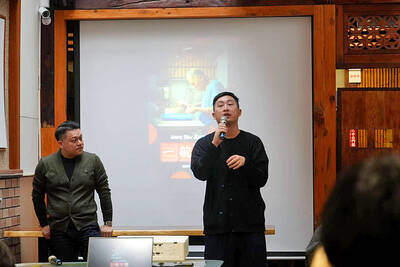
Taiwan Travelogue (臺灣漫遊錄), which earlier this week became the first Taiwanese novel to win the International Booker Prize, is to be adapted into a television series through a Taiwan-Japan coproduction, producer Chang Chen-yu (張辰漁) said yesterday. Chang, a producer at World Softest Production Film Co, wrote on Facebook that the company had been searching for projects with international appeal that retain a strong Taiwanese identity after colleagues and Japanese partners strongly recommended the novel. After reading the book, Chang said he immediately decided to pursue the screen rights. “A great story has the power to transcend time and borders, and connect countless people,”


 RSS
RSS