


The three main candidates in the race for Taipei mayor yesterday wrangled over the purchase of COVID-19 vaccines and quarantine hotels.
Independent candidate Vivian Huang (黃珊珊), a former Taipei deputy mayor who is endorsed by the Taiwan People’s Party (TPP), told an online political talk show that she still cannot forgive the central government for being guided by political ideology when weighing whether to purchase the Pfizer-BioNTech COVID-19 vaccine.
Her remarks came after she earlier this month published a book in which she presents “innovative” COVID-19 prevention measures, including quarantine hotels, disease prevention taxis and COVID-19 testing buses.
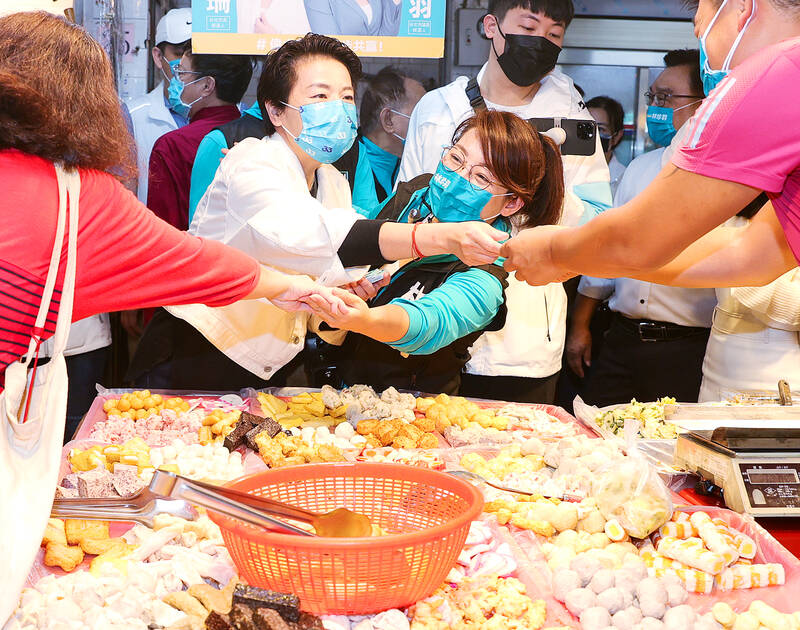
Photo: CNA
The central government made decisions on pandemic prevention with political gains for the Democratic Progressive Party (DPP) in mind, instead of focusing on protecting Taiwanese from the disease, Huang said yesterday, adding that the Taipei City Government was always the last to be informed about the availability of vaccines and disease prevention resources.
DPP Taipei mayoral candidate Chen Shih-chung (陳時中), who had headed the Central Epidemic Command Center (CECC) for most of the pandemic, said that Huang’s book plagiarized the government’s quarantine hotel concept.
Chen said that Deputy Minister of Health and Welfare Shih Chung-liang (石崇良) had the idea to quarantine people in hotels early in the pandemic and subsequently planned the central government’s quarantine policy.
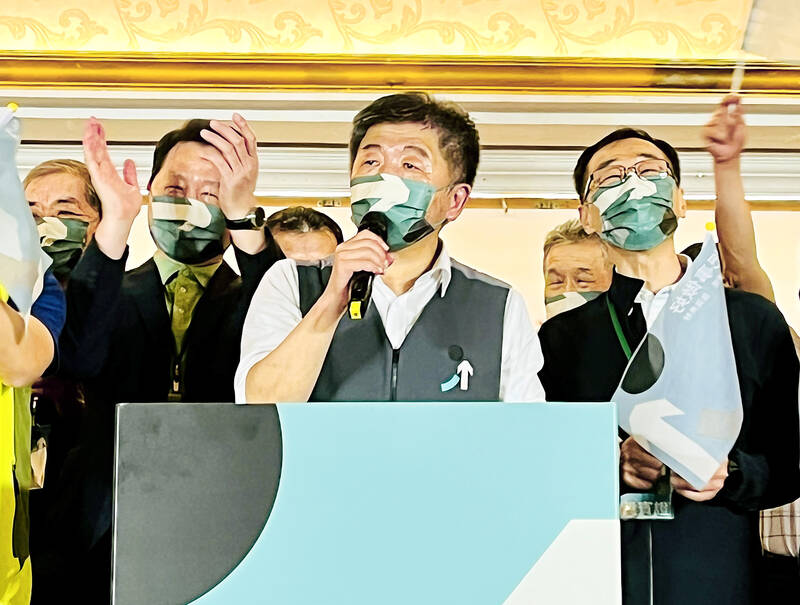
Photo: Chen Chia-yi, Taipei Times
The central government did not block the purchase of vaccines, Chuang said, adding that Huang, who had headed Taipei’s COVID-19 prevention efforts, distorts the truth in her book.
Chen said that when the Pfizer-BioNTech vaccine entered the international market, a Taiwanese company suggested that it can procure doses on behalf of the central government, but the company and a foreign producer of the vaccine could not agree on a deal.
The company’s contract with the producer, including prices, was disclosed to lawmakers at a closed-door meeting at the legislature, Chen said.
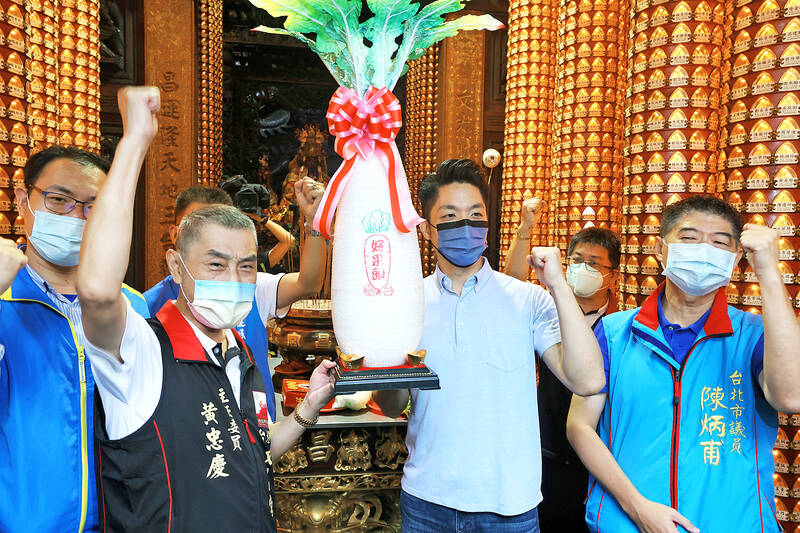
Photo: CNA
The government then contacted the producer directly and ordered 5 million doses, Chen said, but added that the two sides did not sign a deal because the drugmaker “had other ideas.”
The deal’s collapse was not within the government’s control, he added.
Chen said that in the five years he served as health minister, eight public health-related laws were enacted and 332 articles of public health laws were revised.
While heading the CECC for more two years, he went all-in to fight COVID-19, he added.
Chinese Nationalist Party (KMT) Legislator and Taipei mayoral candidate Chiang Wan-an (蔣萬安) said the CECC under Chen did not have an international perspective.
Instead, it pushed domestically made COVID-19 vaccines, such as the Medigen jab, which received emergency use authorization in a closed-door meeting without completing phase 3 clinical trials, Chiang said.
Lacking international recognition, the Medigen vaccine cannot be sold overseas and 1.7 million doses worth more than NT$1 billion (US$31.36 million) might have to be disposed of, he added.
Chen on Friday said that none of the review meetings ahead of the Medigen vaccine’s authorization had been recorded, as recording them might have discouraged academics and experts from stating their opinion or even participating, for fear of negative publicity.
The CECC therefore decided to only announce the result of the meetings, Chen said.
Separately, Taiwan yesterday reported 41,481 new local COVID-19 cases and 65 deaths from the disease, the CECC said.
Those who died were aged from their 30s to 90s, and all but one of them had underlying health issues, while 31 were unvaccinated, the center added.
With the deaths reported yesterday, the number of COVID-19 fatalities in the country since the pandemic began in early 2020 rose to 11,908, CECC data showed.
Taiwan has recorded 7,183,912 COVID-19 cases since the pandemic began, including 35,763 imported cases.

The military has spotted two Chinese warships operating in waters near Penghu County in the Taiwan Strait and sent its own naval and air forces to monitor the vessels, the Ministry of National Defense (MND) said. Beijing sends warships and warplanes into the waters and skies around Taiwan on an almost daily basis, drawing condemnation from Taipei. While the ministry offers daily updates on the locations of Chinese military aircraft, it only rarely gives details of where Chinese warships are operating, generally only when it detects aircraft carriers, as happened last week. A Chinese destroyer and a frigate entered waters to the southwest
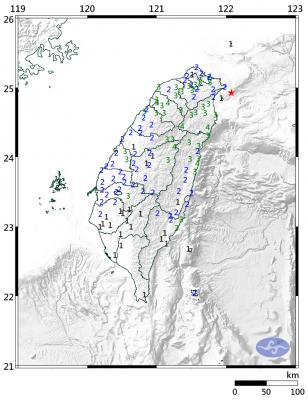
A magnitude 6.1 earthquake struck off the coast of Yilan County at 8:39pm tonight, the Central Weather Administration (CWA) said, with no immediate reports of damage or injuries. The epicenter was 38.7km east-northeast of Yilan County Hall at a focal depth of 98.3km, the CWA’s Seismological Center said. The quake’s maximum intensity, which gauges the actual physical effect of a seismic event, was a level 4 on Taiwan’s 7-tier intensity scale, the center said. That intensity level was recorded in Yilan County’s Nanao Township (南澳), Hsinchu County’s Guansi Township (關西), Nantou County’s Hehuanshan (合歡山) and Hualien County’s Yanliao (鹽寮). An intensity of 3 was
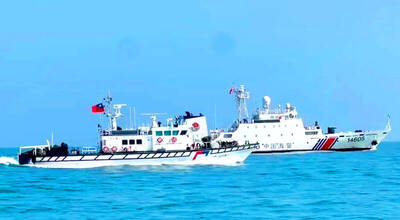
Instead of focusing solely on the threat of a full-scale military invasion, the US and its allies must prepare for a potential Chinese “quarantine” of Taiwan enforced through customs inspections, Stanford University Hoover fellow Eyck Freymann said in a Foreign Affairs article published on Wednesday. China could use various “gray zone” tactics in “reconfiguring the regional and ultimately the global economic order without a war,” said Freymann, who is also a nonresident research fellow at the US Naval War College. China might seize control of Taiwan’s links to the outside world by requiring all flights and ships entering or leaving Taiwan
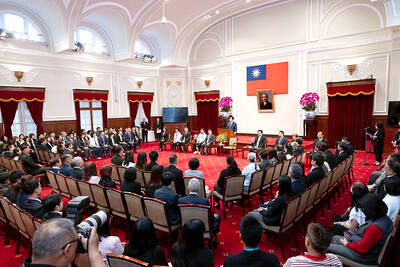
The next minimum wage hike is expected to exceed NT$30,000, President William Lai (賴清德) said yesterday during an award ceremony honoring “model workers,” including migrant workers, at the Presidential Office ahead of Workers’ Day today. Lai said he wished to thank the awardees on behalf of the nation and extend his most sincere respect for their hard work, on which Taiwan’s prosperity has been built. Lai specifically thanked 10 migrant workers selected for the award, saying that although they left their home countries to further their own goals, their efforts have benefited Taiwan as well. The nation’s industrial sector and small businesses lay


 RSS
RSS