


Ahead of Taiwan’s reopening of its borders yesterday, the operator of Taiwan Taoyuan International Airport on Wednesday said it was ready to welcome all foreign visitors, while many Taiwanese in China complained they were still unable to return home because air tickets were hard to come by, with only a few cross-strait flights available.
Effective yesterday, Taiwan lifted the COVID-19 quarantine requirement for all arrivals, but requires a seven-day period of self-health management, with the number of arrivals capped at 150,000 per week.
Operator Taoyuan International Airport Corp (TIAC) estimated that the number of inbound passengers would be 12,322, while the number of people departing from and transiting at the airport would be 6,238 and 5,586 respectively.
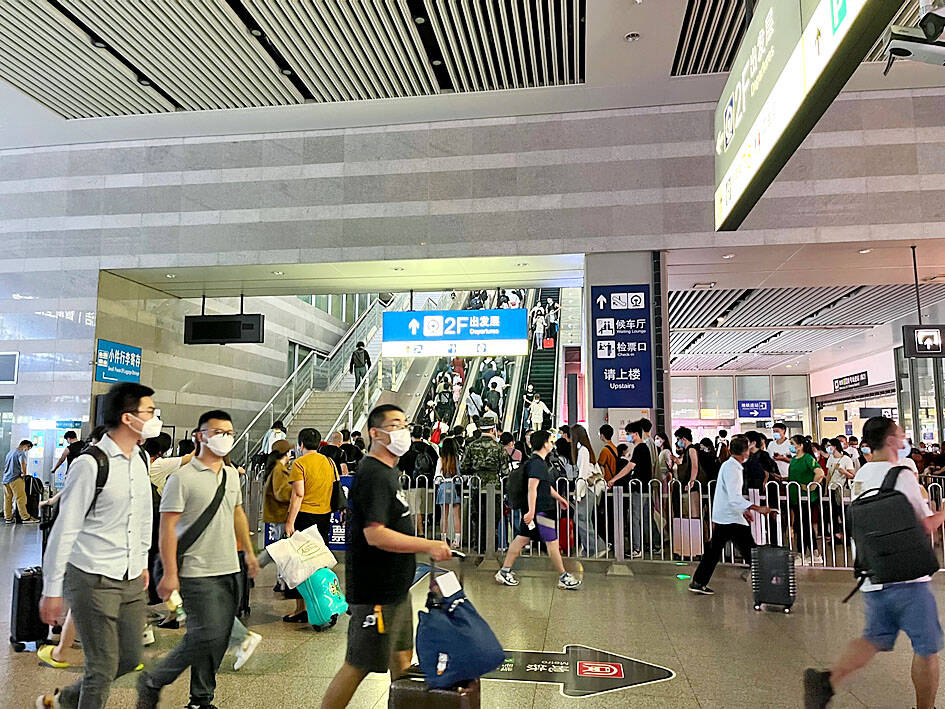
Photo: CNA
The number of passenger flights leaving and arriving that day would be 270, TIAC data showed.
The airport has modified relevant measures in response to the easing of border restrictions, including the cancelation of visitor health certificate reviews, and lifting the ban on shopping and dining for inbound passengers, TIAC president and CEO Fan Hsiao-lun (范孝倫) told reporters on Wednesday.
Other measures include reopening public service facilities such as showers, outdoor smoking rooms and the airport observation deck; and allowing asymptomatic inbound passengers to take public transportation, Fan said.
In an effort to have some facilities that were used for COVID-19 epidemic prevention restored to their previous state, nearly 600 cleaning staff were also mobilized to remove nearly 8,000 social-distancing floor stickers and seat stickers that were often seen during the outbreak, Fan said.
As for public transportation, Fan said that in the future, passengers arriving at or departing from the airport can choose to take the airport MRT, passenger bus, taxi, rental car, drive themselves in a car, or be picked up and dropped off by friends and relatives at the airport, he said.
Starting yesterday, taxis at Taoyuan airport also resumed charging fares based on the meter, while subsidies for taxis, buses and rental vehicles of the airport’s epidemic-prevention fleet used by inbound travelers were canceled, he said.
Fan added that the airport company had coordinated with commercial service providers at the airport to gradually restore their original operating scale.
With the gradual lifting of border restrictions, their operating scale has gradually recovered from about 30 to 40 percent during the outbreak to 50 to 60 percent, Fan said.
On the other hand, after learning about Taiwan’s new “0+7” COVID-19 policy, many Taiwanese businesspeople based in China’s Shanghai and Kunshan are discussing plans to return home, with some having not come back since the outbreak of COVID-19 in 2020.
However, the number of flights between Shanghai and Taiwan is still small, making it difficult to obtain an air ticket.
Even if there is an available seat, the fare is high, discouraging many Taiwanese businesspeople from returning home, said Tsai Shih-ming (蔡世明), a Taiwanese businessman in Shanghai.
Instead, some have decided to wait to return to Taiwan for the Lunar New Year holiday early next year when cross-strait flights are expected to return to normal, Tsai said.
The new measures that require incoming travelers to observe only seven days of self-health management are also expected to boost the passenger volume at Taoyuan airport.
In 2019, there was a record-high 48.68 million passengers who arrived at or departed from the airport, but the number dropped to 7.43 million in 2020 due to the COVID-19 outbreak and further fell to about 900,000 last year, Civil Aeronautics Administration (CAA) statistics showed.
The number of passengers using the airport began to rebound this year. For the first eight months of the year, the airport served 1.57 million passengers, CAA data showed.

The military has spotted two Chinese warships operating in waters near Penghu County in the Taiwan Strait and sent its own naval and air forces to monitor the vessels, the Ministry of National Defense (MND) said. Beijing sends warships and warplanes into the waters and skies around Taiwan on an almost daily basis, drawing condemnation from Taipei. While the ministry offers daily updates on the locations of Chinese military aircraft, it only rarely gives details of where Chinese warships are operating, generally only when it detects aircraft carriers, as happened last week. A Chinese destroyer and a frigate entered waters to the southwest
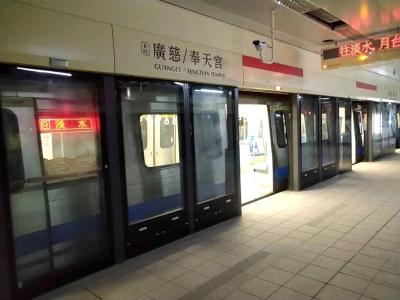
The eastern extension of the Taipei MRT Red Line could begin operations as early as late June, the Taipei Department of Rapid Transit Systems said yesterday. Taipei Rapid Transit Corp said it is considering offering one month of free rides on the new section to mark its opening. Construction progress on the 1.4km extension, which is to run from the current terminal Xiangshan Station to a new eastern terminal, Guangci/Fengtian Temple Station, was 90.6 percent complete by the end of last month, the department said in a report to the Taipei City Council's Transportation Committee. While construction began in October 2016 with an
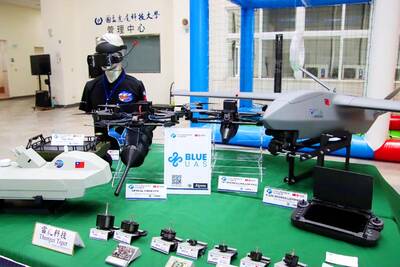
NON-RED SUPPLY: Boosting the nation’s drone industry is becoming increasingly urgent as China’s UAV dominance could become an issue in a crisis, an analyst said Taiwan’s drone exports to Europe grew 41.7-fold from 2024 to last year, with demand from Ukraine’s fight against Russian aggression the most likely driver of growth, a study showed. The Institute for Democracy, Society and Emerging Technology (DSET) in a statement on Wednesday said it found that many of Taiwan’s uncrewed aerial vehicle (UAV) sales were from Poland and the Czech Republic. These countries likely transferred the drones to Ukraine to aid it in its fight against the Russian invasion that started in 2022, it said. Despite the gains, Taiwan is not the dominant drone exporter to these markets, ranking second and fourth
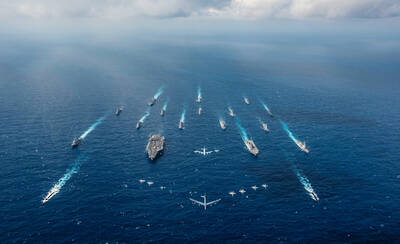
Japanese Prime Minister Sanae Takaichi’s comment last year on Tokyo’s potential reaction to a Taiwan-China conflict has forced Beijing to rewrite its invasion plans, a retired Japanese general said. Takaichi told the Diet on Nov. 7 last year that a Chinese naval blockade or military attack on Taiwan could constitute a “survival-threatening situation” for Japan, potentially allowing Tokyo to exercise its right to collective self-defense. Former Japan Ground Self-Defense Force general Kiyofumi Ogawa said in a recent speech that the remark has been interpreted as meaning Japan could intervene in the early stages of a Taiwan Strait conflict, undermining China’s previous assumptions


 RSS
RSS