


The border reopening plan remains unchanged, even though 49,509 new domestic COVID-19 infections were reported, the second-highest since the wave of cases involving the Omicron BA.5 subvariant of SARS-CoV-2 began in August, the Central Epidemic Command Center (CECC) said yesterday.
Centers for Disease Control (CDC) Deputy Director-General Chuang Jen-hsiang (莊人祥), who is the CECC’s spokesman, said that 49,509 new local cases, 65 imported cases and 31 deaths were confirmed yesterday.
He said the local daily caseload was 8.6 percent higher than that reported on Tuesday last week and the second-highest daily count of the Omicron BA.5 outbreak, only slightly lower than the peak of 49,540 cases reported on Sept. 14.
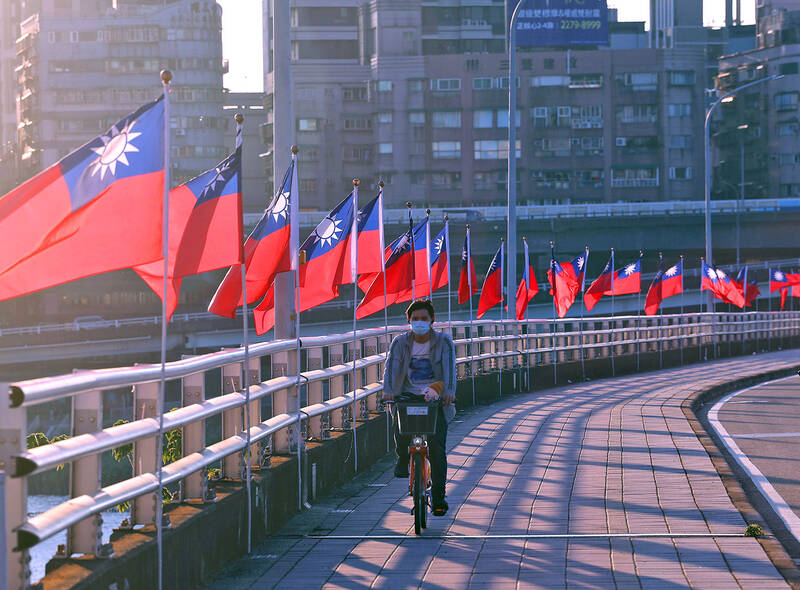
Photo: CNA
The CECC previously predicted that the peak of the Omicron BA.5 outbreak had passed and Chuang, when asked if the peak could be in the next few days, said it was possible, but generally the situation is at a plateau.
He said the fluctuations in daily caseloads has not affected plans for the nation’s border to be reopened on Thursday next week.
CDC Deputy Director-General Philip Lo (羅一鈞), deputy head of the CECC’s medical response division, said 9,219 courses of oral antiviral drugs — 7,291 courses of Paxlovid and 1,928 courses of molnupiravir — were prescribed on Monday, the highest number since August.
There is still about one month of Paxlovid and three months of molnupiravir in stock, so physicians do not have to worry about prescribing the antivirals to patients who are eligible to take them, he said, adding that the CECC had already ordered 400,000 more courses of Paxlovid which are expected to arrive in batches starting this week.
Meanwhile, on Monday it was reported that Chinese Nationalist Party (KMT) and Taiwan People’s Party legislators had questioned why the CDC proposed an exceptionally high disease prevention budget of NT$84.5 billion (US$2.66 billion) for next year, which is about four-and-a-half times the NT$18.7 billion budget this year.
In response, Chuang said that COVID-19 prevention and response funding in the past three years came mainly from the NT$840 billion special budget allocated based on the Special Act for Prevention, Relief and Revitalization Measures for Severe Pneumonia with Novel Pathogens (嚴重特殊傳染性肺炎防治及紓困振興特別條例), but that the prevention and response budget for next year must be included in the CDC’s annual operating budget.
He said that the COVID-19 prevention and response budget allocated this year was NT$94.3 billion — NT$75.6 billion from the special budget and NT$18.7 billion from the CDC’s annual operating budget — so the proposed budget of NT$84.5 billion is actually NT$9.8 billion less than this year.

FUKUOKA SITUATION: Japanese media reported that the pathogen is expected to be identified by the summer, while the CDC downplayed the idea that it was hMPV A “mysterious cold-like illness” reported in Japan’s Fukuoka Prefecture does not seem to be a new disease, but Japanese authorities have been asked about the situation, the Centers for Disease Control (CDC) said yesterday. The Fukuoka Prefectural Medical Association on Wednesday told a news conference that a “mystery cold” that has become a hot topic on social media is “highly likely to be caused by some kind of viral infection,” Japan’s KBC News reported. “Many people are experiencing symptoms starting with a sore throat, followed by a runny nose, phlegm and a severe cough,” KBC News reported, citing association officials. Health authorities are

Nvidia Corp CEO Jensen Huang (黃仁勳) arrived in Taiwan yesterday ahead of upcoming AI and technology events, saying he plans to meet with clients and Taiwan Semiconductor Manufacturing Co Chairman C.C. Wei (魏哲家) during his visit. After landing at Taipei Songshan Airport, Huang posed for photos with fans and handed out Yakult drinks to reporters and supporters waiting at the scene, saying he has “a lot to do” during the trip. Asked about reports that Nvidia’s planned headquarters site in Taipei’s Beitou Shilin Technology Park could break ground on May 27, Huang said that if the company holds an event, he would

Carrefour Taiwan is to begin using a new name from the start of July, but it cannot divulge the name until then, the chairman of the supermarket chain's parent company said today. President Chain Store Co chairman Lo Chih-hsien (羅智先) was asked by reporters after a shareholders' meeting to confirm whether the company has settled on a new name for the supermarket brand. In March, the government-registered name of two Carrefour Taiwan branches was quietly changed to "Le Chia Kang" (樂家康) in Chinese, raising speculation that has been selected as the name. Lo said that because of local regulations and contractual obligations, the

The Philippines would likely be involved in any conflict over Taiwan due to its proximity to the democracy claimed by China, President Ferdinand Marcos Jr said, reiterating a stance that risks angering Beijing. “In the Philippines, we do not have a choice because Taiwan is so close to the Philippines and we have almost 200,000 Filipino nationals living and working in Taiwan,” Marcos said in an interview with Japanese media in Manila on Monday. The Philippine leader’s comments come ahead of a state visit to Japan next week, where he is to meet with Japanese Prime Minister Sanae Takaichi to discuss security


 RSS
RSS