


Poor supervision of a school that had improper dress codes and implemented corporal punishment prompted a Control Yuan censure yesterday of the Yunlin County Department of Education.
Civic groups in February last year reported that Yuan Ming Junior High School illegally imposed corporal punishment and restrictions on hairstyles, Control Yuan member Yeh Ta-hua (葉大華) told a news conference in Taipei.
An investigation conducted by Yeh and Control Yuan member Lai Ting-ming (賴鼎銘) found that the issues were first reported to the Ministry of Education’s K-12 Education Administration in May 2020, but the Yunlin department failed to launch an investigation, she said.
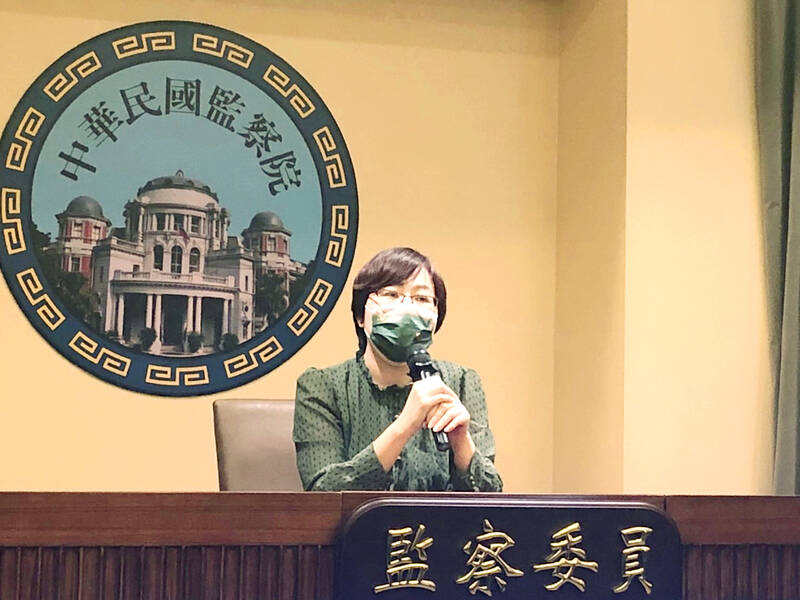
Photo: CNA
The department did not order the school to revise its regulations until the ministry introduced new dress code policies on Aug. 3, 2020, Yeh said.
The department conducted an on-site inspection and found that the school required short hair for male students, contravening Article 21 of the Observations on the Notice Governing Educators’ Teaching and Punishing of Students as Defined by Schools (學校訂定教師輔導與管教學生辦法注意事項), she said.
The school also had regulations regarding underwear, socks and shoes, while the process for electing members of its dress code committee contravened the Principles for Making Regulations on Students’ Clothing and Appearance in Junior High Schools (國民中學訂定學生服裝儀容規定之原則), Yeh said.
The school advised female students to wear light-colored underwear, which might be against the Gender Equity Education Act (性別平等教育法), she said.
The department asked 60 students at the school about corporal punishment, with four saying they had received it “almost every day” and nine saying it happened to them “almost every week,” she said.
The punishments they described constituted physical or mental abuse according to the UN Convention on the Rights of the Child, she added.
The school convened a meeting regarding the issues, but determined that they were not serious or were reasonable teaching methods, Yeh said.
The meeting concluded that the six teachers involved did not act in breach of the Teachers’ Act (教師法), she added.
Expressing doubts regarding the meeting’s conclusions, the K-12 agency ordered a follow-up meeting, which gave four of the six teachers a warning, Yeh said.
The Yunlin department was censored for its poor supervision of the school and not properly investigating the issues, she said.

FUKUOKA SITUATION: Japanese media reported that the pathogen is expected to be identified by the summer, while the CDC downplayed the idea that it was hMPV A “mysterious cold-like illness” reported in Japan’s Fukuoka Prefecture does not seem to be a new disease, but Japanese authorities have been asked about the situation, the Centers for Disease Control (CDC) said yesterday. The Fukuoka Prefectural Medical Association on Wednesday told a news conference that a “mystery cold” that has become a hot topic on social media is “highly likely to be caused by some kind of viral infection,” Japan’s KBC News reported. “Many people are experiencing symptoms starting with a sore throat, followed by a runny nose, phlegm and a severe cough,” KBC News reported, citing association officials. Health authorities are

Nvidia Corp CEO Jensen Huang (黃仁勳) arrived in Taiwan yesterday ahead of upcoming AI and technology events, saying he plans to meet with clients and Taiwan Semiconductor Manufacturing Co Chairman C.C. Wei (魏哲家) during his visit. After landing at Taipei Songshan Airport, Huang posed for photos with fans and handed out Yakult drinks to reporters and supporters waiting at the scene, saying he has “a lot to do” during the trip. Asked about reports that Nvidia’s planned headquarters site in Taipei’s Beitou Shilin Technology Park could break ground on May 27, Huang said that if the company holds an event, he would

Carrefour Taiwan is to begin using a new name from the start of July, but it cannot divulge the name until then, the chairman of the supermarket chain's parent company said today. President Chain Store Co chairman Lo Chih-hsien (羅智先) was asked by reporters after a shareholders' meeting to confirm whether the company has settled on a new name for the supermarket brand. In March, the government-registered name of two Carrefour Taiwan branches was quietly changed to "Le Chia Kang" (樂家康) in Chinese, raising speculation that has been selected as the name. Lo said that because of local regulations and contractual obligations, the
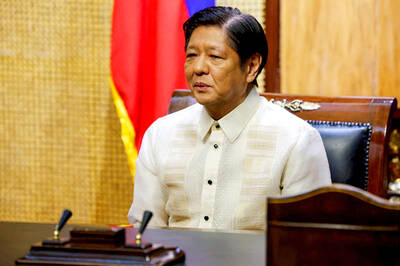
The Philippines would likely be involved in any conflict over Taiwan due to its proximity to the democracy claimed by China, President Ferdinand Marcos Jr said, reiterating a stance that risks angering Beijing. “In the Philippines, we do not have a choice because Taiwan is so close to the Philippines and we have almost 200,000 Filipino nationals living and working in Taiwan,” Marcos said in an interview with Japanese media in Manila on Monday. The Philippine leader’s comments come ahead of a state visit to Japan next week, where he is to meet with Japanese Prime Minister Sanae Takaichi to discuss security


 RSS
RSS