


Government partnerships with academia and enterprises are key to achieving net zero emissions by 2050, President Tsai Ing-wen (蔡英文) said yesterday at the founding of the nation’s first academy dedicated to the circular economy.
The National Chung Hsing University Academy of Circular Economy in Nantou County is the first educational institution of its kind to be established in Taiwan and is to play a lead role in the nation’s efforts to tackle the challenges of climate change, the president said.
The academy is supported by 41 entrepreneurial partners to serve as the backbone of the national team for the development of net zero technologies, she said, adding that more research institutions are planned for the campus.
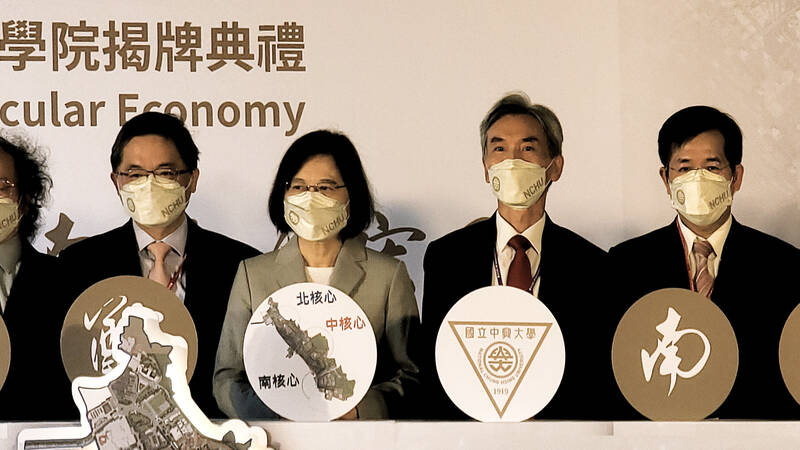
Photo: Tung Chen-kuo, Taipei Times
The creation of the Nantou campus of the Taichung-based university demonstrates the government’s commitment to developing a workforce and technology for the Taiwanese economy to thrive, she said.
Other research institutes would be established at the Nantou campus to provide the education the country needs to create to build a high-tech workforce, she said.
The Nantou campus is in Jhongsing New Village (中興新村), the former seat of the now-defunct Taiwan Provincial Government, university president Shieu Fuh-sheng (薛富盛) said.
As a former economic and political node, the township’s highly developed economic zone lacks only an institution of higher learning, which the founding of the campus would provide, he said.
The Academy of Circular Economy — established under Taipei’s directive to boost industry-university collaboration in key technological fields — would become Asia’s first research institute for new agriculture, digital and green semiconductor technologies, he said.
Taiwan Semiconductor Manufacturing Co and other major corporations are assisting with the academy’s work to develop sustainable and zero emission technologies, he said.
Over the next decade, the university plans to continue expanding the campus to establish six academies, three research centers and other facilities, including an “ark” botanical garden, a museum of entomology, dorms, classroom buildings and labs, he said.
The creation of the campus can potentially remake Nantou into a tech industry powerhouse for Taiwan, Nantou County commissioner candidate Frida Tsai (蔡培慧) said, adding that she would boost green technologies and social welfare if elected.

NATIONAL SECURITY: Authorities are working to confirm the identities of the military personnel involved and investigating possible illegal conduct and regulatory violations Authorities are probing possible national security implications after Kinmen police and immigration officers on Sunday found a Chinese woman allegedly posing as a tourist while engaging in prostitution involving more than 10 military personnel. The woman, surnamed Chen (陳), has since been deported, authorities said, adding that investigators are still working to confirm the identities of those implicated, as the records only listed code names and aliases. The case stemmed from a report received by the Kinmen District Prosecutors’ Office on Friday last week from the Jinhu Precinct of the Kinmen County Police Bureau. On Sunday, police, along with the National Immigration

GLOBALGIVING: ‘ Caving to external pressure is not acceptable for an organization that has cultivated justice reform and human rights for 30 years,’ one NGO said A slew of non-government organizations (NGOs) have withdrawn from the GlobalGiving fundraising platform after it announced it would use “Chinese Taipei” instead of “Taiwan” from next month. The Taiwan Good Rice Association wrote on Facebook on Friday that it was informed on April 28 via a teleconference call of the change, which was made because the platform wanted to operate in China. Taiwan Good Rice is to terminate all cooperative relationships with GlobalGiving in response to the platform’s “unilateral and non-negotiable” decision to remove references to Taiwan, the NGO said. “Taiwan is in the official name of Taiwan Good Rice Association and the

HEAVY WEATHER: Typhoon Jangmi is due to crash straight into the Ryukyus as airlines look to shift flights to larger aircraft or cancel flights to Okinawa entirely Taiwan’s international air carriers announced flight adjustments over the weekend as Typhoon Jangmi is forecast to hit the Ryukyu Islands today and tomorrow. The Central Weather Administration (CWA) upgraded Jangmi from a tropical storm to a typhoon at 8am yesterday, with the eye located 580km south of Naha city. It was moving north at 19kph. Today, China Airlines’ CI-120, CI-121, CI-122 and CI-123 flights between Taoyuan and Naha, Okinawa, have been canceled as well as CI-132 and CI-133 between Kaohsiung and Naha. EVA Air’s BR-112, BR-113, BR-186 and BR-185 flights between Taoyuan and Naha are also canceled. Low-cost carrier Tigerair Taiwan canceled IT-230,
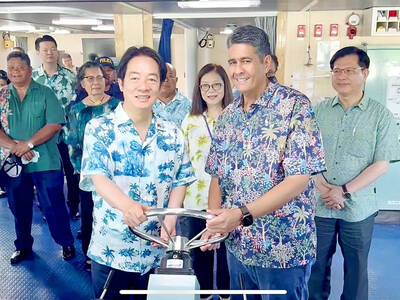
MULTIPRONGED APPROACH: China has sought to pressure Palau across a number of fronts, but the island nation has staunchly resisted overtures to ditch Taiwan Palau has been firm in backing Taiwan despite Chinese pressure that uses tourism economics, cyberattacks and criminal infiltration as tools to threaten the Pacific ally into renouncing its recognition of Taiwan as a sovereign state. The Presidential Office yesterday announced that Vice President Hsiao Bi-khim (蕭美琴) would visit Palau from Saturday to Wednesday next week at the invitation of Palauan President Surangel Whipps Jr. Whipps in April said in an interview that China had outspokenly asked Palau to “denounce Taiwan.” “And we have said: ‘We have no enemies, but nobody tells us who our friends are,’” he said. Whipps has told reporters multiple times


 RSS
RSS