


Filmmakers Lai Cheng-ying (賴成英) and Chang Chao-tang (張照堂) are to be honored with lifetime achievement awards at the 59th Golden Horse Awards on Nov. 19, the event’s executive committee said on Thursday last week.
Lai said that he was surprised and delighted to be named a recipient, adding that he would share the honor with those he had worked with in his decades-long career.
Chang said that he would use his achievement as the first documentary filmmaker to receive the award to appeal to movie lovers’ interest in documentaries.
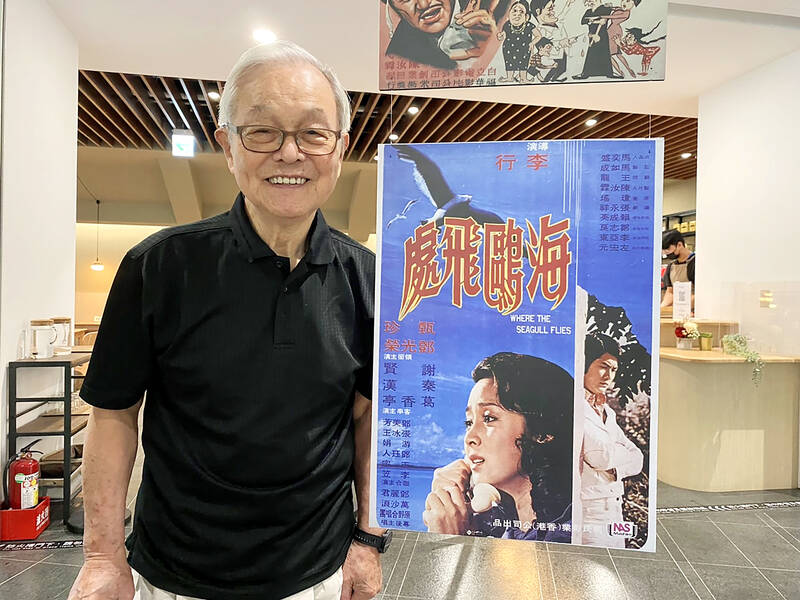
Photo courtesy of the Taiwan Film Institute via CNA
The two filmmakers have five Golden Horse Awards between them.
Lai, 92, made his initial foray into filmmaking as one of the first apprentices at Agriculture Education Motion Pictures, the predecessor to Central Motion Picture Corp, where he became one of the pioneers to help Taiwan’s movie industry transition to color after learning techniques in Japan.
Lai was a common collaborator with late director Lee Hsing (李行) — often hailed as the godfather of Taiwanese cinema.
For his work shooting in color, he won three Golden Horse Awards for Best Cinematography, Color, winning the first at the 3rd Golden Horse Awards in 1965 for Beautiful Duckling (養鴨人家), a second at the eighth awards ceremony in 1970 for Stardust (群星會) and a third at the 10th in 1972 for Execution in Autumn (秋決).
Lai branched out into directing, recruiting the likes of Taiwanese filmmaker Hou Hsiao-Hsien (侯孝賢) as his screenwriter and assistant director.
Chang, 78, transitioned from film cinematography to documentary filmmaking and videography education, influencing the likes of Australian-born Hong Kong cinematographer Christopher Doyle, and Taiwanese directors Chung Mong-hong (鍾孟宏) and Huang Hsin-yao (黃信堯).
Aside from making projects such as The Homecoming Pilgrimage of Dajia Mazu (大甲媽祖回娘家) and Face in Motion (剎那間的容顏), which have been hailed as two of Taiwan’s best documentaries, Chang’s Ancient House — Chinese Traditional Architecture (古厝) won him Best Documentary and Best Cinematography for a Documentary at the 17th Golden Horse Awards in 1980.
To help achieve his goal of cultivating more Taiwanese documentary talent, Chang became one of the founders of the Taiwan International Documentary Festival in 1998.
The popularity of the festival resulted in it becoming an annual event from May 2016.

NATIONAL SECURITY: Authorities are working to confirm the identities of the military personnel involved and investigating possible illegal conduct and regulatory violations Authorities are probing possible national security implications after Kinmen police and immigration officers on Sunday found a Chinese woman allegedly posing as a tourist while engaging in prostitution involving more than 10 military personnel. The woman, surnamed Chen (陳), has since been deported, authorities said, adding that investigators are still working to confirm the identities of those implicated, as the records only listed code names and aliases. The case stemmed from a report received by the Kinmen District Prosecutors’ Office on Friday last week from the Jinhu Precinct of the Kinmen County Police Bureau. On Sunday, police, along with the National Immigration

GLOBALGIVING: ‘ Caving to external pressure is not acceptable for an organization that has cultivated justice reform and human rights for 30 years,’ one NGO said A slew of non-government organizations (NGOs) have withdrawn from the GlobalGiving fundraising platform after it announced it would use “Chinese Taipei” instead of “Taiwan” from next month. The Taiwan Good Rice Association wrote on Facebook on Friday that it was informed on April 28 via a teleconference call of the change, which was made because the platform wanted to operate in China. Taiwan Good Rice is to terminate all cooperative relationships with GlobalGiving in response to the platform’s “unilateral and non-negotiable” decision to remove references to Taiwan, the NGO said. “Taiwan is in the official name of Taiwan Good Rice Association and the

HEAVY WEATHER: Typhoon Jangmi is due to crash straight into the Ryukyus as airlines look to shift flights to larger aircraft or cancel flights to Okinawa entirely Taiwan’s international air carriers announced flight adjustments over the weekend as Typhoon Jangmi is forecast to hit the Ryukyu Islands today and tomorrow. The Central Weather Administration (CWA) upgraded Jangmi from a tropical storm to a typhoon at 8am yesterday, with the eye located 580km south of Naha city. It was moving north at 19kph. Today, China Airlines’ CI-120, CI-121, CI-122 and CI-123 flights between Taoyuan and Naha, Okinawa, have been canceled as well as CI-132 and CI-133 between Kaohsiung and Naha. EVA Air’s BR-112, BR-113, BR-186 and BR-185 flights between Taoyuan and Naha are also canceled. Low-cost carrier Tigerair Taiwan canceled IT-230,

REASONS FOR TRAVEL: An assistant professor said that proposed amendments to penalize drivers if they used drugs overseas would not deter people from traveling People who operate a motor vehicle under the influence of marijuana would have their driver’s license revoked, even if they used the substance while overseas, the Ministry of Transportation and Communications said yesterday, citing proposed amendments to the Road Traffic Management and Penalty Act (道路交通管理處罰條例). The amendments would also authorize the government to revoke the licenses of people determined to have used Category 1 or Category 2 narcotics, even if they were not operating a vehicle while under the influence of drugs, as well as ban them from taking the license test for three years, the ministry said. People aged 18 or


 RSS
RSS