


A petition in Ukraine is urging Kyiv to establish reciprocal representative offices with Taipei as a sign of democratic solidarity.
The petition, posted on the Ukrainian president’s online portal on Monday last week, had 289 signatures as of press time last night.
It needs at least 25,000 signatures from Ukrainians within three months to merit a formal response.
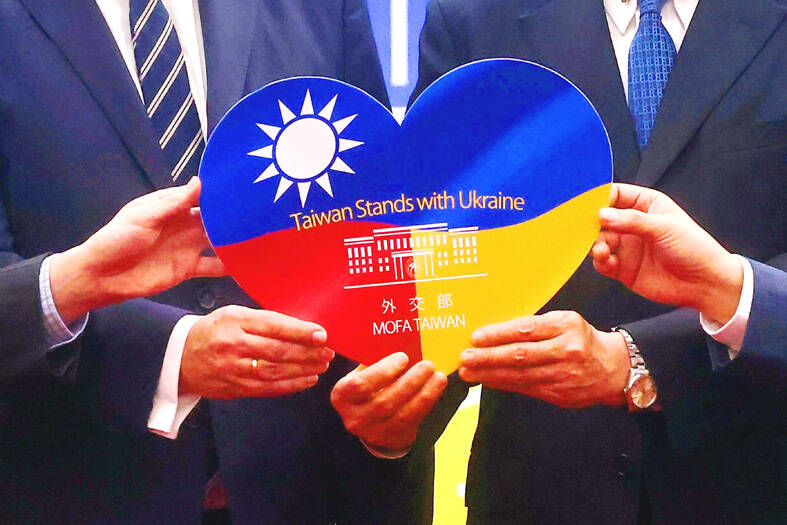
Photo: Ann Wang, Reuters
In explaining its position, the petition references enduring Taiwanese support for Ukraine since Russia launched a large-scale invasion in February, with Taipei issuing an official condemnation of Moscow’s actions, sanctions and material assistance to Ukrainians.
In contrast, the People’s Republic of China has refused to condemn Moscow’s actions and continues to deepen ties, while spreading Russian propaganda blaming the US and NATO for the war, it says.
Ukraine’s allies enjoy “stable interstate relations” with Taiwan through representative offices without officially recognizing its independence, it says.
Meanwhile, Ukraine has even less cooperation with Taipei than Russia, which has its own office in Taiwan, the petition says, calling the situation “absurd.”
“At a time when autocratic states such as Russia and China have challenged the sovereignty of democratic states such as Ukraine and Taiwan, it is important to deepen and strengthen ties between democracies,” it says.
“Ukraine should follow the path of our allies and establish interstate relations with the Republic of China (Taiwan)” by opening a commercial and cultural representative office in Taiwan and negotiating with Taipei to open an office in Ukraine, it adds.
Alex Khomenko, a Ukrainian living in Taiwan, on Sunday told the Liberty Times (sister paper of the Taipei Times) that this petition and the formation on Wednesday of a Ukraine-Taiwan parliamentary friendship group shows a desire among Ukrainians to recognize Taiwan for its support and the potential for bilateral cooperation.
Although it seems unlikely the petition would pass the signature threshold, Ukrainians are starting to recognize Taiwan’s efforts, he said.
More Ukrainians must be persuaded not to fear provoking China, he said, adding that he believes closer ties would eventually be possible.
Dmytro Burtsev, a visiting researcher at Academia Sinica’s Institute of European and American Studies, said that Ukrainians have been grateful for Taiwanese aid.
However, for a nation at war, establishing new diplomatic ties is a sensitive and complicated issue, he said.
Taiwan Stands With Ukraine and the Ukrainian community in Taiwan are planning a festival on Saturday to mark Ukrainian Independence Day, which is tomorrow.
The festival, to be held at Taipei Guting Lane Tailor (小巷裁縫酒吧) in Zhongzheng District (中正), is to feature an open-air “Ukrainian Village” with food, drinks, a flea market, workshops and performances.
All donations and proceeds are to benefit Ukraine.

NATIONAL SECURITY: Authorities are working to confirm the identities of the military personnel involved and investigating possible illegal conduct and regulatory violations Authorities are probing possible national security implications after Kinmen police and immigration officers on Sunday found a Chinese woman allegedly posing as a tourist while engaging in prostitution involving more than 10 military personnel. The woman, surnamed Chen (陳), has since been deported, authorities said, adding that investigators are still working to confirm the identities of those implicated, as the records only listed code names and aliases. The case stemmed from a report received by the Kinmen District Prosecutors’ Office on Friday last week from the Jinhu Precinct of the Kinmen County Police Bureau. On Sunday, police, along with the National Immigration

GLOBALGIVING: ‘ Caving to external pressure is not acceptable for an organization that has cultivated justice reform and human rights for 30 years,’ one NGO said A slew of non-government organizations (NGOs) have withdrawn from the GlobalGiving fundraising platform after it announced it would use “Chinese Taipei” instead of “Taiwan” from next month. The Taiwan Good Rice Association wrote on Facebook on Friday that it was informed on April 28 via a teleconference call of the change, which was made because the platform wanted to operate in China. Taiwan Good Rice is to terminate all cooperative relationships with GlobalGiving in response to the platform’s “unilateral and non-negotiable” decision to remove references to Taiwan, the NGO said. “Taiwan is in the official name of Taiwan Good Rice Association and the

HEAVY WEATHER: Typhoon Jangmi is due to crash straight into the Ryukyus as airlines look to shift flights to larger aircraft or cancel flights to Okinawa entirely Taiwan’s international air carriers announced flight adjustments over the weekend as Typhoon Jangmi is forecast to hit the Ryukyu Islands today and tomorrow. The Central Weather Administration (CWA) upgraded Jangmi from a tropical storm to a typhoon at 8am yesterday, with the eye located 580km south of Naha city. It was moving north at 19kph. Today, China Airlines’ CI-120, CI-121, CI-122 and CI-123 flights between Taoyuan and Naha, Okinawa, have been canceled as well as CI-132 and CI-133 between Kaohsiung and Naha. EVA Air’s BR-112, BR-113, BR-186 and BR-185 flights between Taoyuan and Naha are also canceled. Low-cost carrier Tigerair Taiwan canceled IT-230,

Chinese Nationalist Party (KMT) Chairwoman Cheng Li-wun (鄭麗文) yesterday briefed her party’s Central Standing Committee regarding her scheduled visit to the US between Monday next week and June 16, saying that her purpose would be to persuade the US that the Republic of China (ROC) Constitution was a “one China” constitution that would foster stable and peaceful cross-strait relations. The ROC Constitution is the most important defense for all Taiwanese citizens, as it upholds our democracy and has contributed to our robust economy, which aligns with international and US interests, she said. “We would not be troublemakers and drag the US under,”


 RSS
RSS