


The Taiwan Dental Student Association yesterday criticized an amendment to the Physicians Act (醫師法), saying that it would allow too many aspiring dentists with foreign degrees to travel to Taiwan for internships.
The association said the number of slots for interns with foreign degrees should not be raised, but instead be capped at 10 percent of the number of students admitted at Taiwanese dentistry departments.
The Legislative Yuan passed the amendments and its seven attached resolutions at the end of May.
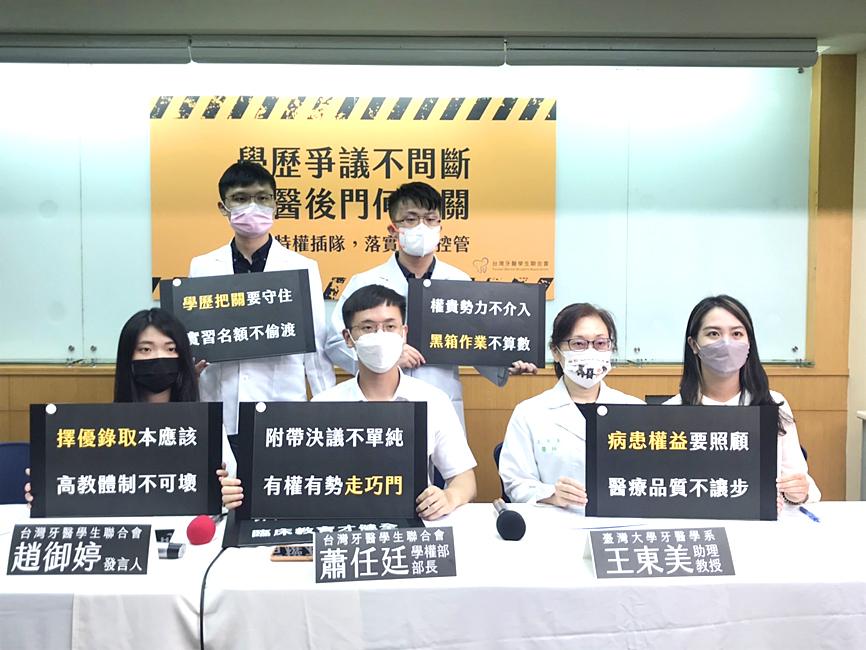
Photo: Yang Mien-chieh, Taipei Times
The amended act stipulates that holders of foreign degrees — obtained outside nine designated countries or areas — would have to seek approval of their education records from the Ministry of Education before they can take an exam that would qualify them to work as doctors in Taiwan.
Chris Hsiao (蕭任廷), head of the association’s student rights department, said wealthy families would increasingly send their children to study in countries exempt from the requirement.
Only 6 percent of those who seek approval by the ministry are allowed to participate in the professional exam, he added.
About 600 aspiring dentists holding foreign degrees enter Taiwan every year, while local dentistry departments only admit about 400 students annually, he said.
Association spokesperson Chao Yu-ting (趙御婷) said some foreign universities have low admission criteria and admit all applicants willing to pay their fees regardless of high-school grades or English-language ability.
Some graduates of foreign programs who claimed to have “completed a dental internship” were unable to perform a root canal treatment, she added.
The National Health Research Institute’s target is that there is one dentist per 2,000 people, but the ratio is currently much lower, Taiwan Dental Association member Chen Chi-hung (陳麒鴻) said.
However, raising that ratio would not be in the interest of patients and doctors, Chen said.
A Taipei Dental Association survey showed that 97 percent of dentists in Taipei support capping the number of practitioners and 96 percent of them are against the resolutions.
More than half of aspiring dentists assigned to internship positions at branches of Taipei City Hospital hold foreign degrees, dentist Huang Huan-yuan (黃煥元) said, calling the ratio too high.
The branches only specialize in one or two of the 10 fields of dentistry, and some employ no dentists with government-approved specialist certificates, he said.
Those branches cannot offer comprehensive internships, he added.
Wang Tong-mei (王東美), an assistant dentistry professor at National Taiwan University, said offering too many internships to holders of foreign degrees might overwhelm the education system and affect the quality of training offered in Taiwan.
Even if the system can accommodate more interns, the government should provide opportunities to those who studied in Taiwan to protect dental education in the country and nurture domestic talent, she added.

The military has spotted two Chinese warships operating in waters near Penghu County in the Taiwan Strait and sent its own naval and air forces to monitor the vessels, the Ministry of National Defense (MND) said. Beijing sends warships and warplanes into the waters and skies around Taiwan on an almost daily basis, drawing condemnation from Taipei. While the ministry offers daily updates on the locations of Chinese military aircraft, it only rarely gives details of where Chinese warships are operating, generally only when it detects aircraft carriers, as happened last week. A Chinese destroyer and a frigate entered waters to the southwest

The eastern extension of the Taipei MRT Red Line could begin operations as early as late June, the Taipei Department of Rapid Transit Systems said yesterday. Taipei Rapid Transit Corp said it is considering offering one month of free rides on the new section to mark its opening. Construction progress on the 1.4km extension, which is to run from the current terminal Xiangshan Station to a new eastern terminal, Guangci/Fengtian Temple Station, was 90.6 percent complete by the end of last month, the department said in a report to the Taipei City Council's Transportation Committee. While construction began in October 2016 with an
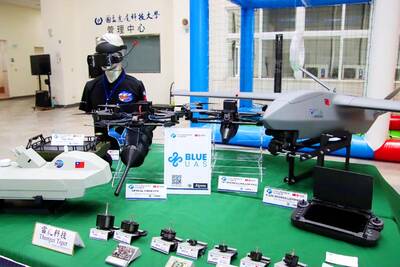
NON-RED SUPPLY: Boosting the nation’s drone industry is becoming increasingly urgent as China’s UAV dominance could become an issue in a crisis, an analyst said Taiwan’s drone exports to Europe grew 41.7-fold from 2024 to last year, with demand from Ukraine’s fight against Russian aggression the most likely driver of growth, a study showed. The Institute for Democracy, Society and Emerging Technology (DSET) in a statement on Wednesday said it found that many of Taiwan’s uncrewed aerial vehicle (UAV) sales were from Poland and the Czech Republic. These countries likely transferred the drones to Ukraine to aid it in its fight against the Russian invasion that started in 2022, it said. Despite the gains, Taiwan is not the dominant drone exporter to these markets, ranking second and fourth

Japanese Prime Minister Sanae Takaichi’s comment last year on Tokyo’s potential reaction to a Taiwan-China conflict has forced Beijing to rewrite its invasion plans, a retired Japanese general said. Takaichi told the Diet on Nov. 7 last year that a Chinese naval blockade or military attack on Taiwan could constitute a “survival-threatening situation” for Japan, potentially allowing Tokyo to exercise its right to collective self-defense. Former Japan Ground Self-Defense Force general Kiyofumi Ogawa said in a recent speech that the remark has been interpreted as meaning Japan could intervene in the early stages of a Taiwan Strait conflict, undermining China’s previous assumptions


 RSS
RSS