


A Taiwanese artist has created an installation piece that takes away people’s cellphones to encourage them to reflect on their relationship with technology.
Cheng Hsien-yu’s (鄭先喻) Discharge What You Charged — which consists of cube-like lidded apparatuses on plinths arranged around a display space — is part of “Transistor,” a special exhibition at the Museum of Contemporary Art (MOCA) in Taipei.
When a viewer places their phone on one of the apparatuses, its lid closes and locks the phone up for 15 to 20 minutes before opening again, revealing it almost completely out of battery, Cheng wrote in his Web site.
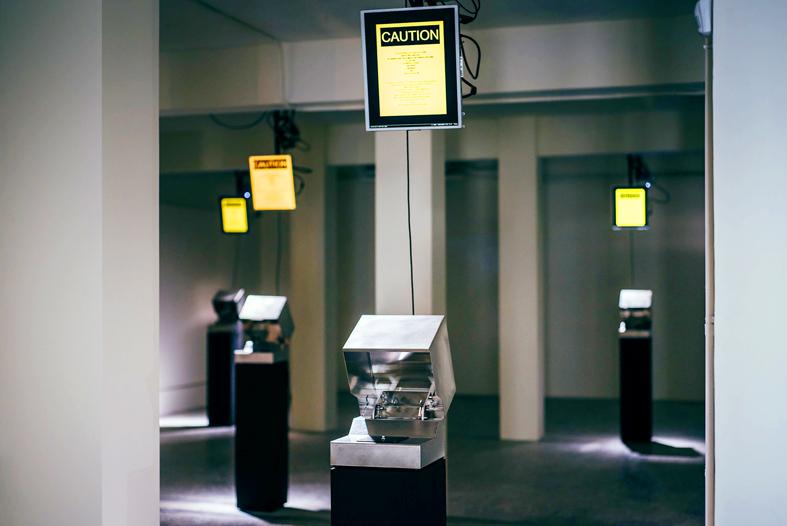
Photo: CNA
The exibition’s organizers sought to encourage artists to create without feeling bound by conventions, and support one another through inspiration and collaboration, Hong Foundation chairman Royce Hong (洪裕鈞) told a news event on Friday, the exhibition’s opening day.
The exhibition, which showcases 11 contemporary artists, has a special focus on works that challenge boundaries, reflect broadly on modern issues and demonstrate a spirit of originality, MOCA director Loh Li-chen (駱麗真) said.
While most of the 23 creations have been displayed before, five pieces debuted at the show, she added.
The new pieces include Hung Yu-chun’s (洪裕鈞) The Instant of Change (創變瞬態), which features a deconstructed and suspended Xing Mobility Miss R electric supercar prototype, Loh said.
The other pieces that debuted at MOCA are creations by Hsu Chia-wei (許家維), Chang Shuo-yin (張碩尹) and James Ming-hsueh Lee (李明學).
The exhibition also showcases Habitat, a collaborative piece by Cheng and Chang Ting-tong (張碩尹) that is comprised of a high-temperature box containing 8,000 mosquitoes that fed on the blood of the artists and a video game that electrocutes the insects when it is played.
Another piece featured is Liu Yu’s (劉玗) If Narratives Are a Deluge, a multimedia creation that uses video and installation art to explore a flood myth that is part of the traditions of 254 ethnic groups speaking 84 different languages.
The exhibition is to run until Oct. 23.

Actor Darren Wang (王大陸) was sentenced to six months in prison, commutable to a fine, by the New Taipei District Court today for contravening the Personal Data Protection Act (個人資料保護法) in a case linked to an alleged draft-dodging scheme. Wang allegedly paid NT$3.6 million (US$114,380) to an illegal group to help him evade mandatory military service through falsified medical documents, prosecutors said. He transferred the funds to Chen Chih-ming (陳志明), the alleged mastermind of a draft-evasion ring, although he lost contact with him as he was already in detention on fraud charges, they said. Chen is accused of helping a

SECURITY: Starlink owner Elon Musk has taken pro-Beijing positions, and allowing pro-China companies to control Taiwan’s critical infrastructure is risky, a legislator said Starlink was reluctant to offer services in Taiwan because of the nation’s extremely high penetration rates in 4G and 5G services, the Ministry of Digital Affairs said yesterday. The ministry made the comments at a meeting of the legislature’s Transportation Committee, which reviewed amendments to Article 36 of the Telecommunications Management Act (電信管理法). Article 36 bans foreigners from holding more than 49 percent of shares in public telecommunications networks, while shares foreigners directly and indirectly hold are also capped at 60 percent of the total, unless specified otherwise by law. The amendments, sponsored by Chinese Nationalist Party (KMT) Legislator Ko
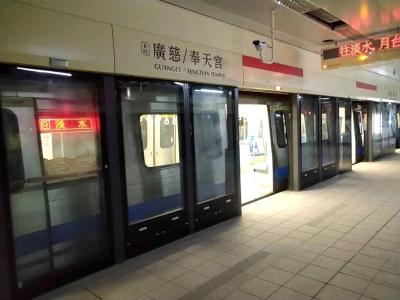
The eastern extension of the Taipei MRT Red Line could begin operations as early as late June, the Taipei Department of Rapid Transit Systems said yesterday. Taipei Rapid Transit Corp said it is considering offering one month of free rides on the new section to mark its opening. Construction progress on the 1.4km extension, which is to run from the current terminal Xiangshan Station to a new eastern terminal, Guangci/Fengtian Temple Station, was 90.6 percent complete by the end of last month, the department said in a report to the Taipei City Council's Transportation Committee. While construction began in October 2016 with an
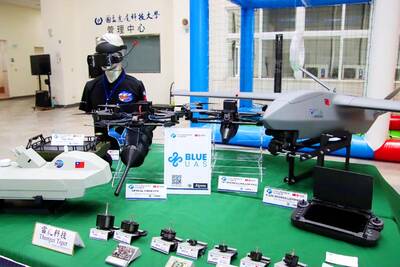
NON-RED SUPPLY: Boosting the nation’s drone industry is becoming increasingly urgent as China’s UAV dominance could become an issue in a crisis, an analyst said Taiwan’s drone exports to Europe grew 41.7-fold from 2024 to last year, with demand from Ukraine’s fight against Russian aggression the most likely driver of growth, a study showed. The Institute for Democracy, Society and Emerging Technology (DSET) in a statement on Wednesday said it found that many of Taiwan’s uncrewed aerial vehicle (UAV) sales were from Poland and the Czech Republic. These countries likely transferred the drones to Ukraine to aid it in its fight against the Russian invasion that started in 2022, it said. Despite the gains, Taiwan is not the dominant drone exporter to these markets, ranking second and fourth


 RSS
RSS