


National Taiwan University’s (NTU) academic ethics committee yesterday recommended that former Hsinchu mayor Lin Chih-chien’s (林智堅) master’s degree be revoked, saying that he had plagiarized the work of another graduate student.
The recommendation was later approved by the university’s Office of Academic Affairs.
University president Kuan Chung-ming (管中閔) said that the incident has severely harmed the university’s reputation.
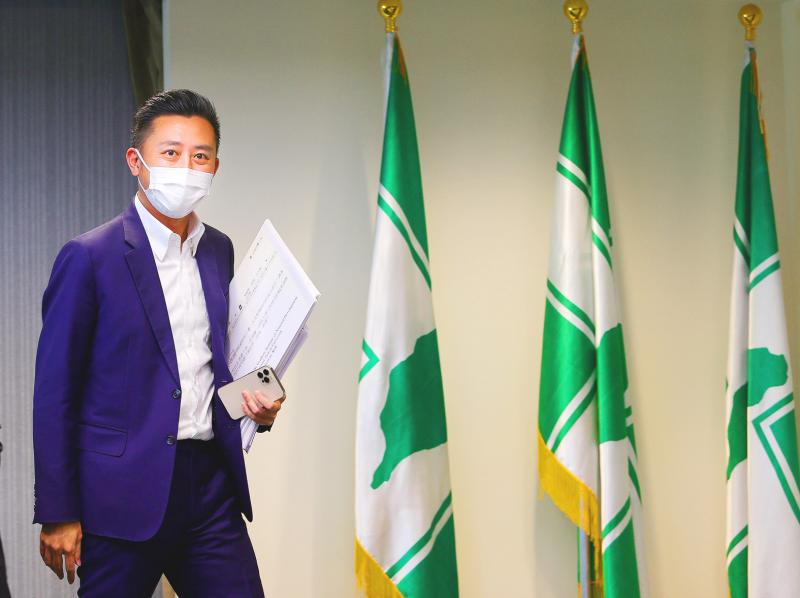
Photo: CNA
“The university already had rules governing the handling of plagiarism in student theses and an investigation was launched immediately after we were informed about the plagiarism allegations,” Kuan said, rejecting accusations that the university deliberately delayed a probe.
Su Hung-dah (蘇宏達), dean of the College of Social Sciences and chair of the review committee, said that the committee found through a computer analysis of the text that Lin’s thesis and one written by graduate student Yu Cheng-huang (余正煌) were more than 40 percent similar.
Lin — the Democratic Progressive Party’s candidate for Taoyuan mayor — and Yu used the same opinion polling data collected during the Hsinchu mayoral election in 2014 and employed the same statistical model and research method, Su said.
Yu used the data to study sources of votes for Lin, while Lin focused on the leverage effect in the election caused by independent candidate Tsai Ren-chien (蔡仁堅), Su said.
However, committee members read Lin’s thesis and found that he neither analyzed nor touched on the leverage effect caused by Tsai, Su said.
Instead, Lin analyzed sources of votes for Tsai, Su said.
“As a result, the structure of the two theses is the same and there is a high degree of overlap in their focus,” he said.
Committee members identified that the two theses were highly similar in research subject, analytical structure, tables and graphs, as well as summary and contents in chapters 1, 3 and 4, he said.
Of the 15 places where the content appeared to be very similar, eight were deemed to have exceeded a reasonable range, Su said.
In the chapter on tools for analysis, Yu misspelled the regression analysis model in English, an error that Lin also committed, Su said.
In another chapter, Yu correctly spelled the regression analysis model in English, but used an incorrect character to write the term in Chinese, Su said, adding that the same error was in Lin’s thesis.
The committee determined that Lin’s thesis was plagarized, as errors and misspellings were consistent between the two.
Yu finished his thesis on July 19, 2016, while Lin completed his on Jan. 13, 2017, Su said.
Lin listed Yu’s thesis in the reference page, which showed that he had obtained and read Yu’s thesis, Su said.
“The committee had no reason to believe that Lin did not read Yu’s thesis, nor did it have reason to believe that the similarities between the two theses were coincidence,” Su said. “As Yu finished his thesis earlier than Lin, and Lin could not provide a draft written prior to July 19, 2016, the committee rules that Lin plagiarized Yu’s thesis and recommends that Lin’s master’s degree be revoked.”
The committee invited Yu, Lin and their thesis adviser, National Security Bureau Director-General Chen Ming-tung (陳明通), to explain themselves at the committee, but Yu was the only one to attend, and even he only attended once.
Lin is entitled to seek judicial recourse if he disagrees with the committee’s decision, the university said, adding that it is investigating Chen’s responsibility as thesis adviser.
Lin told a news conference that he is the real victim, adding that he would not be where he is if he had not voluntarily provided polling data to Chen.
“The committee claimed that I plagiarized Yu’s thesis because Yu finished the thesis first. These accusations have caused a lot of pain,” he said. “I expected a reasonable explanation from the committee for not accepting the evidence I submitted.”
Speaking through his lawyer, Yu thanked the university for proving that he was not the plagiarizer and said he would think about whether to sue Lin for slander and copyright infringement.
Additional reporting by Tseng Ching-yi
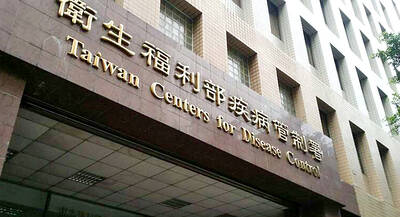
FUKUOKA SITUATION: Japanese media reported that the pathogen is expected to be identified by the summer, while the CDC downplayed the idea that it was hMPV A “mysterious cold-like illness” reported in Japan’s Fukuoka Prefecture does not seem to be a new disease, but Japanese authorities have been asked about the situation, the Centers for Disease Control (CDC) said yesterday. The Fukuoka Prefectural Medical Association on Wednesday told a news conference that a “mystery cold” that has become a hot topic on social media is “highly likely to be caused by some kind of viral infection,” Japan’s KBC News reported. “Many people are experiencing symptoms starting with a sore throat, followed by a runny nose, phlegm and a severe cough,” KBC News reported, citing association officials. Health authorities are
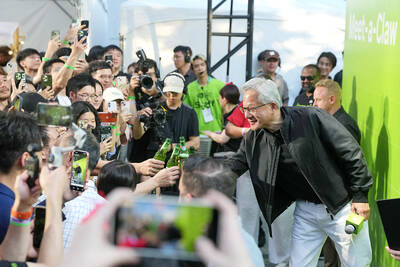
Nvidia Corp CEO Jensen Huang (黃仁勳) arrived in Taiwan yesterday ahead of upcoming AI and technology events, saying he plans to meet with clients and Taiwan Semiconductor Manufacturing Co Chairman C.C. Wei (魏哲家) during his visit. After landing at Taipei Songshan Airport, Huang posed for photos with fans and handed out Yakult drinks to reporters and supporters waiting at the scene, saying he has “a lot to do” during the trip. Asked about reports that Nvidia’s planned headquarters site in Taipei’s Beitou Shilin Technology Park could break ground on May 27, Huang said that if the company holds an event, he would

Carrefour Taiwan is to begin using a new name from the start of July, but it cannot divulge the name until then, the chairman of the supermarket chain's parent company said today. President Chain Store Co chairman Lo Chih-hsien (羅智先) was asked by reporters after a shareholders' meeting to confirm whether the company has settled on a new name for the supermarket brand. In March, the government-registered name of two Carrefour Taiwan branches was quietly changed to "Le Chia Kang" (樂家康) in Chinese, raising speculation that has been selected as the name. Lo said that because of local regulations and contractual obligations, the
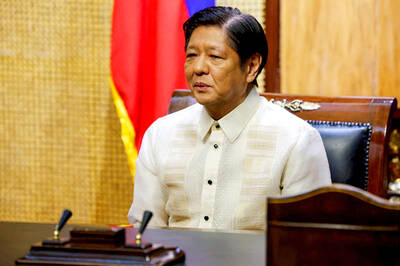
The Philippines would likely be involved in any conflict over Taiwan due to its proximity to the democracy claimed by China, President Ferdinand Marcos Jr said, reiterating a stance that risks angering Beijing. “In the Philippines, we do not have a choice because Taiwan is so close to the Philippines and we have almost 200,000 Filipino nationals living and working in Taiwan,” Marcos said in an interview with Japanese media in Manila on Monday. The Philippine leader’s comments come ahead of a state visit to Japan next week, where he is to meet with Japanese Prime Minister Sanae Takaichi to discuss security


 RSS
RSS