


Experts yesterday said that airports should enhance disinfection and divide airport workers into groups that are kept separate to avoid cluster infections as border control measures for COVID-19 are eased.
A cluster of COVID-19 infections occurred in January among Taiwan Taoyuan International Airport workers, including janitors, security guards, luggage cart handlers and disease prevention taxi drivers assigned to passenger pick-up.
The cluster led to thousands of workers being screened and a group of experts inspecting the airport’s disease prevention procedures.
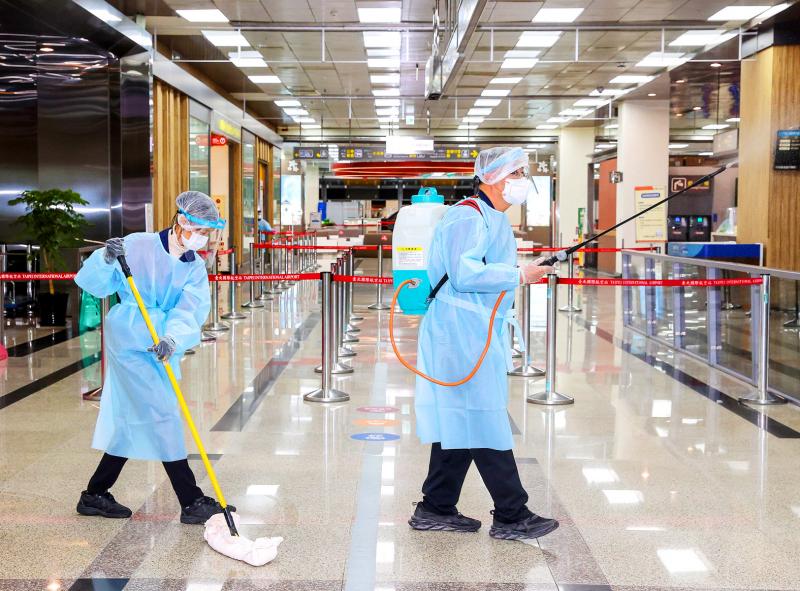
Photo: CNA
Among UK-based consultancy Skytrax’s list of World’s Cleanest Airports, Taoyuan airport’s ranking has been falling since 2017, and it was excluded from the top 10 airports this year.
“We should not make the same mistake again,” Democratic Progressive Party Legislator Tsai Shih-ying (蔡適應) said.
As the COVID-19 pandemic eases and other countries have reopened their borders, Taiwan is beginning to lift some of its border restrictions, he said.
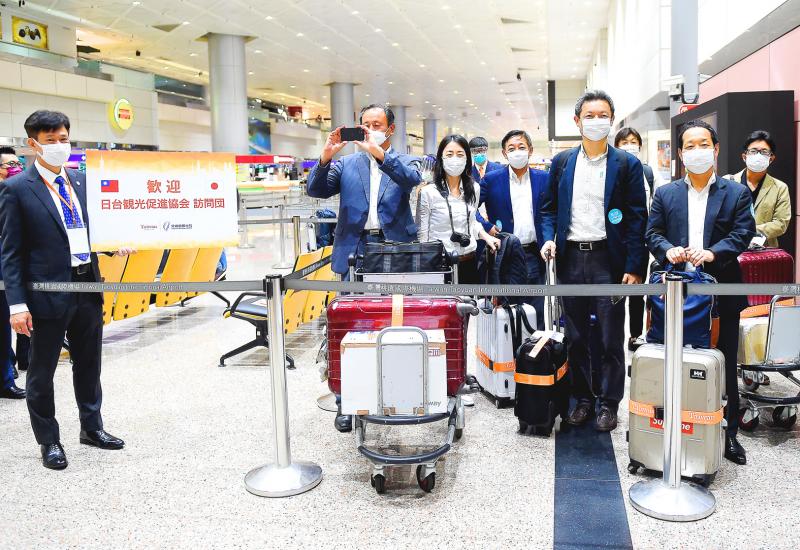
Photo: Chu Pei-hsiung, Taipei Times
As new subvariants of SARS-CoV-2 have emerged, airport environmental sanitation management is the first line of defense, Tsai said.
In addition to arranging proper passenger flow to avoid infections, airports could recruit more janitors and improve their disease prevention knowledge to prevent cluster infections, he said.
Chinese International Logistics and Transportation Association chairperson Lee Mi (李彌) said Taoyuan airport is the nation’s primary gate to the world, so the many people moving through it could easily spread the virus.
Airport janitors should be divided into separate groups that work shifts in specific areas, he said, adding that the airport’s two terminals could be cleaned by two separate companies to reduce the risk of infections and increase efficiency, as they would be competing with one another.
Janitors should also receive more on-the-job training to enhance their hygiene and safety knowledge, Lee said.
Taipei Medical Association council member Chou Hsien-jang (周賢章) said that Taiwan is facing outbreaks of the Omicron subvariants BA.4, BA.5 and BA.2.75 later than many countries, so it could learn from the measures they have taken.
Taiwan also has National Health Insurance and an efficient healthcare system, so it should focus on how to best make use of its medical resources, he added.
In related news, Japanese travel agents and tour operators, invited by the Tourism Bureau, arrived at Taoyuan airport yesterday afternoon.
Taiwan closed its borders to tourists in March 2020, and as the government has decided to gradually reopen to foreign visitors, the Tourism Bureau applied to the Central Epidemic Command Center (CECC) to allow the group to enter under the “business bubble” model.
The 25 Japanese travel agents and tour operators are taking part in a four-day familiarization trip. They are not required to follow the “3+4” quarantine rule, but a negative polymerase chain reaction test is still required.
The group is to visit several tourist destinations in northern Taiwan, including Taipei 101, New Taipei City’s Pingsi District (平溪), the colorful houses at Keelung’s Zhengbin Fishing Port (正濱漁港) and Keelung’s Heping Island Park (和平島公園), as well as take a ride on the double-decker Taipei Sightseeing Bus.
Taiwan yesterday recorded 20,824 new local COVID-19 cases and 34 deaths, the CECC said.
The deceased were aged in their 20s to over 90. Twelve of those who died were unvaccinated, while 33 had chronic illnesses or other severe diseases, it said.
Additional reporting by Lee I-chia and CNA
UPGRADE: The Kang Ding-class frigate is replacing its Chaparall missiles with Tien Chien II and Hua Yang VLS, which would provide it with long-range, 360° air defense Taiwan plans to produce 1,200 to 1,376 Hai Chien II missiles (海劍二, Sea Sword II) — also known as TC-2N — to serve as the standard air defense system of the navy’s surface combatant fleet, a source said yesterday. Last week, the Hai Chien II, the naval version of the Tien Kung II missile (天劍二, Sky Sword II), completed a live-fire test in waters off the National Chungshan Institute of Science and Technology’s Jiupeng facility (九鵬) in Pingtung County’s Manjhou Township (滿州). The MIM72 Chaparral and other dated air defense missiles that currently arm Taiwanese ships have inadequate range to combat Chinese

REASONS FOR TRAVEL: An assistant professor said that proposed amendments to penalize drivers if they used drugs overseas would not deter people from traveling People who operate a motor vehicle under the influence of marijuana would have their driver’s license revoked, even if they used the substance while overseas, the Ministry of Transportation and Communications said yesterday, citing proposed amendments to the Road Traffic Management and Penalty Act (道路交通管理處罰條例). The amendments would also authorize the government to revoke the licenses of people determined to have used Category 1 or Category 2 narcotics, even if they were not operating a vehicle while under the influence of drugs, as well as ban them from taking the license test for three years, the ministry said. People aged 18 or

HEAVY WEATHER: Typhoon Jangmi is due to crash straight into the Ryukyus as airlines look to shift flights to larger aircraft or cancel flights to Okinawa entirely Taiwan’s international air carriers announced flight adjustments over the weekend as Typhoon Jangmi is forecast to hit the Ryukyu Islands today and tomorrow. The Central Weather Administration (CWA) upgraded Jangmi from a tropical storm to a typhoon at 8am yesterday, with the eye located 580km south of Naha city. It was moving north at 19kph. Today, China Airlines’ CI-120, CI-121, CI-122 and CI-123 flights between Taoyuan and Naha, Okinawa, have been canceled as well as CI-132 and CI-133 between Kaohsiung and Naha. EVA Air’s BR-112, BR-113, BR-186 and BR-185 flights between Taoyuan and Naha are also canceled. Low-cost carrier Tigerair Taiwan canceled IT-230,
Johanne Liou (劉喬安), a Taiwanese woman who shot to unwanted fame during the Sunflower movement protests in 2014, returned to Taiwan last night after being deported from the US. She is to stand trial in Taiwan for charges involving embezzlement, fraud and drug crimes. The Criminal Investigation Bureau (CIB) said it took her into custody at Taiwan Taoyuan International Airport and would first question her before transferring her to the New Taipei District Prosecutors’ Office. She was arrested upon disembarking a flight from San Francisco that landed shortly before 7pm. Liou absconded to the US in 2019 after jumping bail


 RSS
RSS