


Former Ting Hsin International Group (頂新集團) executive Wei Ying-chun (魏應充) was yesterday sentenced to more than nine years in prison for his role in a 2014 cooking oil scandal, with the Supreme Court saying that his actions had severely undermined food safety in Taiwan.
The court in a retrial convicted Wei for contravening the Act Governing Food Safety and Sanitation (食品安全衛生管理法) and fraud offenses in the Criminal Code.
It was the final verdict and cannot be appealed.
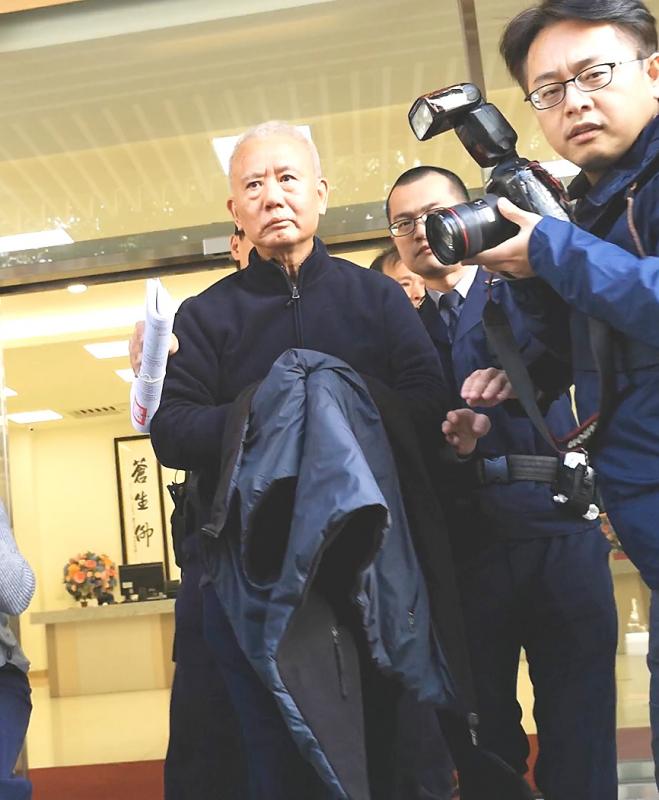
Photo: Huang Chieh, Taipei Times
The judges found Wei guilty on 39 counts leading to a combined sentence of nine years and two months. Nineteen counts, accounting for four years and four months of the total, can be commuted to a fine, calculated at NT$1,000 per day of jail time.
The four years and 10 months from the other 20 counts cannot be commuted, meaning Wei must serve that time behind bars.
The sentence means Wei is to be imprisoned for a third time for separate prosecutions for his role in the cooking oil scandal.
Judges yesterday also fined Ting Hsin International NT$105 million (US$3.51 million) and confiscated NT$74.68 million deemed to be illegal profits from sales of tainted cooking oil.
“The judges found that Wei had abandoned the social responsibility of the corporation by disregarding possible damage to consumers’ health,” the court said. “He purchased materials unfit for human consumption that went into the manufacturing process, producing adulterated cooking oil products for sale.”
“The products severely undermined food safety and contravened the rights of consumers,” the court said. “It also led to financial losses for downstream companies who believed Ting Hsin’s claims about its products.”
“Consumers had grievances and returned items they purchased,” it said, adding that the case has led to a “serious loss of trust in food safety in Taiwan.”
Wei is the third-eldest of four brothers who owned Ting Hsin International.
He previously headed subsidiaries Ting Hsin Oil and Fat Industrial Co (頂新製油實業), Cheng I Food Co (正義股份) and Wei Chuan Foods Corp (味全食品工業).
In 2014, prosecutors said that Wei and other company executives had instructed that animal feed-grade material from Vietnamese firm Dai Hanh Phuc Co be imported.
Investigators said that Wei had looked to cut costs by changing the formulas for 14 blended oil products his companies produced, including one falsely marketed as a premium class of blended oil that was actually 98 percent cheap palm oil and only 1 or 2 percent olive or grape-seed oil.
The scandal created a food-safety furor and led to class-action lawsuits against Ting Hsin companies.
Wei’s first conviction was for breaches of food safety rules and fraud, with the Intellectual Property Court in April 2017 handing him a two-year term, of which he served just over 500 days before being paroled in December 2018.
In a separate prosecution, which Wei’s lawyers appealed to the Supreme Court, he served 12 months in Taipei Prison of a four year and eight month sentence.
He was paroled in January last year.

Considering that most countries issue more than five denominations of banknotes, the central bank has decided to redesign all five denominations, the bank said as it prepares for the first major overhaul of the banknotes in more than 24 years. Central bank Governor Yang Chin-lung (楊金龍) is expected to report to the Legislative Yuan today on the bank’s operations and the redesign’s progress. The bank in a report sent to the legislature ahead of today’s meeting said it had commissioned a survey on the public’s preferences. Survey results showed that NT$100 and NT$1,000 banknotes are the most commonly used, while NT$200 and NT$2,000

The Centers for Disease Control (CDC) yesterday reported the first case of a new COVID-19 subvariant — BA.3.2 — in a 10-year-old Singaporean girl who had a fever upon arrival in Taiwan and tested positive for the disease. The girl left Taiwan on March 20 and the case did not have a direct impact on the local community, it said. The WHO added the BA.3.2 strain to its list of Variants Under Monitoring in December last year, but this was the first imported case of the COVID-19 variant in Taiwan, CDC Deputy Director-General Lin Ming-cheng (林明誠) said. The girl arrived in Taiwan on

South Korea is planning to revise its controversial electronic arrival card, a step Taiwanese officials said prompted them to hold off on planned retaliatory measures, a South Korean media report said yesterday. A Yonhap News Agency report said that the South Korean Ministry of Foreign Affairs is planning to remove the “previous departure place” and “next destination” fields from its e-arrival card system. The plan, reached after interagency consultations, is under review and aims to simplify entry procedures and align the electronic form with the paper version, a South Korean ministry official said. The fields — which appeared only on the electronic form

The Ministry of Foreign Affairs (MOFA) is suspending retaliation measures against South Korea that were set to take effect tomorrow, after Seoul said it is updating its e-arrival system, MOFA said today. The measures were to be a new round of retaliation after Taiwan on March 1 changed South Korea's designation on government-issued alien resident certificates held by South Korean nationals to "South Korea” from the "Republic of Korea," the country’s official name. The move came after months of protests to Seoul over its listing of Taiwan as "China (Taiwan)" in dropdown menus on its new online immigration entry system. MOFA last week


 RSS
RSS