

Taiwan should enshrine in law its goal of achieving net-zero emissions by 2050, environmental experts said yesterday, calling on lawmakers to urgently pass a climate change bill that is being deliberated.
Stipulating net-zero targets in law would establish a governmental duty to act on climate change regardless of which political party is in power, said Hsu Huang-hsiung (許晃雄), the director of Academia Sinica’s Center for Environmental Changes.
A climate law would help the government carry out the complex efforts needed to tackle climate change, such as climate impact studies, policy design and carbon reduction technology research, he said.

Photo: Wu Po-hsuan, Taipei Times
Creating legislation to reach net-zero emissions goals would put Taiwan in league with 137 other governments that have made similar pledges, which account for about 90 percent of the world’s GDP and 88 percent of emissions, he added.
The UK was the first state to make achieving carbon neutrality a legal obligation, Hsu said.
The UK’s Climate Change Act 2008, which deems dealing with climate change a strategic goal — established an comprehensive regulatory system to reduce carbon emissions while growing the economy, he said.
Carbon neutrality laws can take many forms and not all of them are as comprehensive and technically oriented as the British law, Environmental Rights Foundation researcher Ni Mao-ting (倪茂庭) said.
Climate change laws in Germany and Denmark are brief documents of 10 to 20 articles pointing the government in the right direction without specifying a method that must be utilized, Ni said.
In contrast, the British law offers detailed guidance on matters including the principles concerning carbon trading, he said.
Carbon taxes and emissions trading systems are also important policy instruments that raise transaction costs for emission-generating activities to curb their use, Ni said.
According to the World Bank’s State and Trends of Carbon Pricing 2021 report, the price of carbon varies greatly in the 64 carbon pricing systems established by governments across the globe, he said.
Last year, Sweden had the highest carbon price at US$137 per tonne, while Switzerland had the second-highest at US$101 per tonne, Ni said.
The EU had a carbon price of US$50 per tonne, South Korea US$16 per tonne and Japan US$3 per tonne, while Poland and Ukraine had the lowest prices at less than US$1 per tonne, he said.
However, the EU’s carbon prices this year rose to more than US$70 per tonne, approaching US$100 per tonne at times, Ni said, adding that analysts expect prices to increase further.
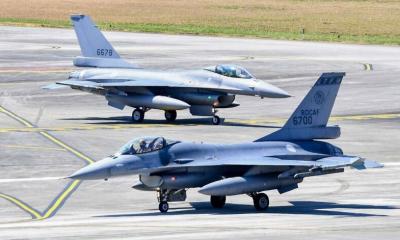
The first two F-16V Block 70 jets Taiwan purchased from the US were spotted unexpectedly turning back after departing from Hawaii yesterday, potentially further delaying delivery of the aircraft. Taiwan has purchased 66 of the F-16 C/D Block 70 jets to be deployed at Chihhang Air Base (志航基地) in Taitung County and operated by the air force's 7th Tactical Fighter Wing to defend Taiwan’s eastern region. Two single-seat jets, bearing serial No. 6727 and 6728, were spotted taking off from Hickam Field in Hawaii yesterday, observers said. Based on the precedent set during the delivery of Taiwan's older F-16 Block 20s, the new
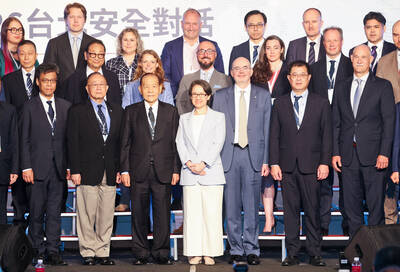
Taiwan’s growing defense preparations might be sending a stronger signal to the US than to Beijing, highlighting the need for Taipei to tailor its deterrence efforts to different audiences, a US security academic said yesterday. Stanford University Freeman Spogli Institute for International Studies fellow Oriana Skylar Mastro made the comment during a Taipei Security Dialogue panel examining lessons Taiwan could draw from the wars in Ukraine and the Middle East. Mastro said she was impressed by Taiwan’s increased defense spending, emphasis on asymmetric capabilities and efforts to prepare society for conflict, but questioned whom those initiatives were influencing. She said when she asked
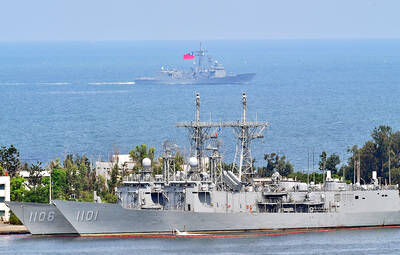
SIZE MATTERS: Large ships are politically attractive as visible symbols of national defense, but small surface combatants are more likely to survive an initial strike Taiwan needs to restructure its naval fleet from focusing on large warships, which are “sitting ducks” for China’s advanced tracking technology, to smaller, stealthy corvettes that are harder to detect but retain sufficient firepower to deter a Chinese invasion, a Taiwanese academic and a former US military commander said in an article published on Friday in the journal Foreign Affairs. Taiwan does not need a fleet capable of competing with the Chinese navy for traditional control of the Taiwan Strait, but rather “sea denial” capabilities that would prevent China from freely using the waterway, Taiwanese aerospace and security expert Holmes Liao
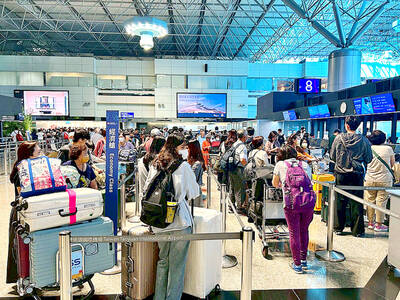
EVA Airways Corp is to raise excess baggage fees and revise other international baggage charges beginning on Sept. 29, citing higher fuel prices and rising global operating costs amid economic and geopolitical pressures. The changes would apply to international flights with travel dates on or after Sept. 29, the Taiwanese carrier said in a statement on its Web site. The revised baggage policy covers excess baggage, prepaid excess baggage, overweight and oversized baggage fees. It also covers updated pricing rules, and fees for transporting pets and sports equipment. Under the new rates, excess baggage fees would increase by between US$20 and US$90 per


 RSS
RSS