


Chewing betel nuts, even without the commonly used flavorings, has adverse health effects, the Health Promotion Administration (HPA) said on Thursday last week.
Many people erroneously believe that chewing “all-natural” betel nuts is harmless to their health, HPA Cancer Prevention and Control Division Director Lin Li-ju (林莉茹) said.
Arecoline, a nicotinic stimulant that the WHO’s International Agency for Research on Cancer classifies as a Group 1 carcinogen, occurs naturally in betel nuts and cannot be removed before consumption, she said.
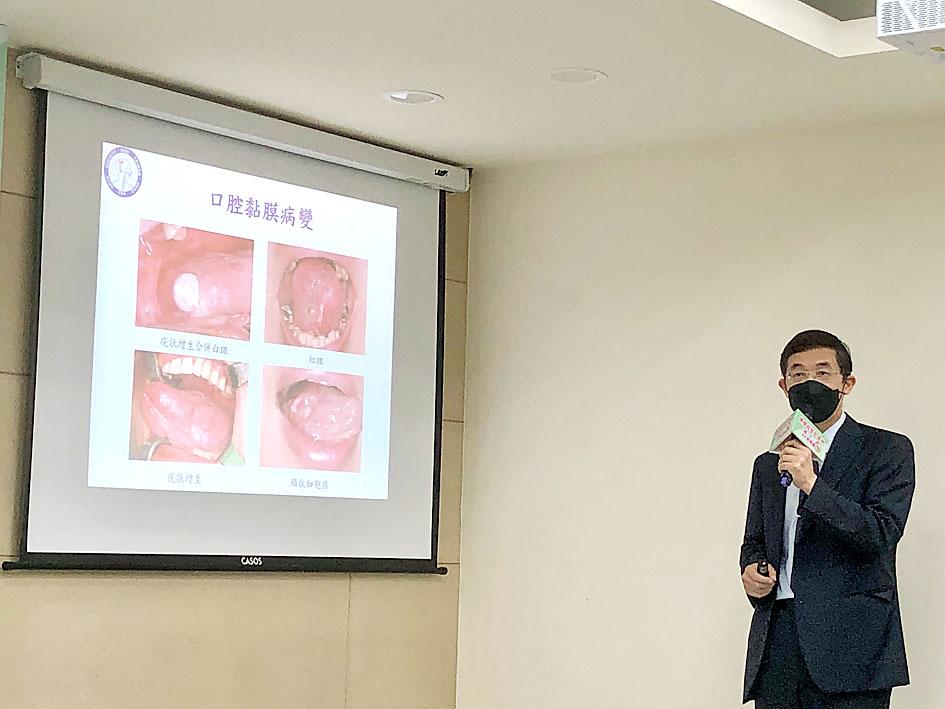
Photo: Lo Chi, Taipei Times
Chewing betel nuts also causes abrasions in the mouth, which can trigger the growth of premalignant tissue that precedes cancer, she said.
An elevated cancer risk remains after a person quits chewing betel nuts, Lin added.
An estimated 8,000 cases of oral cancer are reported in Taiwan every year, including 3,000 deaths, HPA Deputy Director-General Chia Shu-li (賈淑麗) said.
About 70 percent of those who develop oral cancer frequently chew betel nuts, Chia added.
Chewing betel nuts is linked to a fivefold increase in the risks of oral, pharynx and esophageal cancer, while the combination of chewing betel nuts, smoking tobacco and drinking alcohol results in a 10-fold increase in the health risks, she said.
Oral cancer is one of the top 10 causes of death in Taiwan, Chia said.
It has a high fatality rate because it is usually discovered late, at stages 3 or 4, she said.
Early discovery improves the chances of survival by 26 percent, she added.
Past and present chewers should seek routine oral cancer screenings, which the HPA offers for free once every two years to betel nut chewers, smokers and indigenous people, as well as everybody aged 18 to 30, she said.
Taiwan Head and Neck Society president Chu Pen-yuan (朱本元) said screenings are a crucial strategy to lower the oral cancer fatality rate, as stage 1 cancer can be treated relatively easily, with a recovery time of as little as one month.
Huang Ming-yu (黃明裕), who chairs the Taiwan Dental Association’s oral health committee, said that cancer is not the only reason that people should not chew betel nuts, a practice that is also linked to increased teeth, masticatory muscle and jaw joint wear.

Considering that most countries issue more than five denominations of banknotes, the central bank has decided to redesign all five denominations, the bank said as it prepares for the first major overhaul of the banknotes in more than 24 years. Central bank Governor Yang Chin-lung (楊金龍) is expected to report to the Legislative Yuan today on the bank’s operations and the redesign’s progress. The bank in a report sent to the legislature ahead of today’s meeting said it had commissioned a survey on the public’s preferences. Survey results showed that NT$100 and NT$1,000 banknotes are the most commonly used, while NT$200 and NT$2,000

The Centers for Disease Control (CDC) yesterday reported the first case of a new COVID-19 subvariant — BA.3.2 — in a 10-year-old Singaporean girl who had a fever upon arrival in Taiwan and tested positive for the disease. The girl left Taiwan on March 20 and the case did not have a direct impact on the local community, it said. The WHO added the BA.3.2 strain to its list of Variants Under Monitoring in December last year, but this was the first imported case of the COVID-19 variant in Taiwan, CDC Deputy Director-General Lin Ming-cheng (林明誠) said. The girl arrived in Taiwan on

South Korea is planning to revise its controversial electronic arrival card, a step Taiwanese officials said prompted them to hold off on planned retaliatory measures, a South Korean media report said yesterday. A Yonhap News Agency report said that the South Korean Ministry of Foreign Affairs is planning to remove the “previous departure place” and “next destination” fields from its e-arrival card system. The plan, reached after interagency consultations, is under review and aims to simplify entry procedures and align the electronic form with the paper version, a South Korean ministry official said. The fields — which appeared only on the electronic form

The Ministry of Foreign Affairs (MOFA) is suspending retaliation measures against South Korea that were set to take effect tomorrow, after Seoul said it is updating its e-arrival system, MOFA said today. The measures were to be a new round of retaliation after Taiwan on March 1 changed South Korea's designation on government-issued alien resident certificates held by South Korean nationals to "South Korea” from the "Republic of Korea," the country’s official name. The move came after months of protests to Seoul over its listing of Taiwan as "China (Taiwan)" in dropdown menus on its new online immigration entry system. MOFA last week


 RSS
RSS