


The government plans to spend NT$12.6 billion (US$423.64 million) in the next two years to build a cold chain system for agricultural, fishery and animal husbandry products, Council of Agriculture Minister Chen Chi-chung (陳吉仲) said on Sunday.
The announcement came after China on Friday suspended grouper fish imports from Taiwan, which took effect yesterday, for allegedly containing banned chemicals and excessive levels of oxytetracycline.
The budget for the system, which was approved by the Executive Yuan earlier this year, would first be spent on establishing a cold chain system for processed fishery products, Chen said on Facebook.
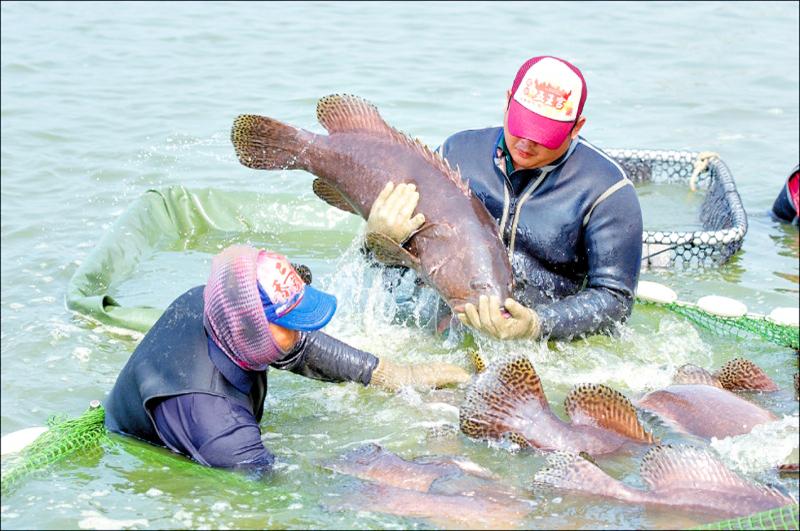
Photo: Taipei Times
The announcement was made online as Chen is in isolation after testing positive for COVID-19 last week.
The government has allocated NT$600 million to build regional cold chain logistics facilities in Kaohsiung’s Shingda Fishing Port and Pingtung County’s Yenpu Fishing Port, he said, adding that there are plans for another center in Tainan.
“A government-run cold chain system will ensure that Taiwan stays competitive in fishery products, as it would facilitate the export of fishery products to other countries, and ensure better coordination of production and marketing of the products,” he said.
Meanwhile, the council also plans to assist retail markets and private businesses to upgrade their refrigeration systems as well, he said.
Taiwan offers a wide variety of seafood and other fishery products given its excellent distant-water fishing industry and advanced fish farming technology, but it must upgrade processing and cold chain technology to make it offerings more easily available to consumers at home and abroad, Chen said.
“Fishery products should be stored in cold chain facilities after they are caught, bred, inspected and cleaned. Commercial sale should be planned to ensure stable revenue for fishers,” he said.
“We also encourage fishers and fishing associations to establish brands for their products,” he said.
China contravened international trade regulations by using unscientific measures to ban grouper imports from Taiwan, but the nation should turn the crisis into an opportunity to expand grouper exports to the US, New Zealand, Japan and other markets, Chen said.
Aside from Taiwanese groupers, Beijing has since last year stopped importing Taiwanese pineapples, custard apples and wax apples, citing concerns about pests.
Beijing’s ban on the high-value fish was widely interpreted as politically motivated amid deteriorating cross-strait relations.
The export value of Taiwanese groupers last year topped nearly US$60 million, of which US$55 million came from exports to China.
Grouper exports to China this year have already reached a record-high 93.31 percent, up from 91.76 percent last year.

Considering that most countries issue more than five denominations of banknotes, the central bank has decided to redesign all five denominations, the bank said as it prepares for the first major overhaul of the banknotes in more than 24 years. Central bank Governor Yang Chin-lung (楊金龍) is expected to report to the Legislative Yuan today on the bank’s operations and the redesign’s progress. The bank in a report sent to the legislature ahead of today’s meeting said it had commissioned a survey on the public’s preferences. Survey results showed that NT$100 and NT$1,000 banknotes are the most commonly used, while NT$200 and NT$2,000

The Centers for Disease Control (CDC) yesterday reported the first case of a new COVID-19 subvariant — BA.3.2 — in a 10-year-old Singaporean girl who had a fever upon arrival in Taiwan and tested positive for the disease. The girl left Taiwan on March 20 and the case did not have a direct impact on the local community, it said. The WHO added the BA.3.2 strain to its list of Variants Under Monitoring in December last year, but this was the first imported case of the COVID-19 variant in Taiwan, CDC Deputy Director-General Lin Ming-cheng (林明誠) said. The girl arrived in Taiwan on

South Korea is planning to revise its controversial electronic arrival card, a step Taiwanese officials said prompted them to hold off on planned retaliatory measures, a South Korean media report said yesterday. A Yonhap News Agency report said that the South Korean Ministry of Foreign Affairs is planning to remove the “previous departure place” and “next destination” fields from its e-arrival card system. The plan, reached after interagency consultations, is under review and aims to simplify entry procedures and align the electronic form with the paper version, a South Korean ministry official said. The fields — which appeared only on the electronic form

The Ministry of Foreign Affairs (MOFA) is suspending retaliation measures against South Korea that were set to take effect tomorrow, after Seoul said it is updating its e-arrival system, MOFA said today. The measures were to be a new round of retaliation after Taiwan on March 1 changed South Korea's designation on government-issued alien resident certificates held by South Korean nationals to "South Korea” from the "Republic of Korea," the country’s official name. The move came after months of protests to Seoul over its listing of Taiwan as "China (Taiwan)" in dropdown menus on its new online immigration entry system. MOFA last week


 RSS
RSS