


The Omicron BA.2 subvariant of SARS-CoV-2 is rapidly spreading in Taiwan, while the original BA.1 subvariant has not been recorded in domestic COVID-19 cases since April 21, the Central Epidemic Command Center (CECC) said yesterday.
Centers for Disease Control Deputy Director-General Philip Lo (羅一鈞), the deputy head of the CECC’s medical response division, said that a few imported cases reported at the end of last month were infected with the earlier subvariant, but about 96 percent of the total had the BA.2 subvariant.
Genome sequencing results have not shown any BA.4 or BA.5 subvariants among domestic or imported cases, he added.
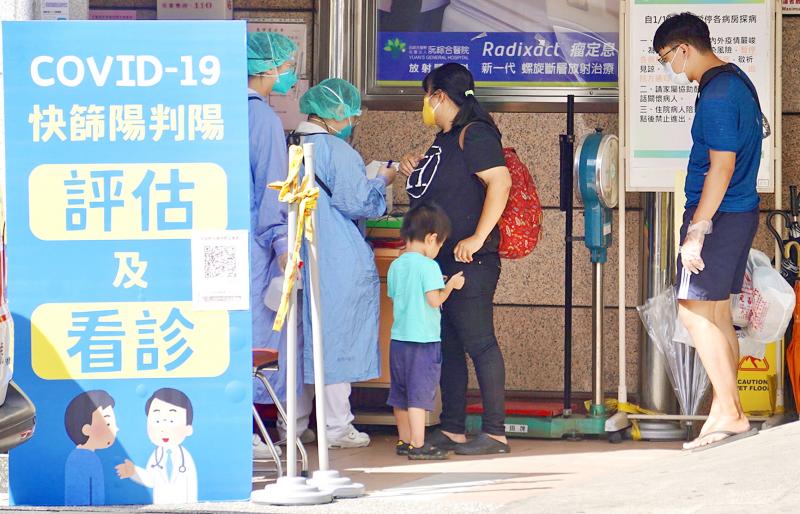
Photo: CNA
Meanwhile, Taiwan’s COVID-19 death toll reached another single-day high, as the CECC reported 213 deaths from the disease along with 68,311 new local cases.
The number of deaths topped the 211 reported on Thursday, and brought the total number of people in Taiwan who have died from COVID-19 complications since the pandemic began more than two years ago to 3,797, CECC data showed.
The deceased ranged in age from people in their 40s to those older than 90, and included 197 who had chronic illnesses or other severe diseases, and 85 who had not been vaccinated against COVID-19, the CECC said.
The CECC said that 209 previously reported COVID-19 cases had developed into severe infections, and another 344 had developed moderate symptoms of the disease.
Among the new severe cases was a six-year-old girl, who was diagnosed with multisystem inflammatory syndrome, the third such case in children recorded in Taiwan, the center said.
Lo said the girl did not have any underlying health conditions and had tested positive for COVID-19 using a polymerase chain reaction test on May 5 after displaying symptoms.
After she finished her quarantine on May 13, she appeared normal except for a mild cough, Lo said.
However, on Monday last week, she developed a fever of 38.5°C, which persisted for the next few days, he said.
On Thursday last week, she reported feeling nauseous, prompting her parents to take her to a hospital emergency room, Lo said.
The girl was admitted and diagnosed with multisystem inflammatory syndrome, he said, adding that she is undergoing treatment in an intensive care unit, and her condition is improving.
As of Thursday, 5,735 of the 2,665,809 domestic cases reported this year have been classified as severe infections and 3,457 as moderate, accounting for 0.13 percent and 0.215 percent of the total respectively, CECC data showed.
In all other cases, the patients were either asymptomatic or had mild infections, the CECC said.
Yesterday, Taichung reported the highest number of new domestic cases at 10,032, followed by Kaohsiung with 9,864 and New Taipei City with 8,858.
Tainan recorded 6,291 cases, Taoyuan 6,081, Changhua County 5,088, Taipei 4,891, Pingtung County 2,989, Hsinchu County 1,748, Yunlin County 1,597, Nantou County 1,530, Miaoli County 1,509, Hsinchu City 1,272, Chiayi County 1,266 and Yilan County 1,259.
Hualien County reported 1,063, Keelung 965, Taitung County 806, Chiayi City 753, Penghu County 230, Kinmen County 198 and Lienchiang County 21.

FUKUOKA SITUATION: Japanese media reported that the pathogen is expected to be identified by the summer, while the CDC downplayed the idea that it was hMPV A “mysterious cold-like illness” reported in Japan’s Fukuoka Prefecture does not seem to be a new disease, but Japanese authorities have been asked about the situation, the Centers for Disease Control (CDC) said yesterday. The Fukuoka Prefectural Medical Association on Wednesday told a news conference that a “mystery cold” that has become a hot topic on social media is “highly likely to be caused by some kind of viral infection,” Japan’s KBC News reported. “Many people are experiencing symptoms starting with a sore throat, followed by a runny nose, phlegm and a severe cough,” KBC News reported, citing association officials. Health authorities are

Nvidia Corp CEO Jensen Huang (黃仁勳) arrived in Taiwan yesterday ahead of upcoming AI and technology events, saying he plans to meet with clients and Taiwan Semiconductor Manufacturing Co Chairman C.C. Wei (魏哲家) during his visit. After landing at Taipei Songshan Airport, Huang posed for photos with fans and handed out Yakult drinks to reporters and supporters waiting at the scene, saying he has “a lot to do” during the trip. Asked about reports that Nvidia’s planned headquarters site in Taipei’s Beitou Shilin Technology Park could break ground on May 27, Huang said that if the company holds an event, he would

The Ministry of Finance this afternoon announced the winning numbers for the March-April uniform invoice lottery. The winning number for the NT$10 million (US$318,060) special prize is 19531471, and the winning number for the NT$2 million grand prize is 85941329. Three numbers were drawn for the NT$200,000 first prize: 07225810, 20231230 and 83518781. Those with receipts matching the last seven digits of any of the first-prize numbers will win the NT$40,000 second prize, while those matching the last six digits will win the NT$10,000 third prize. Those whose receipts match the last five digits of the first-prize numbers can claim the NT$4,000 fourth prize,
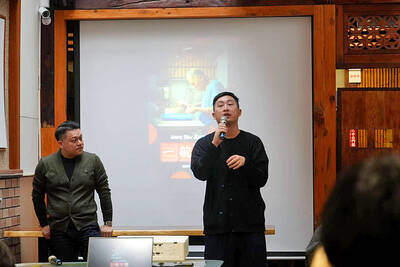
Taiwan Travelogue (臺灣漫遊錄), which earlier this week became the first Taiwanese novel to win the International Booker Prize, is to be adapted into a television series through a Taiwan-Japan coproduction, producer Chang Chen-yu (張辰漁) said yesterday. Chang, a producer at World Softest Production Film Co, wrote on Facebook that the company had been searching for projects with international appeal that retain a strong Taiwanese identity after colleagues and Japanese partners strongly recommended the novel. After reading the book, Chang said he immediately decided to pursue the screen rights. “A great story has the power to transcend time and borders, and connect countless people,”


 RSS
RSS