


Slovakia will stand with Taiwan as it resists strong powers that threaten democracy, Deputy Speaker of the Slovak National Council Milan Laurencik told President Tsai Ing-wen (蔡英文) in Taipei yesterday.
During the meeting, Laurencik, the head of a visiting delegation from the central European nation, said that Taiwan and Slovakia have gone through long and difficult journeys to achieve democracy.
Laurencik said his country would stand with Taiwan to guard against external interference.
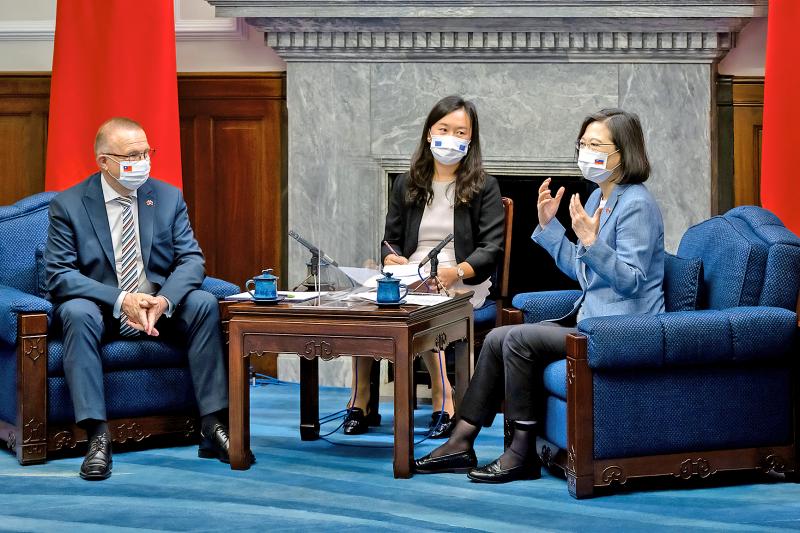
Photo courtesy of the Presidential Office via AP
The two countries are geographically distant from each other, but have been drawn closer through their shared values, Laurencik said, adding that Slovakians and Taiwanese cherish democracy and freedom.
Similarly, Tsai said she looked forward to seeing the two countries deepen their cooperation on “consolidating the democratic defense.”
Taiwan and Slovakia have teamed up on numerous global issues, including sharing medical supplies during the COVID-19 pandemic and providing aid to Ukrainian refugees in Slovakia amid the ongoing Russian invasion, Tsai said.
The two countries signed 16 memorandums of understanding in December last year during the inaugural Taiwan-Slovakia Economic Consultation in Taipei, Tsai said.
These agreements have paved the way for bilateral collaborations on research and development, trade, space technology and semiconductors, she added.
Juraj Droba, president of the Bratislava Region in western Slovakia, invited Tsai to visit the Slovakian capital “when future conditions permit.”
Droba also said he would sign a cooperation agreement between Bratislava and Kaohsiung when he travels to the southern city to meet with Kaohsiung Mayor Chen Chi-mai (陳其邁) on Friday.
He pledged to facilitate bilateral ties between Kaohsiung and Bratislava, especially in the fields of technology and trade, while encouraging academic exchanges between the two sides.
The delegation, which arrived in Taiwan on Sunday for a six-day visit, also includes Peter Osusky, a Slovak lawmaker and chairman of the Slovakia-Taiwan Parliamentary Group, and parliamentarians Anna Zemanova, Tomas Lehotsky, Miroslav Ziak and Andrej Stancik, the Ministry of Foreign Affairs said.

The brilliant blue waters, thick foliage and bucolic atmosphere on this seemingly idyllic archipelago deep in the Pacific Ocean belie the key role it now plays in a titanic geopolitical struggle. Palau is again on the front line as China, and the US and its allies prepare their forces in an intensifying contest for control over the Asia-Pacific region. The democratic nation of just 17,000 people hosts US-controlled airstrips and soon-to-be-completed radar installations that the US military describes as “critical” to monitoring vast swathes of water and airspace. It is also a key piece of the second island chain, a string of
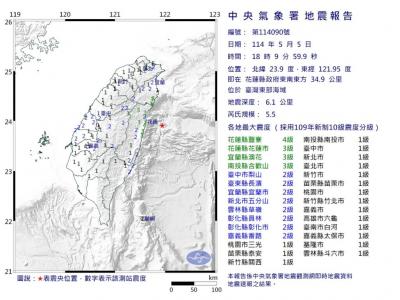
A magnitude 5.9 earthquake that struck about 33km off the coast of Hualien City was the "main shock" in a series of quakes in the area, with aftershocks expected over the next three days, the Central Weather Administration (CWA) said yesterday. Prior to the magnitude 5.9 quake shaking most of Taiwan at 6:53pm yesterday, six other earthquakes stronger than a magnitude of 4, starting with a magnitude 5.5 quake at 6:09pm, occurred in the area. CWA Seismological Center Director Wu Chien-fu (吳健富) confirmed that the quakes were all part of the same series and that the magnitude 5.5 temblor was

Taiwan will now have four additional national holidays after the Legislative Yuan passed an amendment today, which also made Labor Day a national holiday for all sectors. The Chinese Nationalist Party (KMT) and Taiwan People’s Party (TPP) used their majority in the Legislative Yuan to pass the amendment to the Act on Implementing Memorial Days and State Holidays (紀念日及節日實施辦法), which the parties jointly proposed, in its third and final reading today. The legislature passed the bill to amend the act, which is currently enforced administratively, raising it to the legal level. The new legislation recognizes Confucius’ birthday on Sept. 28, the

The Central Weather Administration has issued a heat alert for southeastern Taiwan, warning of temperatures as high as 36°C today, while alerting some coastal areas of strong winds later in the day. Kaohsiung’s Neimen District (內門) and Pingtung County’s Neipu Township (內埔) are under an orange heat alert, which warns of temperatures as high as 36°C for three consecutive days, the CWA said, citing southwest winds. The heat would also extend to Tainan’s Nansi (楠西) and Yujing (玉井) districts, as well as Pingtung’s Gaoshu (高樹), Yanpu (鹽埔) and Majia (瑪家) townships, it said, forecasting highs of up to 36°C in those areas


 RSS
RSS