


Shortly after dawn on a southern Taiwanese beach, Robin Hsu’s (許耿睿) iPhone pings with the first radio message of the day from the air force as it warns away Chinese aircraft.
“Attention,” a voice says on the radio, speaking in Mandarin to a Chinese military plane flying at an altitude of 3,500m. “You have entered our southwestern air defense identification zone and are jeopardizing aviation safety. Turn around and leave immediately.”
Taiwan has complained for years of repeated Chinese air force missions into its air defense identification zone, which is not territorial airspace, but a broader area it monitors for threats.
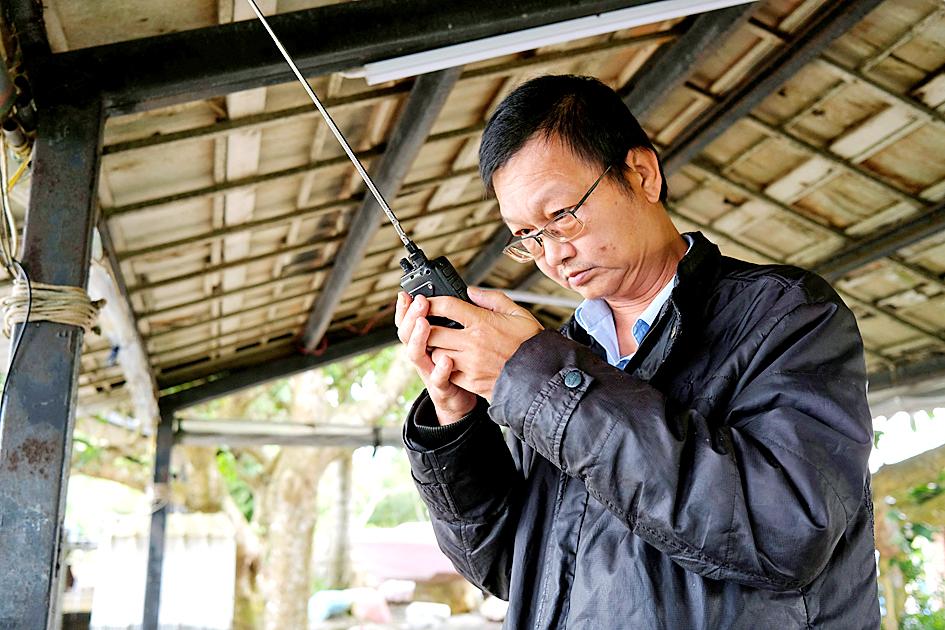
Photo: Fabian Hamacher, Reuters
Although the Ministry of National Defense details these almost-daily incursions on its Web site, including maps outlining the activity, a band of Taiwanese radio enthusiasts like Hsu has been tuning in to related radio traffic and publishing the recordings online.
“The Chinese communist planes are like flies on your dining table. If you kill them on your plate then your meal is ruined,” said Hsu, 50, a tour guide and military enthusiast. “All you can do is to wave them away.”
The action ebbs and flows. On one day this month, when reporters accompanied Hsu, nine other warnings were broadcast to Chinese warplanes after the one at dawn.
The Chinese aircraft have not fired a shot and have not come near Taiwan’s shores, the military has said.
However, the incursions amount to a low-key war of attrition, as the nation frequently scrambles aircraft to intercept Chinese planes.
The ministry has termed the flights “gray zone” tactics, designed to exhaust its air defenses physically and financially.
Halfway through lunch, Hsu’s iPhone — which is linked to a separate radio antenna — tracked another broadcast, this time in English.
“Chinese Air Force, I am a United States aircraft operating in international airspace and exercising these rights as guaranteed by international law,” the transmission said. “I am operating with due regard to the rights and duties of all states.”
On a flight tracker app, a US military refueling plane was flying east off Taiwan’s southwest into the Bashi Channel that separates the nation from the Philippines.
A spokesperson for the US Indo-Pacific Command said that there are routine flights conducted in international airspace in accordance with international law and that the language in the broadcast is consistent with US military aviation units operating in the Indo-Pacific.
The same day, Taiwan scrambled jets to warn away six Chinese aircraft, including two H-6 bombers and one Y-8 anti-submarine aircraft, the ministry said.
The Chinese Ministry of Defense and its Taiwan Affairs Office did not respond to requests for comment.
Hsu and his team have set up a dozen reception points on hills across Taiwan. With the help of those stations and flight-tracking apps, Hsu has counted 317 Taiwan warnings to Chinese warplanes from the start of the year to early May, 3 percent more than in the same period a year earlier.
“I want people to know the Chinese communist planes are very close to us,” said Hsu, who releases his recordings on a Facebook page that has attracted nearly 16,000 followers and is widely tracked by Taiwanese media.
He said that making such information public could boost support for Taiwan’s armed forces, which are dwarfed by China’s.
Taiwan’s defense ministry said that it respects any opinion that helps boost defense, but had no further comment.
On rare occasions, Chinese pilots have responded to Taiwan’s radio communications.
“This is China’s People’s Liberation Army [PLA]. I am conducting routine exercises. Please do not interrupt my activities,” one message in Mandarin said in late 2020, minutes after Taiwan warned away a Chinese warplane.
Hsu, a former navy radar operator, described a pattern of activities off Taiwan’s southwest in which US military planes, often refueling and surveillance aircraft, are shadowed by Chinese planes, who are warned away.
Military experts say that the strategic waters, where the largely shallow Taiwan Strait descends in depth, provide submarines a location for an ambush, drawing anti-submarine and surveillance aircraft.
Su Tzu-yun (蘇紫雲), a research fellow at the Institute for National Defense and Security Research, said that Hsu’s efforts help the public understand that the threat from China is “very real and immediate.”
The transparency could also help both militaries avoid an accidental conflict, Su said.
At one of his reception points, a hilltop cafe overlooking the Taiwan Strait, Hsu said he planned to expand his network to include communications in Taiwan’s northern skies, where the air forces of Taiwan, Japan and China regularly cross paths.
“On the surface, we have peace, but the reality is Chinese communist planes are flying on our doorstep every day,” he said. “People need to be aware of the crisis.”
Fast food chain McDonald's is to raise prices by up to NT$5 on some products at its restaurants across Taiwan, starting on Wednesday next week, the company announced today. The prices of all extra value meals and sharing boxes are to increase by NT$5, while breakfast combos and creamy corn soup would go up by NT$3, the company said in a statement. The price of the main items of those meals, if ordered individually, would remain the same. Meanwhile, the price of a medium-sized lemon iced tea and hot cappuccino would rise by NT$3, extra dipping sauces for chicken nuggets would go up

FUKUOKA SITUATION: Japanese media reported that the pathogen is expected to be identified by the summer, while the CDC downplayed the idea that it was hMPV A “mysterious cold-like illness” reported in Japan’s Fukuoka Prefecture does not seem to be a new disease, but Japanese authorities have been asked about the situation, the Centers for Disease Control (CDC) said yesterday. The Fukuoka Prefectural Medical Association on Wednesday told a news conference that a “mystery cold” that has become a hot topic on social media is “highly likely to be caused by some kind of viral infection,” Japan’s KBC News reported. “Many people are experiencing symptoms starting with a sore throat, followed by a runny nose, phlegm and a severe cough,” KBC News reported, citing association officials. Health authorities are

Nvidia Corp CEO Jensen Huang (黃仁勳) arrived in Taiwan yesterday ahead of upcoming AI and technology events, saying he plans to meet with clients and Taiwan Semiconductor Manufacturing Co Chairman C.C. Wei (魏哲家) during his visit. After landing at Taipei Songshan Airport, Huang posed for photos with fans and handed out Yakult drinks to reporters and supporters waiting at the scene, saying he has “a lot to do” during the trip. Asked about reports that Nvidia’s planned headquarters site in Taipei’s Beitou Shilin Technology Park could break ground on May 27, Huang said that if the company holds an event, he would

Carrefour Taiwan is to begin using a new name from the start of July, but it cannot divulge the name until then, the chairman of the supermarket chain's parent company said today. President Chain Store Co chairman Lo Chih-hsien (羅智先) was asked by reporters after a shareholders' meeting to confirm whether the company has settled on a new name for the supermarket brand. In March, the government-registered name of two Carrefour Taiwan branches was quietly changed to "Le Chia Kang" (樂家康) in Chinese, raising speculation that has been selected as the name. Lo said that because of local regulations and contractual obligations, the


 RSS
RSS