


The Legislative Yuan yesterday passed the third reading of an amendment to the Act on Promoting Transitional Justice (促進轉型正義條例), which would ask the Executive Yuan to launch a task force after the Transitional Justice Commission is dissolved.
The commission is to be dissolved after completing its designated tasks by the end of this month and submitting its summary report to the Cabinet.
The legislature’s Judiciary and Organic Laws and Statutes Committee passed the first review of the proposed amendment on March 28, but discarded some articles after cross-party negotiations reached a consensus.
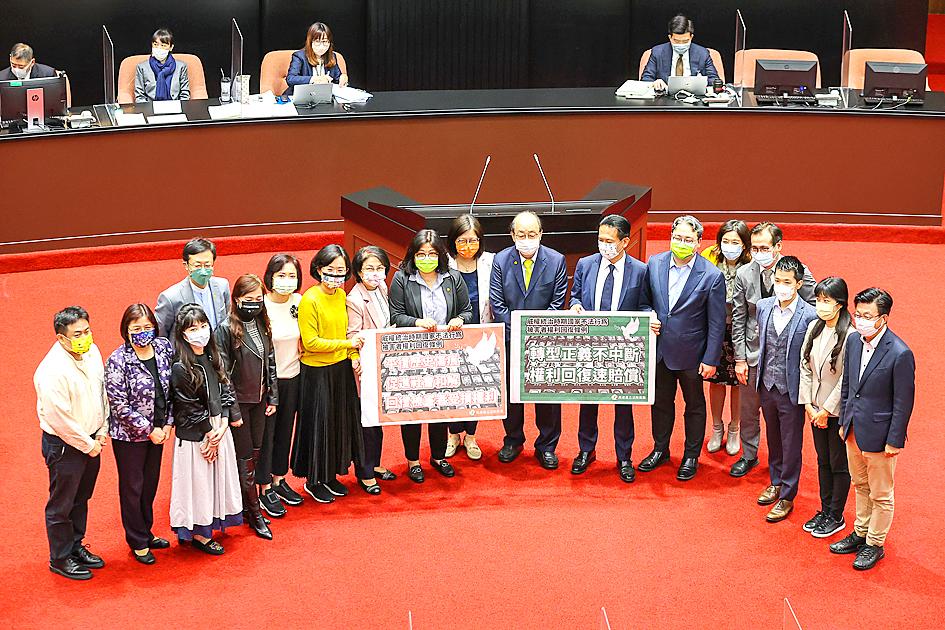
Photo: CNA
The proposed law would assign the premier as task force convenor to coordinate and monitor matters related to transitional justice, which should be taken over by other agencies after the commission is dissolved.
Justice authorities should redress judicial and administrative unlawfulness, as well as identify and punish perpetrators; interior affairs authorities should purge authoritarian symbols; and culture authorities should preserve historical sites of injustice, the proposed amendment says.
In addition, health and welfare authorities should take care of people affected by political persecution and their families; education authorities should organize transitional justice education; and national development authorities should handle transitional justice funds, it says.
Government agencies at all levels should cooperate with these authorities in dealing with transitional justice matters, the amendment says.
If government agencies or civil servants during Taiwan’s past authoritarian rule infringed on people’s right to life or freedom, or deprived them of property, the commission should verify the situation and revoke the unlawful acts, it says.
Separately, the legislature yesterday passed the third reading of the Act Governing the Recovery of the Rights of Victims of State Illegal Activities During the Period of Authoritarian Rule.
To provide a clear legislative basis for the restoration of the rights of such people and their families, the Cabinet passed a draft of the rights act on Jan. 13 and submitted it to the legislature for review.
The legislature passed a preliminary review of the draft on March 28, but discarded some of its articles.
On May 13, party caucuses failed to reach a consensus on some articles, such as how much should be paid in death benefits, and whether compensation and rights recovery should be handled by the Memorial Foundation of 228 or a new foundation.
The Cabinet should establish a rights recovery foundation with 13 board members to handle compensation and rights recovery, the proposed act says.
The public assets to handle matters stipulated in the rights act should be provided by government agencies free of charge, it says.
The period of authoritarian rule is defined as from Aug. 15, 1945, to Nov. 6, 1992, and the state’s illegal activities are defined as the acts of judicial unlawfulness and administrative unlawfulness stipulated in Articles 6 and 6.1 of the transitional justice act.
Compensation of NT$12 million (US$403,606) should be given to the families of people who were executed, shot to death, tortured to death, disappeared or died during arrest, the proposed act says.
People or their family members who have been deprived of property due to unlawful acts of the state can apply for compensation by submitting documents to the foundation, it says.
If the property is now publicly owned and is idle, barely used or used for noneconomic activity, it should be returned to its original owner, it says.

Considering that most countries issue more than five denominations of banknotes, the central bank has decided to redesign all five denominations, the bank said as it prepares for the first major overhaul of the banknotes in more than 24 years. Central bank Governor Yang Chin-lung (楊金龍) is expected to report to the Legislative Yuan today on the bank’s operations and the redesign’s progress. The bank in a report sent to the legislature ahead of today’s meeting said it had commissioned a survey on the public’s preferences. Survey results showed that NT$100 and NT$1,000 banknotes are the most commonly used, while NT$200 and NT$2,000

The Centers for Disease Control (CDC) yesterday reported the first case of a new COVID-19 subvariant — BA.3.2 — in a 10-year-old Singaporean girl who had a fever upon arrival in Taiwan and tested positive for the disease. The girl left Taiwan on March 20 and the case did not have a direct impact on the local community, it said. The WHO added the BA.3.2 strain to its list of Variants Under Monitoring in December last year, but this was the first imported case of the COVID-19 variant in Taiwan, CDC Deputy Director-General Lin Ming-cheng (林明誠) said. The girl arrived in Taiwan on

South Korea is planning to revise its controversial electronic arrival card, a step Taiwanese officials said prompted them to hold off on planned retaliatory measures, a South Korean media report said yesterday. A Yonhap News Agency report said that the South Korean Ministry of Foreign Affairs is planning to remove the “previous departure place” and “next destination” fields from its e-arrival card system. The plan, reached after interagency consultations, is under review and aims to simplify entry procedures and align the electronic form with the paper version, a South Korean ministry official said. The fields — which appeared only on the electronic form

The Ministry of Foreign Affairs (MOFA) is suspending retaliation measures against South Korea that were set to take effect tomorrow, after Seoul said it is updating its e-arrival system, MOFA said today. The measures were to be a new round of retaliation after Taiwan on March 1 changed South Korea's designation on government-issued alien resident certificates held by South Korean nationals to "South Korea” from the "Republic of Korea," the country’s official name. The move came after months of protests to Seoul over its listing of Taiwan as "China (Taiwan)" in dropdown menus on its new online immigration entry system. MOFA last week


 RSS
RSS