


Taiwan’s representative offices in Austria, the Czech Republic, Slovakia, Hungary and Poland have jointly produced a video calling for Taiwan’s participation in the annual World Health Assembly (WHA), which is to begin on Sunday.
In the video, members of the five representative offices can be seen holding banners reading “Taiwan can help” and “Taiwan is helping.”
International Ombudsman Institute secretary-general Werner Amon and Czech Senator Marek Hilser also appear in the video, saying that democracies should work together in the face of the war in Ukraine, the COVID-19 pandemic and global economic crises.
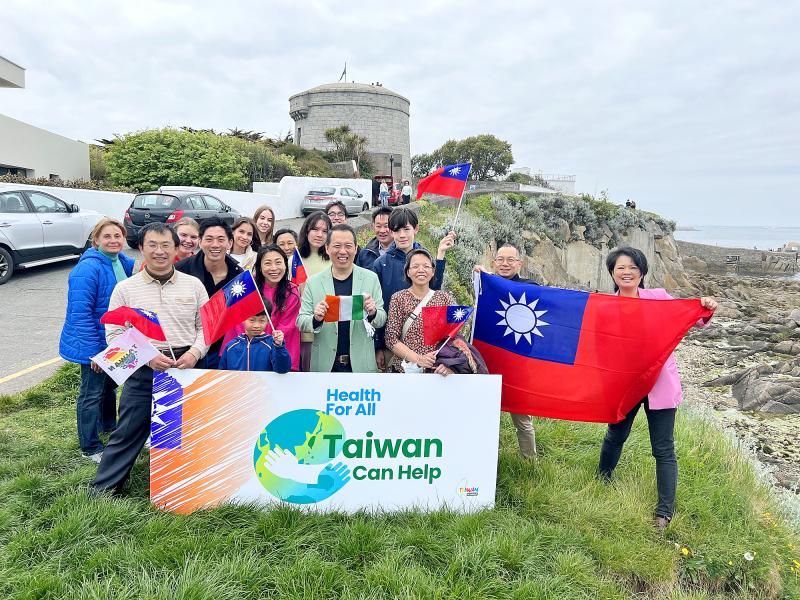
Photo courtesy of the Taipei Representative Office in Ireland via CNA
Former Hungarian lawmaker Bana Tibor in the video calls Taiwan a “model for universal health coverage,” and Slovakia’s Bratislava Province Governor Juraj Droba calls Taiwan a “model for the world,” citing the country’s successes during the pandemic.
Droba said that Taiwan’s voice should not be ignored in the field of medicine.
Arkadiusz Mularczyk, vice chairman of the Polish House of Representatives’ Foreign Affairs Committee, appears in the video saying that Taiwan’s commitment to improving global public health makes it important in maintaining global stability.
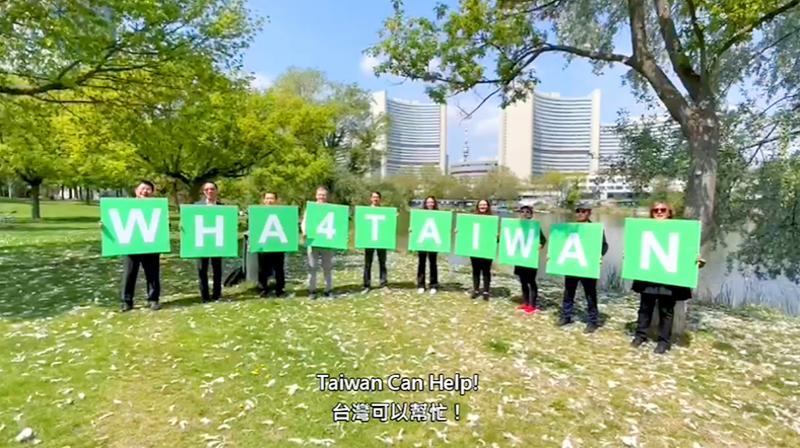
Photo: screenshot from YouTube
Citing Taiwan’s recent donations to Ukraine, Slovak Parliamentary Friendship Group chairman Peter Osusky said that Taiwan is a force of good for the international community.
“The world should hear Taiwan’s voice. Please give Taiwan a seat at the World Health Assembly,” he said.
Representative to Hungary Liu Shih-chung (劉世忠), Representative to the Czech Republic Ko Liang-juei (柯良叡), Representative to Austria Katharine Chang (張小月), Representative to Slovakia David Lee (李南陽) and Representative to Poland Bob Chen (陳龍錦) also appear in the video calling for Taiwan’s participation in the WHA.
Lee said that Taiwan is an important member of the international community, not only through its contributions to world health, but through its involvement in humanitarian missions, including US$33 million in donations, plus and 650 tonnes of materials toward efforts to assist Ukraine.
Separately, President Tsai Ing-wen (蔡英文) yesterday on Facebook thanked those in the international community who had supported Taiwan’s WHA participation bid.
“Taiwan has the determination and ability to help, and will continue to make important contributions to the international community,” she wrote.
“Taiwan’s participation will surely help to build a stronger health system for the world to better face future challenges,” Tsai said.
Additional reporting by Su Yung-yao

Considering that most countries issue more than five denominations of banknotes, the central bank has decided to redesign all five denominations, the bank said as it prepares for the first major overhaul of the banknotes in more than 24 years. Central bank Governor Yang Chin-lung (楊金龍) is expected to report to the Legislative Yuan today on the bank’s operations and the redesign’s progress. The bank in a report sent to the legislature ahead of today’s meeting said it had commissioned a survey on the public’s preferences. Survey results showed that NT$100 and NT$1,000 banknotes are the most commonly used, while NT$200 and NT$2,000

The Centers for Disease Control (CDC) yesterday reported the first case of a new COVID-19 subvariant — BA.3.2 — in a 10-year-old Singaporean girl who had a fever upon arrival in Taiwan and tested positive for the disease. The girl left Taiwan on March 20 and the case did not have a direct impact on the local community, it said. The WHO added the BA.3.2 strain to its list of Variants Under Monitoring in December last year, but this was the first imported case of the COVID-19 variant in Taiwan, CDC Deputy Director-General Lin Ming-cheng (林明誠) said. The girl arrived in Taiwan on

South Korea is planning to revise its controversial electronic arrival card, a step Taiwanese officials said prompted them to hold off on planned retaliatory measures, a South Korean media report said yesterday. A Yonhap News Agency report said that the South Korean Ministry of Foreign Affairs is planning to remove the “previous departure place” and “next destination” fields from its e-arrival card system. The plan, reached after interagency consultations, is under review and aims to simplify entry procedures and align the electronic form with the paper version, a South Korean ministry official said. The fields — which appeared only on the electronic form

The Ministry of Foreign Affairs (MOFA) is suspending retaliation measures against South Korea that were set to take effect tomorrow, after Seoul said it is updating its e-arrival system, MOFA said today. The measures were to be a new round of retaliation after Taiwan on March 1 changed South Korea's designation on government-issued alien resident certificates held by South Korean nationals to "South Korea” from the "Republic of Korea," the country’s official name. The move came after months of protests to Seoul over its listing of Taiwan as "China (Taiwan)" in dropdown menus on its new online immigration entry system. MOFA last week


 RSS
RSS