


US President Joe Biden was yesterday set to meet with US Federal Reserve Chairman Jerome Powell as soaring inflation takes a bite out of Americans’ pocketbooks.
The meeting would be the first since Biden renominated Powell to lead the central bank and comes weeks after his confirmation for a second term by the US Senate.
The White House said the pair would discuss the state of the US and global economies, and especially inflation, described as Biden’s “top economic priority.”
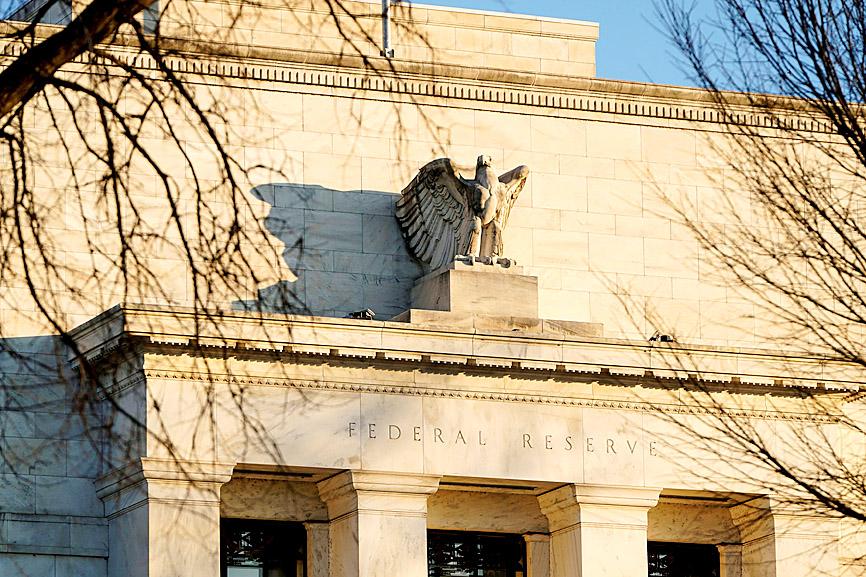
Photo: Reuters
It said that the goal is a “transition from a historic economic recovery to stable, steady growth that works for working families.”
Inflation in the US hit a 40-year high earlier this year, amid supply chain constraints caused by the global economy’s recovery from the COVID-19 pandemic and Russia’s invasion of Ukraine.
The Fed’s preferred gauge of price pressures, the personal consumption expenditures price index, rose 6.3 percent in April from a year earlier — more than three times the Fed’s 2 percent target, data released on Friday last week showed.
It also showed that US consumer spending is holding up as households dip into savings.
Powell has pledged to keep ratcheting up the Fed’s key short-term interest rate to cool the economy until inflation is “coming down in a clear and convincing way.”
US Federal Reserve Governor Christopher Waller on Monday said he wants to keep raising interest rates in half-percentage point steps until inflation is easing back toward the US central bank’s goal.
“I support tightening policy by another 50 basis points for several meetings,” he said in Frankfurt, Germany. “In particular, I am not taking 50 basis-point hikes off the table until I see inflation coming down closer to our 2 percent target,” he told an event hosted by the Institute for Monetary and Financial Stability.
US central bankers raised rates by a half point last month to cool the hottest inflation in 40 years, and have signaled that they would hike them by the same amount again at their meetings this month and in July. They also plan to start shrinking their massive balance sheet at a monthly pace of US$47.5 billion from today, stepping up to US$95 billion in September, in a process also called quantitative tightening.
Officials are counting on a combination of higher rates and quantitative tightening to rebalance supply and demand that was pushed out of line during the COVID-19 pandemic.
Waller said that various economic models suggest that the overall reduction in the balance sheet would be equivalent to about “a couple of 25-basis-point rate hikes,” while warning that such estimates are very uncertain.
Waller, who has emerged as one of the more hawkish members at the US central bank since becoming a governor in December 2020, said that no one should doubt the Fed’s commitment to curbing price pressures.
“By the end of this year, I support having the policy rate at a level above neutral,” said Waller, referring to the level of interest rates that neither speed up nor slow down the economy.
“If the data suggest that inflation is stubbornly high, I am prepared to do more,” he said.
Additional reporting by Bloomberg

SECOND-RATE: Models distilled from US products do not perform the same as the original and undo measures that ensure the systems are neutral, the US’ cable said The US Department of State has ordered a global push to bring attention to what it said are widespread efforts by Chinese companies, including artificial intelligence (AI) start-up DeepSeek (深度求索), to steal intellectual property from US AI labs, according to a diplomatic cable. The cable, dated Friday and sent to diplomatic and consular posts around the world, instructs diplomatic staff to speak to their foreign counterparts about “concerns over adversaries’ extraction and distillation of US AI models.” Distillation is the process of training smaller AI models using output from larger, more expensive ones to lower the costs of training a powerful new
Shares of Taiwan Semiconductor Manufacturing Co (TSMC, 台積電) have repeatedly hit new highs, but an equity analyst said the stock’s valuation remains within a reasonable range and any pullback would likely be technical. The contract chipmaker’s historical price-to-earnings (P/E) ratio has ranged between 20 and 30, Cathay Futures Consultant Co (國泰證期) analyst Tsai Ming-han (蔡明翰) told Central News Agency. With market consensus projecting that TSMC would post earnings per share of about NT$100 (US$3.17) this year, supported by strong global demand for artificial intelligence (AI) applications, and the stock currently trading at a P/E ratio of below 25, Tsai said the valuation
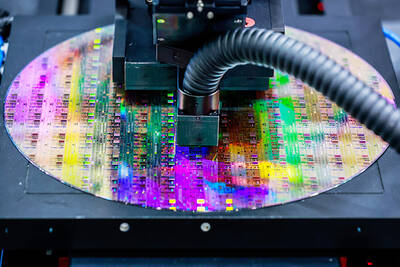
The artificial intelligence (AI) boom has triggered a seismic reshuffling of global equity markets, with Taiwan and South Korea muscling past European nations one by one. With its stock market now valued at nearly US$4.3 trillion, Taiwan surpassed the UK, Europe’s biggest market, earlier this month, data compiled by Bloomberg showed. South Korea is about US$140 billion away from doing the same. The tech-heavy Asian markets have shot past Germany and France in the past seven months. The shift is largely down to massive gains in shares of three companies that provide essential hardware for AI: Taiwan Semiconductor Manufacturing Co (TSMC, 台積電),

The US Department of Commerce last week ordered multiple chip equipment companies to halt shipments of certain tools to China’s second-largest chipmaker, Hua Hong Semiconductor Ltd (華虹半導體), its latest action to slow the country’s development of advanced chips, two people familiar with the matter said. The department sent letters to at least a handful of companies informing them of restrictions on tools and other materials destined for two Hua Hong facilities US officials believe make China’s most sophisticated chips, the people said. Top US chip equipment companies Lam Research Corp, Applied Materials Inc and KLA Corp, each of which has significant


 RSS
RSS