


The Taiwan Statebuilding Party together with pro-Taiwan independence groups slammed recent government moves at a media briefing yesterday, while also opposing the president’s nomination of People First Party (PFP) Secretary-General Lee Hung-chun (李鴻鈞) as vice president of the Control Yuan.
At the event in Taipei, Taiwan Statebuilding Party Secretary-General Wang Sing-huan (王興煥) said he was disappointed that the government was moving backwards with regard to political reform and pandering to conservative forces by not allowing a Taiwanese historian to serve as a board member of the publicly funded Taiwan Broadcasting System (TBS).
Wang and the groups said they were marking May 9 as “A Day of Setback for Taiwan Transitional Justice,” referring to Monday, when the decisions were announced.
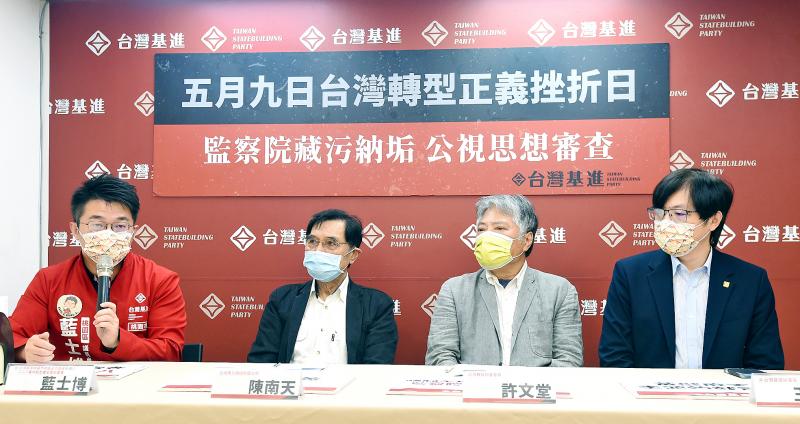
Photo: Liao Chen-huei, Taipei Times
“Looking at the core values and history of the KMT [Chinese Nationalist Party] and the PFP, the transitional justice process is working to clean up the stains and past wrongdoings, done by these two parties,” Wang said, explaining why they are offended that President Tsai Ing-wen (蔡英文) nominated Lee, who was previously also a KMT member.
World United Formosans for Independence (WUFI) chairman Chen Nan-tien (陳南天) said that the Control Yuan deputy president must rise above partisan politics and have a long-term vision.
He questioned Lee’s political stance and his roles during Taiwan’s democratization and transitional justice process.
Lee served four terms as legislator from 2002 to 2020, representing the PFP during his first two terms and the KMT during the latter two.
President Tsai could find numerous people from the Democratic Progressive Party or prominent figures in Taiwan to nominate instead, Chen said.
“This nomination has betrayed the wishes of the vast majority of the public, and seems like a personal appointment that is not based on a balance of political power,” Chen added.
Taiwan Statebuilding Party and WUFI officials condemned the decision by the TBS board member selection committee to reject the appointment of Chen Tsui-lien (陳翠蓮), a Taiwan National University professor of history.
Wang referred to the TBS committee’s explanation that Chen Tsui-lien was unsuitable “because she conducts research into the 228 Incident, resulting in strife between Taiwan’s various ethnic groups.”
The TBS governing board is in charge of the state-funded Taiwan Public Television Service, which together with its affiliated state television networks braodcasts in Hoklo (commonly known as Taiwanese), Hakka and other indigenous languages, showing the people with this decision that it does not have the public interest in mind and is hypocritical, he said.
“The rejection also rejects the current transitional process,” Wang said.

UPGRADE: The Kang Ding-class frigate is replacing its Chaparall missiles with Tien Chien II and Hua Yang VLS, which would provide it with long-range, 360° air defense Taiwan plans to produce 1,200 to 1,376 Hai Chien II missiles (海劍二, Sea Sword II) — also known as TC-2N — to serve as the standard air defense system of the navy’s surface combatant fleet, a source said yesterday. Last week, the Hai Chien II, the naval version of the Tien Kung II missile (天劍二, Sky Sword II), completed a live-fire test in waters off the National Chungshan Institute of Science and Technology’s Jiupeng facility (九鵬) in Pingtung County’s Manjhou Township (滿州). The MIM72 Chaparral and other dated air defense missiles that currently arm Taiwanese ships have inadequate range to combat Chinese

REASONS FOR TRAVEL: An assistant professor said that proposed amendments to penalize drivers if they used drugs overseas would not deter people from traveling People who operate a motor vehicle under the influence of marijuana would have their driver’s license revoked, even if they used the substance while overseas, the Ministry of Transportation and Communications said yesterday, citing proposed amendments to the Road Traffic Management and Penalty Act (道路交通管理處罰條例). The amendments would also authorize the government to revoke the licenses of people determined to have used Category 1 or Category 2 narcotics, even if they were not operating a vehicle while under the influence of drugs, as well as ban them from taking the license test for three years, the ministry said. People aged 18 or
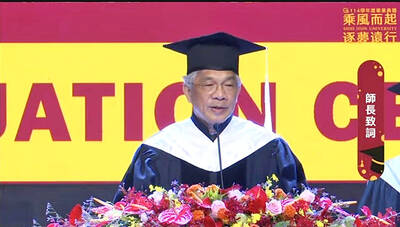
Shih Hsin University President Chen Ching-he (陳清河) yesterday issued a public apology for comments made in his commencement speech last week, stating that he has asked the school to suspend his duties and halt his wages for two months as a show of contrition. At the commencement ceremony on May 30, Chen said, “If you don’t manage your time well, or your own emotions, or your health, then I am telling every one of you — put a quick end to ‘you,’ because the world has no need for ‘you.’” The comments have sparked significant controversy online, and Chen through an open
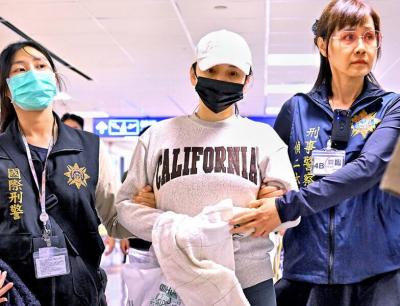
Johanne Liou (劉喬安), a Taiwanese woman who shot to unwanted fame during the Sunflower movement protests in 2014, returned to Taiwan last night after being deported from the US. She is to stand trial in Taiwan for charges involving embezzlement, fraud and drug crimes. The Criminal Investigation Bureau (CIB) said it took her into custody at Taiwan Taoyuan International Airport and would first question her before transferring her to the New Taipei District Prosecutors’ Office. She was arrested upon disembarking a flight from San Francisco that landed shortly before 7pm. Liou absconded to the US in 2019 after jumping bail


 RSS
RSS