


The New Power Party (NPP) caucus yesterday called on the government to shorten border quarantine in favor of measures emphasizing regular testing and vaccination to bring the nation in line with the rest of the world.
The party’s news conference yesterday was held just before the Central Epidemic Command Center announced that mandatory quarantine for inbound travelers would next week be shortened from 10 days to seven days, while revising its regulations to allow clinics to perform polymerase chain reaction (PCR) tests.
As the world is gradually opening up and preparing to live with the virus, Taiwan should not fall behind as it is heavily reliant on international trade, NPP Legislator Claire Wang (王婉諭) said.
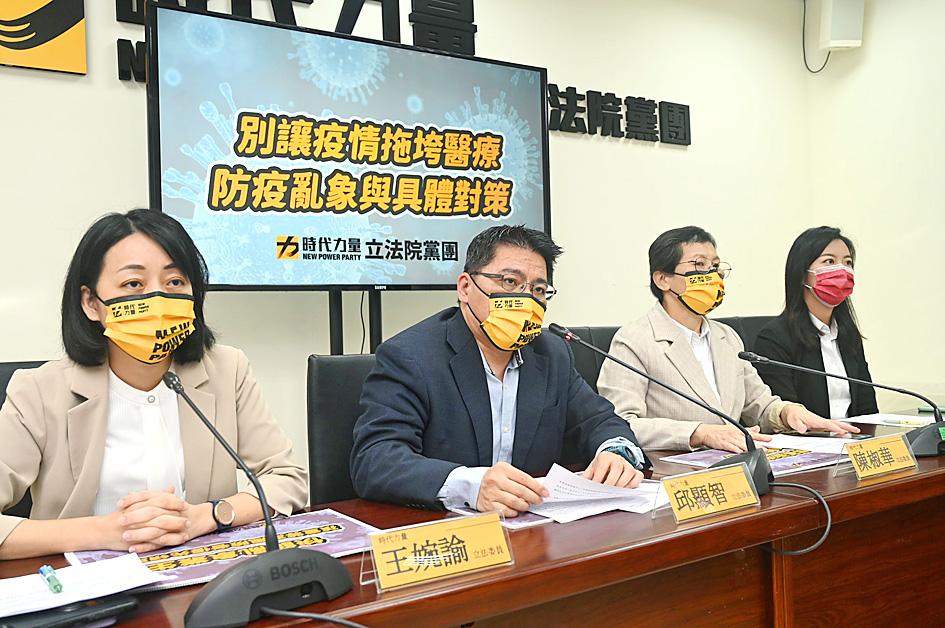
Photo: Tien Yu-hua, Taipei Times
Taiwan is facing a serious COVID-19 outbreak, as are many other nations, but the quarantine policy is not in line with international norms, she said.
Tight quarantine rules imposed on inbound travelers have to be changed as they draw on considerable resources and conflict with calls to open the border, she added.
Wang suggested that the center gradually relax border controls by conducting regular testing and using the number of vaccines a traveler has received to determine the quarantine period.
In addition, the center should conduct DNA sequencing on domestic COVID-19 cases to monitor potential new variants of SARS-CoV-2, she said.
Following panic buying of rapid test kits, Wang said that the center could launch a preorder system like the one used last year for purchasing masks to ease the burden on pharmacies and distribute the kits more efficiently to those in need, such as close contacts and high-risk groups.
NPP Legislator Chen Jiau-hua (陳椒華) said that PCR tests should be conducted in a designated area in hospitals or in communities to avoid disrupting emergency rooms.
The government should increase the number of children’s wards and the capacity of emergency treatment for children, fully implement home isolation policies to prevent children from being infected and temporarily relax rules to allow trained medical personnel to collect specimens for testing, Chen said.
NPP caucus whip Chiu Hsien-chih (邱顯智) cited Article 46 of the Communicable Disease Control Act (傳染病防治法) as stipulating that “in principle, specimens of communicable diseases shall be collected by physicians; specimens from contacts of patients shall be collected by physicians or other medical personnel.”
In hospitals, doctors have been overwhelmed by the number of PCR tests they have to conduct and are unable to perform other tasks, so the government should consider allowing other medical personnel to share the workload, Chiu said.
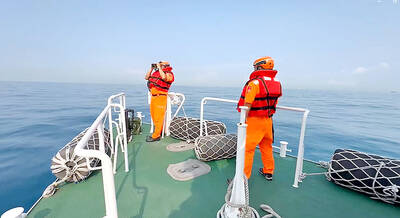
An increase in Taiwanese boats using China-made automatic identification systems (AIS) could confuse coast guards patrolling waters off Taiwan’s southwest coast and become a loophole in the national security system, sources familiar with the matter said yesterday. Taiwan ADIZ, a Facebook page created by enthusiasts who monitor Chinese military activities in airspace and waters off Taiwan’s southwest coast, on Saturday identified what seemed to be a Chinese cargo container ship near Penghu County. The Coast Guard Administration went to the location after receiving the tip and found that it was a Taiwanese yacht, which had a Chinese AIS installed. Similar instances had also

GOOD DIPLOMACY: The KMT has maintained close contact with representative offices in Taiwan and had extended an invitation to Russia as well, the KMT said The Chinese Nationalist Party (KMT) would “appropriately handle” the fallout from an invitation it had extended to Russia’s representative to Taipei to attend its international banquet last month, KMT Chairman Eric Chu (朱立倫) said yesterday. US and EU representatives in Taiwan boycotted the event, and only later agreed to attend after the KMT rescinded its invitation to the Russian representative. The KMT has maintained long-term close contact with all representative offices and embassies in Taiwan, and had extended the invitation as a practice of good diplomacy, Chu said. “Some EU countries have expressed their opinions of Russia, and the KMT respects that,” he

AMENDMENT: Contact with certain individuals in China, Hong Kong and Macau must be reported, and failure to comply could result in a prison sentence, the proposal stated The Chinese Nationalist Party (KMT) and the Taiwan People’s Party (TPP) yesterday voted against a proposed bill by Democratic Progressive Party (DPP) lawmakers that would require elected officials to seek approval before visiting China. DPP Legislator Puma Shen’s (沈伯洋) proposed amendments to the Act Governing Relations Between the People of the Taiwan Area and the Mainland Area (臺灣地區與大陸地區人民關係條例), stipulate that contact with certain individuals in China, Hong Kong and Macau should be reported, while failure to comply would be punishable by prison sentences of up to three years, alongside a fine of NT$10 million (US$309,041). Fifty-six voted with the TPP in opposition
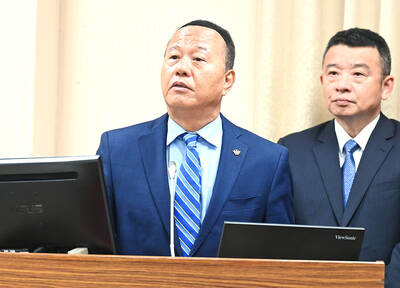
VIGILANCE: The military is paying close attention to actions that might damage peace and stability in the region, the deputy minister of national defense said The People’s Republic of China (PRC) might consider initiating a hack on Taiwanese networks on May 20, the day of the inauguration ceremony of president-elect William Lai (賴清德), sources familiar with cross-strait issues said. While US Secretary of State Anthony Blinken’s statement of the US expectation “that all sides will conduct themselves with restraint and prudence in the period ahead” would prevent military actions by China, Beijing could still try to sabotage Taiwan’s inauguration ceremony, the source said. China might gain access to the video screens outside of the Presidential Office Building and display embarrassing messages from Beijing, such as congratulating Lai


 RSS
RSS