


Scientists at Academia Sinica have identified a new form of cell division that occurs without the replication of DNA, challenging the scientific consensus on one of the most basic biological processes.
Since the 19th century, scientists have known of only two main types of cell division in animals — meiosis in germ cells (sperm or egg cells) and mitosis in somatic cells, which comprise all other cells in the body.
However, in a new paper published in the British scientific journal Nature, an Academia Sinica team described a previously unknown form of cell division which, unlike mitosis, does not involve the duplication of DNA.
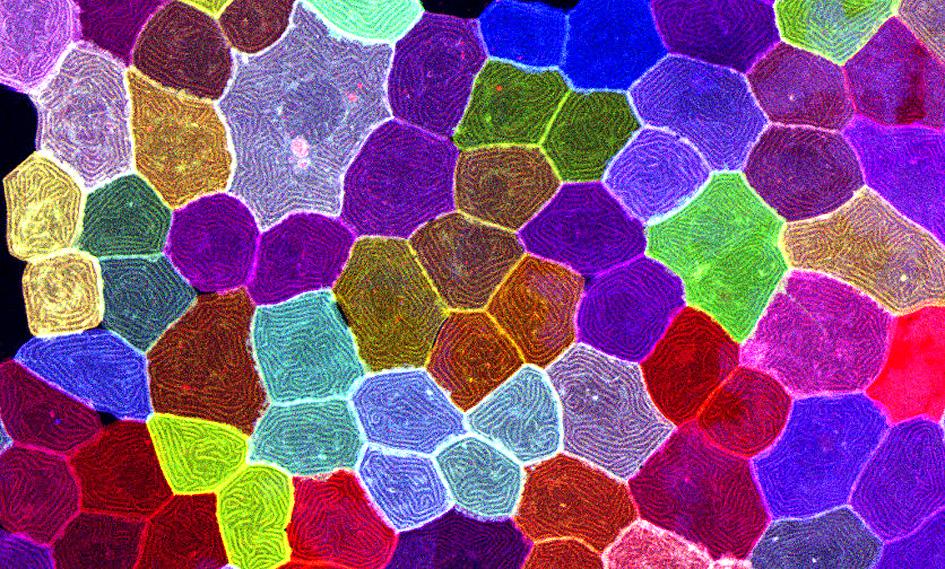
Photo courtesy of Academia Sinica
The team, led by Chen Chen-hui (陳振輝), an assistant research fellow at the academy’s Institute of Cellular and Organismic Biology, held a news conference on Monday to explain their findings.
To conduct the research, Chen’s team used a custom-made computer tagging system to color and track individual cells on zebrafish larvae as they developed.
To do so, the researchers had to catch and anesthetize the 0.5cm fish every 12 hours and photograph them under a high-powered microscope.
They discovered that during a specific stage in the fishes’ growth, some of the outer layers of their skin cells underwent up to two rounds of cell division (one cell becoming four cells) by splitting, rather than duplicating, their DNA.
The phenomenon, called asynthetic fission, is a temporary measure used to expand the coverage of epithelial cells, or outer skin cells, during a period of rapid growth, Chen said.
According to a video produced by Nature, the process happens so quickly that cells even appeared to make “mistakes,” such as not cleanly separating the DNA between the new cells.
However, within a few weeks the zebrafish get rid of the unusual cells and replace them with regular cells containing normal amounts of DNA, the video said.
While the team is still in the early stages of understanding the process, this mode of cell proliferation might occur in contexts beyond zebrafish skin expansion, Chen said.
The article, titled Skin cells undergo asynthetic fission to expand body surfaces in zebrafish, was published on Wednesday last week.
The journal’s video on the research, A new kind of cell division, was released on Sunday.

Considering that most countries issue more than five denominations of banknotes, the central bank has decided to redesign all five denominations, the bank said as it prepares for the first major overhaul of the banknotes in more than 24 years. Central bank Governor Yang Chin-lung (楊金龍) is expected to report to the Legislative Yuan today on the bank’s operations and the redesign’s progress. The bank in a report sent to the legislature ahead of today’s meeting said it had commissioned a survey on the public’s preferences. Survey results showed that NT$100 and NT$1,000 banknotes are the most commonly used, while NT$200 and NT$2,000

The Centers for Disease Control (CDC) yesterday reported the first case of a new COVID-19 subvariant — BA.3.2 — in a 10-year-old Singaporean girl who had a fever upon arrival in Taiwan and tested positive for the disease. The girl left Taiwan on March 20 and the case did not have a direct impact on the local community, it said. The WHO added the BA.3.2 strain to its list of Variants Under Monitoring in December last year, but this was the first imported case of the COVID-19 variant in Taiwan, CDC Deputy Director-General Lin Ming-cheng (林明誠) said. The girl arrived in Taiwan on

South Korea is planning to revise its controversial electronic arrival card, a step Taiwanese officials said prompted them to hold off on planned retaliatory measures, a South Korean media report said yesterday. A Yonhap News Agency report said that the South Korean Ministry of Foreign Affairs is planning to remove the “previous departure place” and “next destination” fields from its e-arrival card system. The plan, reached after interagency consultations, is under review and aims to simplify entry procedures and align the electronic form with the paper version, a South Korean ministry official said. The fields — which appeared only on the electronic form

The Ministry of Foreign Affairs (MOFA) is suspending retaliation measures against South Korea that were set to take effect tomorrow, after Seoul said it is updating its e-arrival system, MOFA said today. The measures were to be a new round of retaliation after Taiwan on March 1 changed South Korea's designation on government-issued alien resident certificates held by South Korean nationals to "South Korea” from the "Republic of Korea," the country’s official name. The move came after months of protests to Seoul over its listing of Taiwan as "China (Taiwan)" in dropdown menus on its new online immigration entry system. MOFA last week


 RSS
RSS