


An international human rights group has called on Beijing to release Morrison Lee (李孟居), a Taiwanese who served a 22-month prison sentence for spying in China, but since his release last year has been prevented from leaving the country.
Beijing’s refusal to allow Lee to depart contravenes China’s domestic laws and international treaty obligations, Safeguard Defenders wrote in a news release on Wednesday.
China “manipulates deprivation of political rights to prevent Chinese rights defenders from freely going home after release from jail, instead subjecting them to weeks, months, even years of continued illegal detention ... in a phenomenon called ‘non-release release,’” the group said.
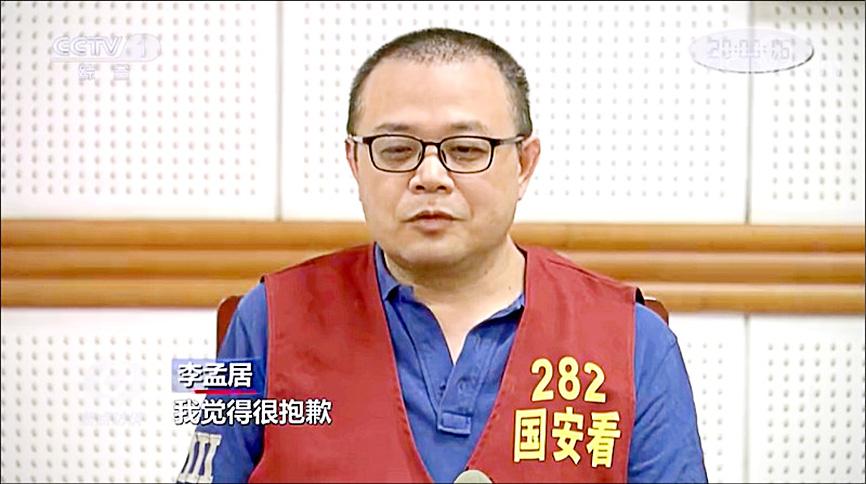
Photo copied by Chen Yu-fu, Taipei Times
Lee — a Hsinchu native and an unpaid adviser to Pingtung County’s Fangliao Township (枋寮) — went missing in 2019 after he sent photographs of Chinese paramilitary police amassing on the border between Shenzhen and Hong Kong to Fangliao Mayor Archer Chen (陳亞麟).
Beijing’s state-run China Central Television later broadcasted footage of Lee confessing to espionage, and Chinese authorities said that he had been sentenced to prison and deprivation of his political rights for two years.
However, Lee’s prosecution for taking images of military drills in Shenzhen was politically motivated, as Chinese media have aired higher-quality photos and footage from the same event, Safeguard Defenders said.
The situation has drawn attention because other Taiwanese imprisoned in China for political offenses have also been deprived of political rights, the group said, adding that Beijing could “weaponize the deprivation of political rights” to indefinitely detain political prisoners.
Similar fears were felt prior to the release of democracy advocate Lee Ming-che (李明哲), who was allowed to return to Taiwan following the completion of a five-year prison sentence for subverting the state, Safeguard Defenders said.
China in 2020 claimed to have arrested 100 Taiwanese spies, the group said.
Human rights groups determined that at least three people — Shih Cheng-ping (施正屏), Tsai Chin-shu (蔡金樹) and Cheng Yu-chin (鄭宇欽) — were jailed, it said.
The International Covenant on Civil and Political Rights, which China signed in 1998, but did not ratify, stipulates that every person should be free to leave any country, including their own, the group said.
Furthermore, restriction of movement is not associated with the deprivation of political rights under China’s Criminal Law, which defines political rights as the right to elect or be elected, assemble, speak and hold positions at state-owned enterprises, it said.
“China’s weaponization of exit bans is the topic of a forthcoming Safeguard Defenders report that will reveal the full scope of Beijing’s rights abuse targeting not only Taiwanese, but Chinese and foreigners involved in civil disputes and corruption cases,” it added.
In Beijing, China’s Taiwan Affairs Office spokesman Ma Xiaoguang (馬曉光) told a routine news conference on Wednesday that Morrison Lee was serving out the part of his sentence concerning the deprivation of political freedoms.
The Chinese legal system has proved Morisson Lee’s guilt and that his legal rights were fully respected during the process, Ma said.


UPGRADE: The Kang Ding-class frigate is replacing its Chaparall missiles with Tien Chien II and Hua Yang VLS, which would provide it with long-range, 360° air defense Taiwan plans to produce 1,200 to 1,376 Hai Chien II missiles (海劍二, Sea Sword II) — also known as TC-2N — to serve as the standard air defense system of the navy’s surface combatant fleet, a source said yesterday. Last week, the Hai Chien II, the naval version of the Tien Kung II missile (天劍二, Sky Sword II), completed a live-fire test in waters off the National Chungshan Institute of Science and Technology’s Jiupeng facility (九鵬) in Pingtung County’s Manjhou Township (滿州). The MIM72 Chaparral and other dated air defense missiles that currently arm Taiwanese ships have inadequate range to combat Chinese

REASONS FOR TRAVEL: An assistant professor said that proposed amendments to penalize drivers if they used drugs overseas would not deter people from traveling People who operate a motor vehicle under the influence of marijuana would have their driver’s license revoked, even if they used the substance while overseas, the Ministry of Transportation and Communications said yesterday, citing proposed amendments to the Road Traffic Management and Penalty Act (道路交通管理處罰條例). The amendments would also authorize the government to revoke the licenses of people determined to have used Category 1 or Category 2 narcotics, even if they were not operating a vehicle while under the influence of drugs, as well as ban them from taking the license test for three years, the ministry said. People aged 18 or
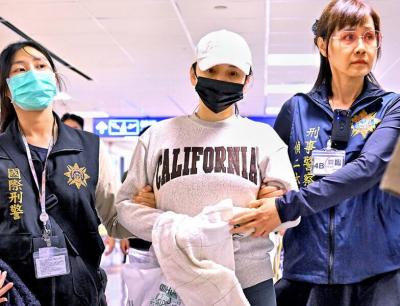
Johanne Liou (劉喬安), a Taiwanese woman who shot to unwanted fame during the Sunflower movement protests in 2014, returned to Taiwan last night after being deported from the US. She is to stand trial in Taiwan for charges involving embezzlement, fraud and drug crimes. The Criminal Investigation Bureau (CIB) said it took her into custody at Taiwan Taoyuan International Airport and would first question her before transferring her to the New Taipei District Prosecutors’ Office. She was arrested upon disembarking a flight from San Francisco that landed shortly before 7pm. Liou absconded to the US in 2019 after jumping bail
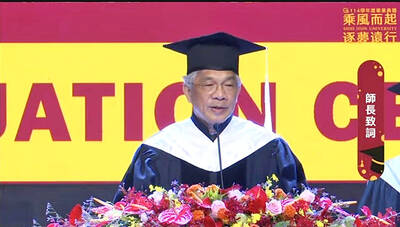
Shih Hsin University President Chen Ching-he (陳清河) yesterday issued a public apology for comments made in his commencement speech last week, stating that he has asked the school to suspend his duties and halt his wages for two months as a show of contrition. At the commencement ceremony on May 30, Chen said, “If you don’t manage your time well, or your own emotions, or your health, then I am telling every one of you — put a quick end to ‘you,’ because the world has no need for ‘you.’” The comments have sparked significant controversy online, and Chen through an open


 RSS
RSS