


The Control Yuan yesterday presented a report on relocation of indigenous villages following Typhoon Morakot in 2009, calling for policy changes and better oversight mechanisms.
Policies for relocating people in mountainous regions due to natural disasters are needed, including oversight mechanisms to ensure the quality and safety of new housing, as well as the participation of residents throughout the process, the report said.
After Typhoon Morakot struck southern Taiwan in August 2009, requiring more than 40 villages to be resettled, numerous issues emerged regarding relocations to areas that were deemed safer.
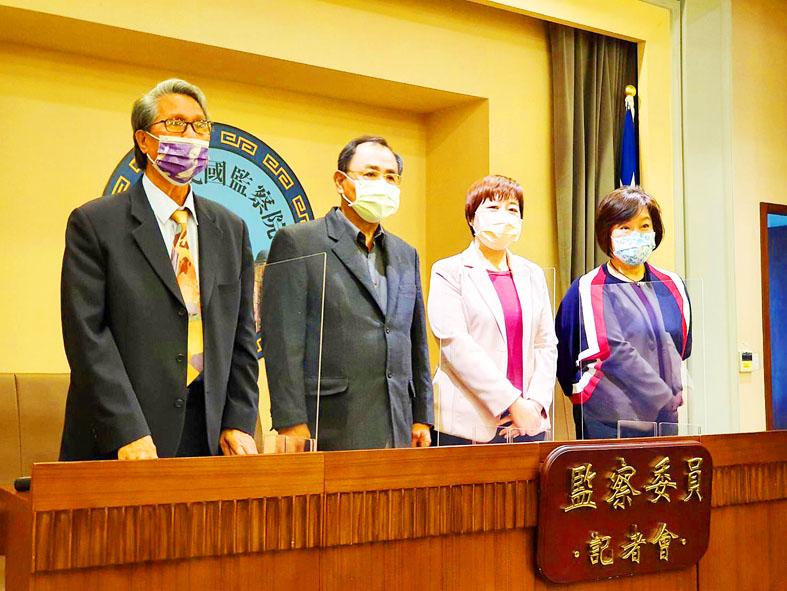
Photo: Hsieh Chun-lin, Taipei Times
The catastrophe led experts and government officials to designate it as the “worst natural disaster in Taiwan’s history,” with 699 people killed and estimated economic losses in excess of NT$1 trillion (US$34.19 billion at current exchange rate).
Some resettled communities have complained of poor-quality construction, the report said.
After villagers filed a petition in November 2020, a task force conducted a probe that lasted a year, with on-site assessments headed by four Control Yuan members: Pasuya Poiconu of the Tsou people, Antonio Hong (鴻義章), an Amis, and Yeh Ta-hua (葉大華) and Chi Hui-jung (紀惠容).
Yeh introduced the report, saying that under government programs, 43 resettlement communities with 3,583 housing units were built to relocate 11,703 people.
Most of the fatalities during Typhoon Morakot were caused by the collapse of a massive mountain slope that buried Siaolin Village (小林村) in Kaohsiung. The village residents were mainly Tavalong. Almost all them — about 490 people — were missing and presumed dead.
Afterward, the government set up a special commission to coordinate relief efforts, and the Post-Typhoon Morakot Reconstruction Special Act (莫拉克颱風災後重建特別條例) was passed swiftly, Poiconu said.
Then-president Ma Ying-jeou (馬英九) and his administration called for entire mountain villages affected by Morakot to be relocated to lower altitudes, as they were deemed unsafe and at risk of future natural disasters.
Yeh said in the report that residents believed the program was rushed.
Their new villages were built in three to six months, and the houses now have leaks, with clogged drainage, broken roofs and cracked walls, while some have eroded foundations, Yeh said.
A major issue for the affected indigenous communities is that they only have the legal right to live in and use the housing units, meaning they have no land rights, Poicuno said, adding that they are cut off from their original homes, and are unable to continue their traditional livelihoods and cultural activities.
Control Yuan members recommended that the resettlement policy be changed to include the participation of the affected indigenous people throughout the process, including in the selection of a new site, and the assessment of the quality and safety of the new housing.
The policy must ensure that their traditional way of life is maintained, their culture and right to return to their traditional land is preserved, and their indigenous rights are better protected, the report said.
It was also recommended that oversight mechanisms be set up to monitor on contractors building the housing, and to solve disputes over who should pay for the repair and maintenance of housing.

UPGRADE: The Kang Ding-class frigate is replacing its Chaparall missiles with Tien Chien II and Hua Yang VLS, which would provide it with long-range, 360° air defense Taiwan plans to produce 1,200 to 1,376 Hai Chien II missiles (海劍二, Sea Sword II) — also known as TC-2N — to serve as the standard air defense system of the navy’s surface combatant fleet, a source said yesterday. Last week, the Hai Chien II, the naval version of the Tien Kung II missile (天劍二, Sky Sword II), completed a live-fire test in waters off the National Chungshan Institute of Science and Technology’s Jiupeng facility (九鵬) in Pingtung County’s Manjhou Township (滿州). The MIM72 Chaparral and other dated air defense missiles that currently arm Taiwanese ships have inadequate range to combat Chinese

REASONS FOR TRAVEL: An assistant professor said that proposed amendments to penalize drivers if they used drugs overseas would not deter people from traveling People who operate a motor vehicle under the influence of marijuana would have their driver’s license revoked, even if they used the substance while overseas, the Ministry of Transportation and Communications said yesterday, citing proposed amendments to the Road Traffic Management and Penalty Act (道路交通管理處罰條例). The amendments would also authorize the government to revoke the licenses of people determined to have used Category 1 or Category 2 narcotics, even if they were not operating a vehicle while under the influence of drugs, as well as ban them from taking the license test for three years, the ministry said. People aged 18 or

HEAVY WEATHER: Typhoon Jangmi is due to crash straight into the Ryukyus as airlines look to shift flights to larger aircraft or cancel flights to Okinawa entirely Taiwan’s international air carriers announced flight adjustments over the weekend as Typhoon Jangmi is forecast to hit the Ryukyu Islands today and tomorrow. The Central Weather Administration (CWA) upgraded Jangmi from a tropical storm to a typhoon at 8am yesterday, with the eye located 580km south of Naha city. It was moving north at 19kph. Today, China Airlines’ CI-120, CI-121, CI-122 and CI-123 flights between Taoyuan and Naha, Okinawa, have been canceled as well as CI-132 and CI-133 between Kaohsiung and Naha. EVA Air’s BR-112, BR-113, BR-186 and BR-185 flights between Taoyuan and Naha are also canceled. Low-cost carrier Tigerair Taiwan canceled IT-230,
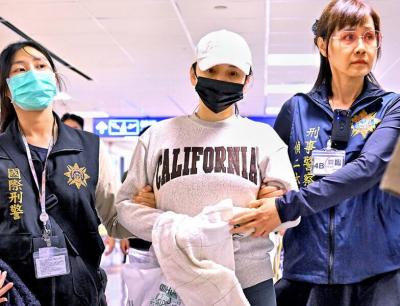
Johanne Liou (劉喬安), a Taiwanese woman who shot to unwanted fame during the Sunflower movement protests in 2014, returned to Taiwan last night after being deported from the US. She is to stand trial in Taiwan for charges involving embezzlement, fraud and drug crimes. The Criminal Investigation Bureau (CIB) said it took her into custody at Taiwan Taoyuan International Airport and would first question her before transferring her to the New Taipei District Prosecutors’ Office. She was arrested upon disembarking a flight from San Francisco that landed shortly before 7pm. Liou absconded to the US in 2019 after jumping bail


 RSS
RSS