

The National Health Insurance Administration (NHIA) on Saturday warned the public against fraudulent text messages asking for personal information, bank account numbers and passwords to renew National Health Insurance (NHI) cards.
People have reported receiving texts in the name of the NHIA with links to fake Health Passbook pages that request information to verify the devices, NHIA associate researcher Chen Tzu-yu (陳孜瑜) said.
Chen said that the Health Passbook, which is available on the NHIA app and its Web site, would never ask users for bank information.
As of Wednesday last week, the app has been downloaded 1,696 times, and 8.01 million people are using the Health Passbook, NHIA Director-General Lee Po-chang (李伯璋) said.
People should be careful not to fall for the fake passbook, as the design and color tone look just like the official one, he said.
Scammers are constantly using new schemes, such as this one, to obtain personal information or money, the NHIA said.
Other tactics include pretending to be NHIA staff informing people that their NHI cards have been stolen and used by others, or have been locked because abnormal activity had been detected, it said.
In other news, MOS Burger on Saturday said that it would never ask customers for their bank and credit card information via telephone to top up their credit cards online or to use ATMs to cancel payments or alter payment methods.
The fast-food chain issued the statement after receiving reports from some customers alleging that an unknown person claiming to be an employee at MOS Burger had asked for their credit card information to top up their accounts with the prize money they just won.
People should be alert to scam phone calls and should never provide financial information when they receive suspicious phone calls or text messages, it added.
Additional reporting by Yang Ya-min
A total of 400 foreign “high- level” professionals have been naturalized as Republic of China (Taiwan) citizens over the past decade as the government has eased nationality rules to attract talent from a wider range of fields, the Ministry of the Interior said yesterday. The 400th high-level professional, who works in the electronics industry, was approved for ROC citizenship on Aug. 26, the MOI said. The MOI quoted the newly naturalized citizen as saying that Taiwan is a leader in fields such as semiconductors, electronics manufacturing, artificial intelligence development and energy technology. He also said
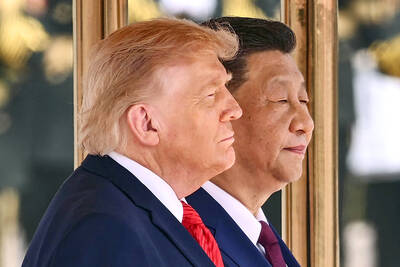
China has warned that it could cancel a planned US-China leaders’ summit if Washington approves new arms sales to Taiwan, a Japanese media outlet quoted sources as saying yesterday. US President Donald Trump, “apparently eager to showcase some diplomatic achievements ahead of November’s midterm congressional elections, places great importance on holding the summit with Chinese President Xi Jinping (習近平),” Japan’s Kyodo News reported. “While preparing for Xi’s upcoming trip, China has restated its position that the Taiwan issue is a ‘red line’ in bilateral relations,” the report said. The report said that when Xi met with Trump in Beijing in May, Xi said
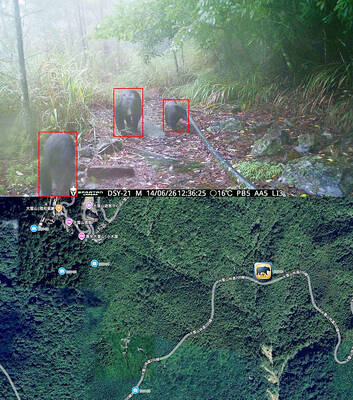
RARE PEEK: The footage released showed one of the bears staying in a cave for as long as 70 days, providing the first record of Formosan black bear’s overwintering The Forestry and Nature Conservation Agency yesterday released tracking records of released Formosan black bears for the first time, showing that they get much closer to human settlements than previously thought. The agency said it had captured two bears, Da Qu-ali (達古阿里) and Aziman (阿里曼), in indigenous villages in Hualien County and began to track them with a camera-mounted satellite collar after releasing them back into the wild. The results confirmed that the bears have moved from deep mountain areas into lowland hills closer to human communities, leading to an increase in human-bear conflicts, it said. The agency has introduced artificial intelligence-assisted early
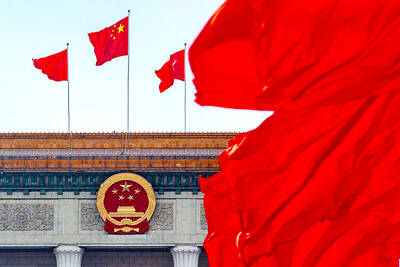
DIPLOMATIC TOUR: Chinese President Xi Jinping began a series of overseas visits last month to Kyrgyzstan, Egypt and India, aimed at securing leverage, an official said Recent Chinese diplomatic and military moves are aimed at creating pressure ahead of a planned meeting between Chinese President Xi Jinping (習近平) and US President Donald Trump, National Security Council adviser Huang Chung-yen (黃重諺) said. Trump when visiting China in May extended an invitation to Xi to visit Washington on Sept. 24. China is yet to officially announce plans for Xi’s visit to the US. In an interview with the Liberty Times (sister paper of the Taipei Times) on Thursday, Huang said Xi’s overseas visits, China’s “gray zone” activities along the First Island Chain and efforts to expand its trade surplus with the


 RSS
RSS