


A group of puppeteers in Yunlin County is using non-fungible tokens (NFTs) to help bring their traditional art form into the modern era and keep it relevant to new generations.
NFTs are cryptoassets representing a digital item such as an image, video or virtual object, with prices of some rising so fast last year that speculators around the world sometimes “flipped” them within days for profit.
Pili International Multimedia, whose puppet show produced in Yunlin is Taiwan’s longest-running TV program, says it is starting to use NFTs as a new source of revenue.

Photo: Ann Wang, REUTERS
“The sort of imagination everyone nowadays has for the online world is developing so fast that we are almost unable to grasp it,” Pili brand director Seika Huang (黃政嘉) said.
“Instead of sitting on the sidelines, the best approach is to go ahead and understand fully what’s going on. This is the fastest way to catch up,” she said.
Pili has thousands of glove puppet characters, a traditional part of Taiwanese street entertainment culture that spins colorful and highly stylized stories of heroic courage and romance, often with martial arts.
The puppets are painstakingly created and expertly maneuvered during the filming of the shows, with costumes that are sewn on and strands of hair meticulously put in place.
Pili said that four of its puppet characters were made into digital versions, and 30,000 sets have been sold as NFTs.
The company declined to reveal its NFT profit on the market platform, but said prices for each set started at US$40, translating to generated revenue of at least US$1.2 million since listing in early February.
The stories of the puppet heroes resonate with young audiences and could draw in foreign fans of superhero films, such as those based on characters from the Marvel cinematic universe, said marketing technology company VeVe, which is in charge of selling the NFTs.
“Westerners actually really like our martial arts heroes and kung fu,” VeVe brand manager Raymond Chou (周銘志) said.
Huang, who said that the company’s initial listings sold out seconds after launching on VeVe, is working on transforming up to 50 other puppet characters into NFTs, potentially adding another million-dollar revenue stream for the studio.

Actor Darren Wang (王大陸) was sentenced to six months in prison, commutable to a fine, by the New Taipei District Court today for contravening the Personal Data Protection Act (個人資料保護法) in a case linked to an alleged draft-dodging scheme. Wang allegedly paid NT$3.6 million (US$114,380) to an illegal group to help him evade mandatory military service through falsified medical documents, prosecutors said. He transferred the funds to Chen Chih-ming (陳志明), the alleged mastermind of a draft-evasion ring, although he lost contact with him as he was already in detention on fraud charges, they said. Chen is accused of helping a

SECURITY: Starlink owner Elon Musk has taken pro-Beijing positions, and allowing pro-China companies to control Taiwan’s critical infrastructure is risky, a legislator said Starlink was reluctant to offer services in Taiwan because of the nation’s extremely high penetration rates in 4G and 5G services, the Ministry of Digital Affairs said yesterday. The ministry made the comments at a meeting of the legislature’s Transportation Committee, which reviewed amendments to Article 36 of the Telecommunications Management Act (電信管理法). Article 36 bans foreigners from holding more than 49 percent of shares in public telecommunications networks, while shares foreigners directly and indirectly hold are also capped at 60 percent of the total, unless specified otherwise by law. The amendments, sponsored by Chinese Nationalist Party (KMT) Legislator Ko

The eastern extension of the Taipei MRT Red Line could begin operations as early as late June, the Taipei Department of Rapid Transit Systems said yesterday. Taipei Rapid Transit Corp said it is considering offering one month of free rides on the new section to mark its opening. Construction progress on the 1.4km extension, which is to run from the current terminal Xiangshan Station to a new eastern terminal, Guangci/Fengtian Temple Station, was 90.6 percent complete by the end of last month, the department said in a report to the Taipei City Council's Transportation Committee. While construction began in October 2016 with an
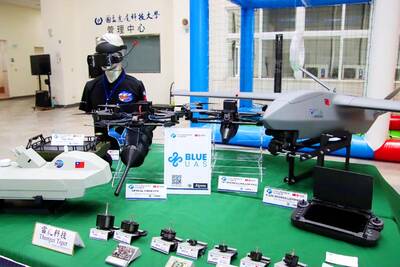
NON-RED SUPPLY: Boosting the nation’s drone industry is becoming increasingly urgent as China’s UAV dominance could become an issue in a crisis, an analyst said Taiwan’s drone exports to Europe grew 41.7-fold from 2024 to last year, with demand from Ukraine’s fight against Russian aggression the most likely driver of growth, a study showed. The Institute for Democracy, Society and Emerging Technology (DSET) in a statement on Wednesday said it found that many of Taiwan’s uncrewed aerial vehicle (UAV) sales were from Poland and the Czech Republic. These countries likely transferred the drones to Ukraine to aid it in its fight against the Russian invasion that started in 2022, it said. Despite the gains, Taiwan is not the dominant drone exporter to these markets, ranking second and fourth


 RSS
RSS